The Displacement Contingency: Quantifying the Survival Gap in California
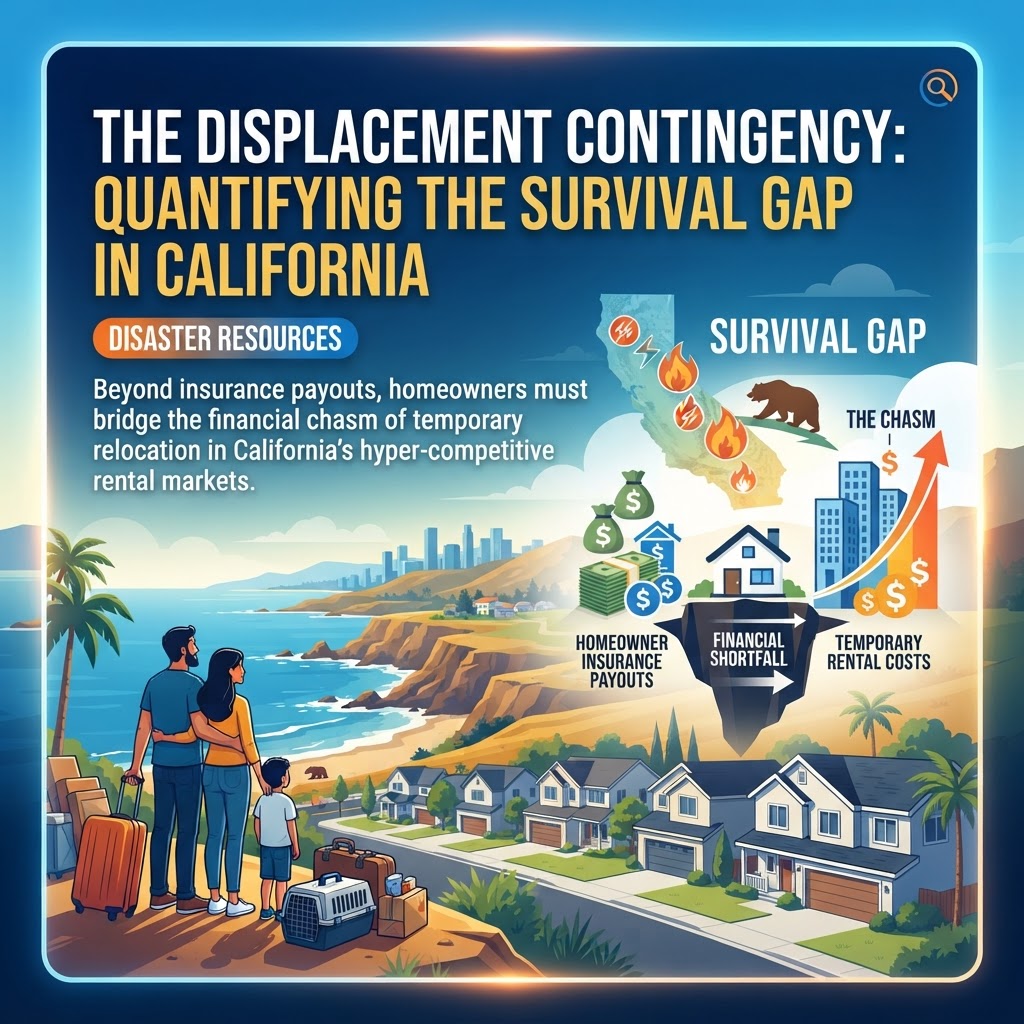
While much of the discourse surrounding California’s multi-hazard landscape focuses on “hardening” structures or securing elusive insurance policies, a critical vulnerability remains largely unaddressed: the financial survival gap between the moment of impact and the commencement of reconstruction. In a state where the median home price remains over 140% higher than the national average and rental inventory is historically tight, the cost of displacement has become a primary risk factor for household insolvency.
The Rental Market Squeeze and 'Loss of Use' Reality
Standard homeowners insurance policies typically include Additional Living Expenses (ALE) or "Loss of Use" coverage, usually capped at 20% to 30% of the dwelling coverage. However, in California’s 2026 real estate climate, these figures are increasingly decoupled from reality. According to data from the U.S. Census Bureau and Zillow, median rents in major California metros have outpaced general inflation by 4.2% annually over the last three years.
For a homeowner with a $700,000 dwelling limit, a 20% ALE cap provides $140,000 for temporary housing. While this sounds substantial, the California Department of Insurance notes that the average rebuild time in high-risk wildfire zones now stretches between 24 and 36 months due to labor shortages and environmental permitting. In markets like the Bay Area or coastal Southern California, where three-bedroom rentals can exceed $5,500 per month, a family can exhaust their ALE reserves well before the foundation of their new home is even poured.
The Liquidity Math: Moving Beyond the 6-Month Fund
The traditional financial advice of maintaining a six-month emergency fund is proving insufficient for the California homeowner. Displacement doesn't just involve rent; it involves the immediate “liquidity shock” of security deposits, pet deposits, and the replacement of essential daily goods before insurance adjusters have issued the first check.
Data from NAR (National Association of Realtors) suggests that displaced homeowners in California face an average immediate out-of-pocket cash requirement of $12,000 to $18,000 in the first 30 days post-disaster. This "Displacement Contingency" must be liquid and accessible outside of standard brokerage accounts that may be subject to market volatility during regional economic shocks.
Leveraging State and Local Resilience Resources
To mitigate this gap, homeowners must look toward state-level infrastructure. The California Governor’s Office of Emergency Services (Cal OES) and the California Residential Mitigation Program (CRMP) provide frameworks, but the 2026 homeowner must be more proactive. Accessing the California FAIR Plan is now the baseline, but the sophisticated owner layers this with supplemental “difference in conditions” (DIC) policies that specifically bolster the ALE limits to reflect actual local rental comps.
Practical Takeaways for Homeowners and Investors
- Conduct a 'Rental Reality' Audit: Every 12 months, check the current rental rates for a comparable home in a lower-risk zip code within a 20-mile radius. Ensure your ALE coverage can sustain that rent for at least 36 months.
- Structure the 'Disaster Tier' Fund: Maintain a tiered liquidity strategy. Keep $15,000 in a high-yield savings account specifically for “Day 1-30” displacement costs, separate from your general emergency fund.
- Document the 'Digital Twin': Use 3D scanning technology (now standard in many high-end real estate listings) to create a digital twin of your assets. This accelerates the claims process by up to 40%, reducing the time spent in expensive temporary housing.
- Verify 'Loss of Rent' for Portfolios: For investors, ensure that 'Loss of Rent' coverage is based on current market rates (Actual Loss Sustained) rather than a fixed limit established at the time of policy inception.
In California, resilience is no longer just about the strength of the roof; it is about the depth of the displacement reservoir. As recovery timelines extend, the ability to remain financially solvent while living elsewhere is the ultimate marker of a prepared homeowner.