The Shift from Survival to Residential Autonomy
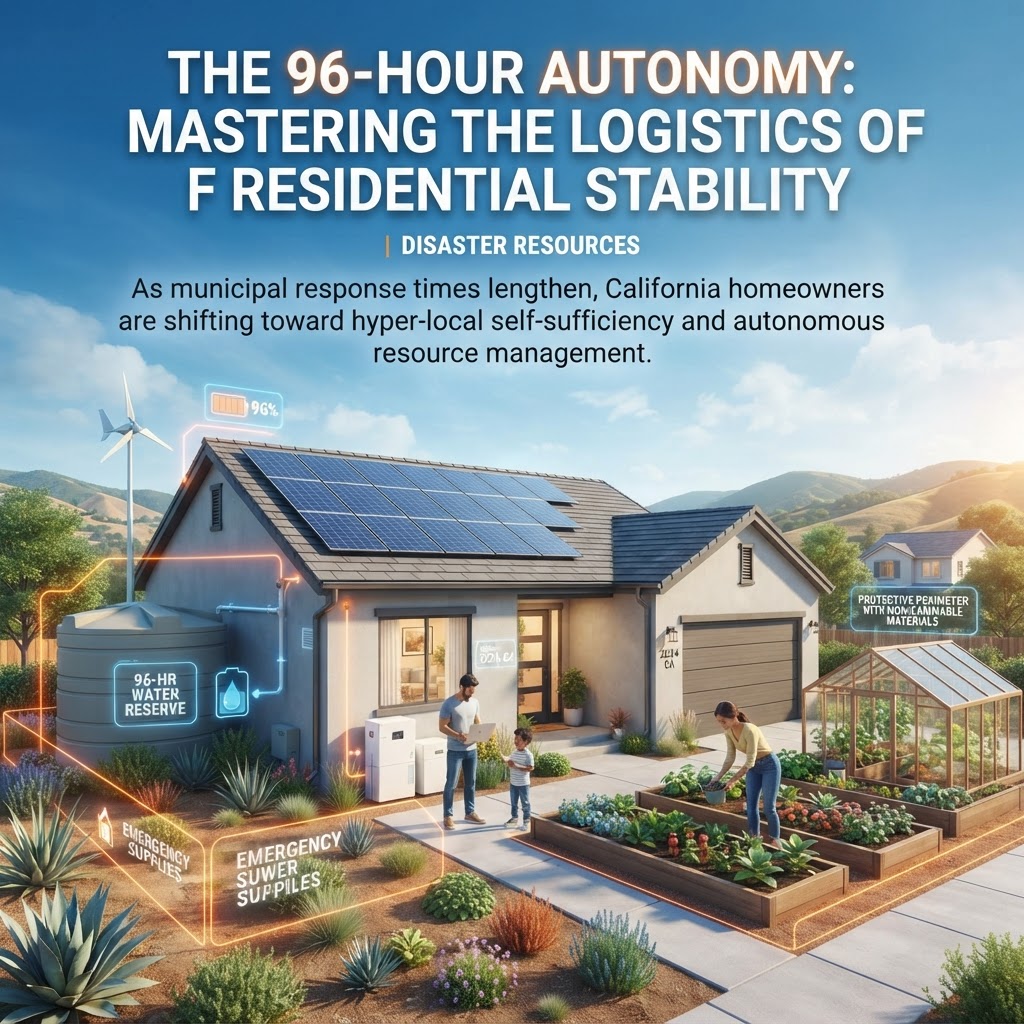
In the summer of 2026, the California residential landscape faces a paradox of sophistication and vulnerability. While architectural hardening has reached new heights, the strain on municipal emergency services has necessitated a shift in the homeowner’s preparedness paradigm. The traditional "72-hour kit" has been superseded by a 96-hour autonomy standard—a professional-grade approach to maintaining residential stability during the critical window when public infrastructure is most likely to fail.
The Data of Delay: Why 96 Hours?
According to recent 2025 data from the California Department of Forestry and Fire Protection (CAL FIRE) and state logistics analysts, the 'response lag' for non-life-threatening property assistance has increased by 18% in high-risk Wildland-Urban Interface (WUI) zones. This is largely due to the increased frequency of concurrent events. Furthermore, the USGS 'ShakeOut' scenarios updated for 2026 suggest that in a major seismic event on the Hayward or San Andreas faults, utility restoration in many suburban pockets may not even begin for the first four days. For the modern homeowner, resilience is no longer about waiting for help; it is about managing a private micro-grid and supply chain.
Strategic Energy Independence and NEM 4.0
Energy is the cornerstone of residential stability. With the evolution of Net Energy Metering (NEM) standards and the proliferation of high-capacity lithium-iron-phosphate (LFP) home batteries, the objective has moved beyond simple backup. Practical Takeaway: Homeowners should audit their 'critical load' panels to ensure that HVAC filtration (crucial during smoke events) and refrigeration can run for 96 hours on battery alone if solar recharging is hindered by ash cover. Current market data from California real estate analysts shows that homes equipped with autonomous 'islanding' energy systems command a 4.5% premium over those with standard grid-tied solar.
Communications: Beyond the Cellular Grid
Traditional cellular networks remain notoriously fragile during California’s 'Public Safety Power Shutoffs' (PSPS). The 2026 preparedness standard involves integrating low-earth orbit (LEO) satellite internet with terrestrial mesh networking. Tools like LoRaWAN-based communicators allow homeowners to maintain a 'hyper-local' network with neighbors to coordinate resources without relying on centralized towers. This layer of 'digital sovereignty' ensures that even if the primary grid is dark, the property remains an informed node in the community.
Insurance and the Evacuation Trigger
The California FAIR Plan has seen record enrollment in early 2026, but coverage is only half the battle. Homeowners must understand the 'Evacuation Trigger' logistics. Practical Takeaway: Modern policies often include sub-limits for wildfire defense services (private fire crews). Homeowners should ensure these services are pre-authorized and that 'defensible space' certificates are digitized and stored in three geographic locations. Real-time documentation of property conditions via 3D scans—performed biannually—is now the gold standard for expediting claims in a saturated post-disaster market.
Actionable Resilience Checklist
- Resource Redundancy: Maintain a minimum of 2.5 gallons of potable water per person, per day, for 4 days, stored in UV-stabilized containers.
- Atmospheric Management: Install HEPA-grade MERV 16 filtration systems capable of running on DC power to mitigate smoke inhalation during prolonged fire events.
- Logistical Coordination: Establish a 'mutual aid' pact with five immediate neighbors to share specialized tools (e.g., chainsaws, portable pumps, satellite uplinks).
- Financial Ready-Fund: Maintain a physical 'disruption stash' of $1,000–$2,000 in small denominations, as digital payment gateways frequently fail during regional power outages.
As we move deeper into 2026, the definition of a luxury property in California is increasingly tied to its ability to function as an autonomous fortress. Resilience is no longer a seasonal consideration; it is a permanent feature of high-value asset management.