Beyond the Perimeter: The Operational Reality of 2026
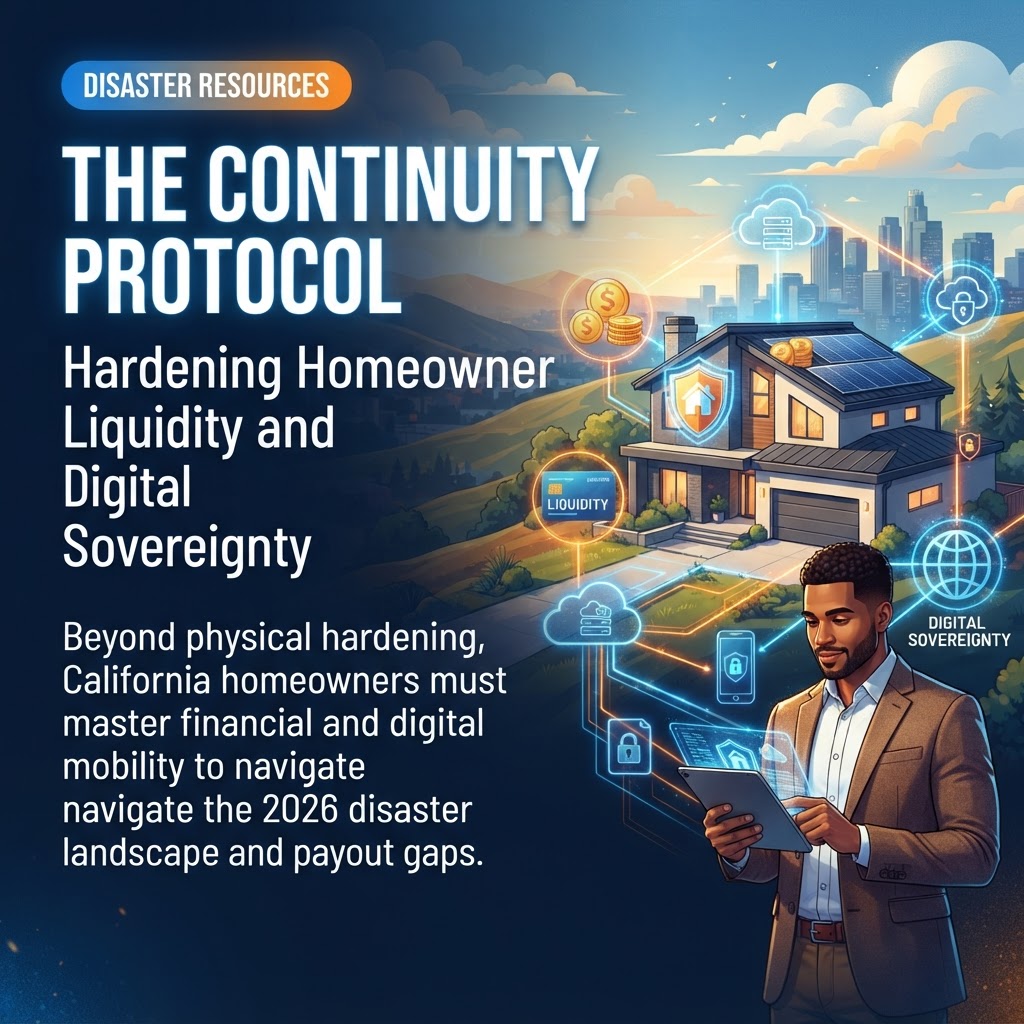
As California enters the peak of the 2026 wildfire season, the conversation around disaster preparedness has shifted from physical survival to operational continuity. While previous strategies focused on hardening structures or securing insurance credits, the modern California homeowner faces a new challenge: the 'Displacement Gap.' With the California Department of Insurance reporting that complex claims for total losses now take an average of 14 to 22 months to fully settle, the ability to maintain financial and digital mobility during an evacuation is no longer a luxury—it is a core component of property asset management.
The 90-Day Payout Paradox
Data from the 2025 California Residential Recovery Survey suggests that the average homeowner faces upwards of $18,500 in immediate, un-reimbursed costs within the first 60 days of a major disaster. These costs—ranging from short-term rentals in supply-constrained markets to the rapid replacement of essential professional equipment—often precede the first major 'Additional Living Expense' (ALE) check from insurers.
For the investor or high-net-worth homeowner, this creates a liquidity trap. To mitigate this, savvy owners are now establishing 'Disaster Liquidity Ladders.' This involves maintaining a segregated, high-yield liquid account specifically for displacement, distinct from traditional emergency funds, to bypass the initial friction of insurance adjusters who are increasingly backlogged by the 'Cascade Effect' of statewide climate events.
Digital Sovereignty: Beyond Cloud Dependencies
While the 'Data Dividend' focuses on documenting the property for claims, 2026’s resilience leaders are prioritizing 'Digital Sovereignty.' In recent regional outages, reliance on centralized cloud storage proved a liability when local cellular towers and fiber backbones were compromised.
Homeowners should adopt a 'Tri-Location' data strategy: one local encrypted physical drive in a fire-rated vault, one cloud-based repository, and one off-site physical node located outside the California ISO grid region. This ensures that even in a 'Total Grid Down' scenario, essential legal documents, trust records, and historical property valuations remain accessible for immediate leveraged financing or bridge loans.
Navigating the California Disaster Assistance Act (CDAA)
Many owners mistakenly believe that FEMA is the primary source of recovery funds. In reality, the California Disaster Assistance Act (CDAA) often plays a more critical role in local infrastructure restoration that directly impacts property accessibility. Homeowners must understand that while individual assistance is limited, the CDAA provides up to 75% of state funding for the repair of local roads and utilities. Resilience in 2026 means active participation in Community Facilities Districts (CFDs) to ensure that local agencies are compliant with CDAA documentation standards long before a fire or seismic event occurs.
Practical Takeaways for the Resilient Homeowner
- Audit the ALE Clause: Review your insurance policy specifically for the 'Loss of Use' duration. Ensure it covers at least 36 months, as the implementation gap in California’s construction market has extended rebuild timelines significantly.
- Establish a 'Shadow' Office: For those whose property is also their place of business, maintain a pre-configured, remote digital workspace that can be activated in under four hours.
- Tiered Evacuation Liquidity: Maintain $15,000 to $25,000 in a highly liquid, non-volatile account to cover the 'First-Mile' costs of displacement before insurance triggers.
- Verify Local Mutual Aid Links: Ensure your property is registered with local 'Zonehaven' or equivalent evacuation platforms, and that your emergency contact sequence includes a designated out-of-state 'Information Anchor.'
Disaster preparedness in the current California market is no longer just about the fire-resistance of your siding; it is about the resilience of your financial and digital infrastructure. Those who treat their home as a mobile operational unit, rather than a static asset, will be the ones who preserve wealth through the inevitable cycles of the Golden State.