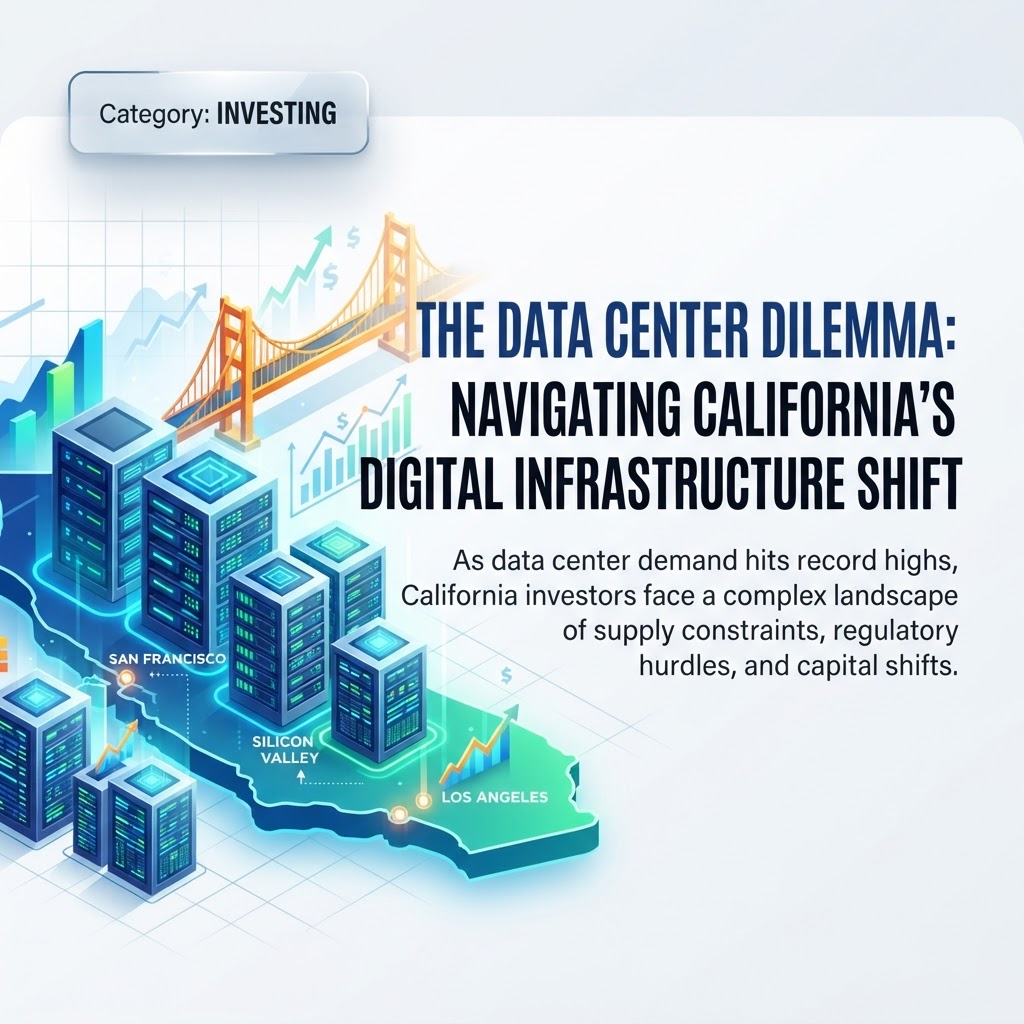
The Data Center Dilemma: Navigating California’s Digital Infrastructure Shift
The landscape of commercial real estate in California is undergoing a profound transformation. While traditional sectors like office and retail grapple with shifting occupancy patterns, the data center market has emerged as a critical, albeit increasingly complex, asset class. With vacancy rates in primary North American markets hitting a record low of 1.6% as of late 2026, the pressure on infrastructure has never been higher [4].
The Infrastructure-First Investment Strategy
For California investors, the narrative has shifted from simple property acquisition to an infrastructure-first approach. Data center project spending has reached a seasonally adjusted annual rate of $51 billion nationally, officially surpassing traditional office development [10]. However, in California, this growth is tempered by significant regulatory and power-related headwinds. The recent voter-enacted municipal ban on data center development in one California city serves as a stark reminder that local sentiment and entitlement challenges remain the primary deal-breakers for new projects [10].
Market Dynamics and Capital Shifts
Investment activity in the sector is evolving. While institutional confidence remains high, the limited availability of stabilized, high-quality assets has moderated direct equity activity [2]. Investors are increasingly turning to:
- Platform Investments and Joint Ventures: To gain exposure without the risks of greenfield development [2].
- Construction Financing: With demand outstripping supply, capital is flowing toward development equity to secure future capacity [3].
- Evergreen Funds: A notable shift away from traditional closed-end funds, allowing for longer-term holding strategies as assets reach stabilization [2].
Implications for California Investors
California remains a top-tier market, with Southern California inventory levels now rivaling major global hubs [6]. However, investors must be wary of the "Power Paradox." As grid capacity becomes the ultimate constraint, the value of existing, powered-shell facilities is rising. For example, smaller flex/data center campuses in regions like Rancho Cordova are trading as stable, long-term income generators, often leased to credit-worthy telecommunications tenants through the end of the decade [7].
Practical Takeaways for 2026
- Prioritize Entitlement Certainty: Avoid markets with high political volatility regarding power usage. Focus on existing industrial zones where data center use is already permitted.
- Evaluate Lease Durability: In the current financing environment, banks are prioritizing leases that extend well beyond loan maturity. Seek assets with long-term, triple-net leases to credit-grade tenants [1].
- Monitor Power Costs: With primary market requirements exceeding $200 per kW/month, operational efficiency is the primary driver of net operating income (NOI) [6].
Ultimately, the California data center market is no longer a "build-it-and-they-will-come" play. It is a sophisticated infrastructure game where success is defined by the ability to navigate power constraints, secure long-term capital, and manage the delicate balance between local regulatory environments and the insatiable demand for digital capacity.