The Retail Resilience: Why Scarcity is Driving California’s CRE Strategy
In the shifting landscape of 2026, the commercial real estate narrative has moved beyond the initial post-pandemic uncertainty. While office and industrial sectors navigate their own unique structural transitions, the retail sector has emerged as a surprising pillar of stability. For California investors, the current market is defined not by expansion, but by the strategic management of extreme supply scarcity.
The Supply-Demand Disconnect
Nationally, retail construction has hit a 10-year low, a trend acutely felt in California where land availability and high development costs act as natural barriers to entry. According to recent market data, this lack of new supply is the primary engine behind current retail fundamentals. With vacancy rates in Southern California hovering between 5.5% and 6.0%, the market is effectively operating at near-full capacity for high-quality assets.
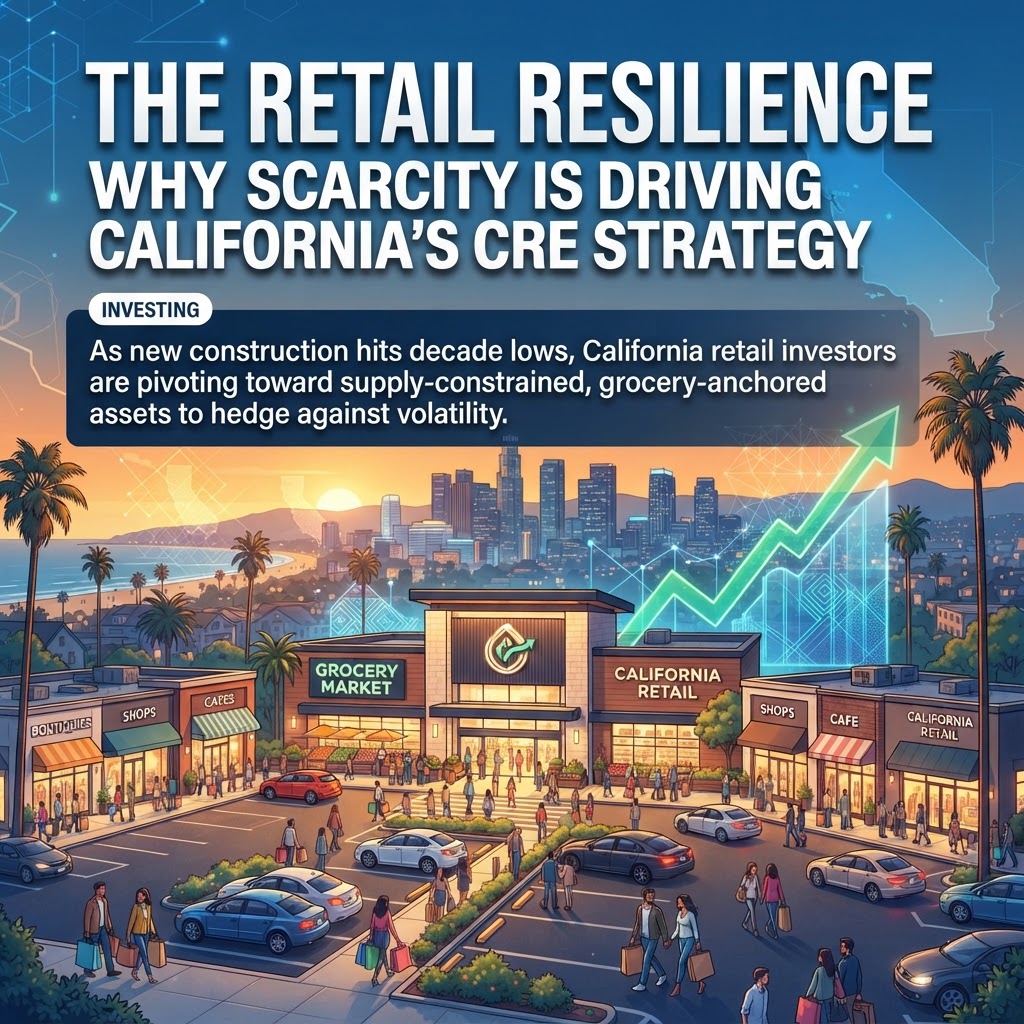
Unlike previous cycles, the current retail environment is characterized by a flight to quality. Grocery-anchored centers and neighborhood strip centers in high-income suburban corridors are outperforming, as these assets provide the essential services that remain insulated from broader economic fluctuations.
Investment Implications for California
For investors, the "mixed signals" from the broader capital markets—where rising interest rates have occasionally stalled deal flow—have created a bifurcated retail market. Strong, well-located assets are trading quickly, often at compressed cap rates, while secondary or poorly located properties linger on the market.
- Focus on Essential Retail: Investors should prioritize assets with credit-worthy, necessity-based tenants. Grocery-anchored centers continue to demonstrate the highest resilience against shifting consumer habits.
- Navigating the Financing Gap: With rising rates impacting deal velocity, buyers must account for the "repricing" effect. Deals that were under contract earlier in the year are facing scrutiny, making conservative underwriting and strong debt-service coverage ratios more critical than ever.
- The Value of Existing Footprint: Because new construction is sluggish, the value of existing, well-positioned retail real estate is appreciating. Investors should look for opportunities to add value through tenant mix optimization rather than relying on ground-up development, which remains hampered by high construction costs.
Strategic Outlook
The retail sector’s performance in 2026 mirrors consumer fortitude. While elevated interest rates remain a headwind, the lack of competitive new supply provides a floor for rent growth. For California investors, the strategy is clear: in a market where you cannot build your way to growth, you must buy your way into scarcity. By focusing on high-barrier-to-entry submarkets, investors can mitigate the risks associated with the current interest rate environment while positioning themselves to benefit from the long-term stability of the retail asset class.