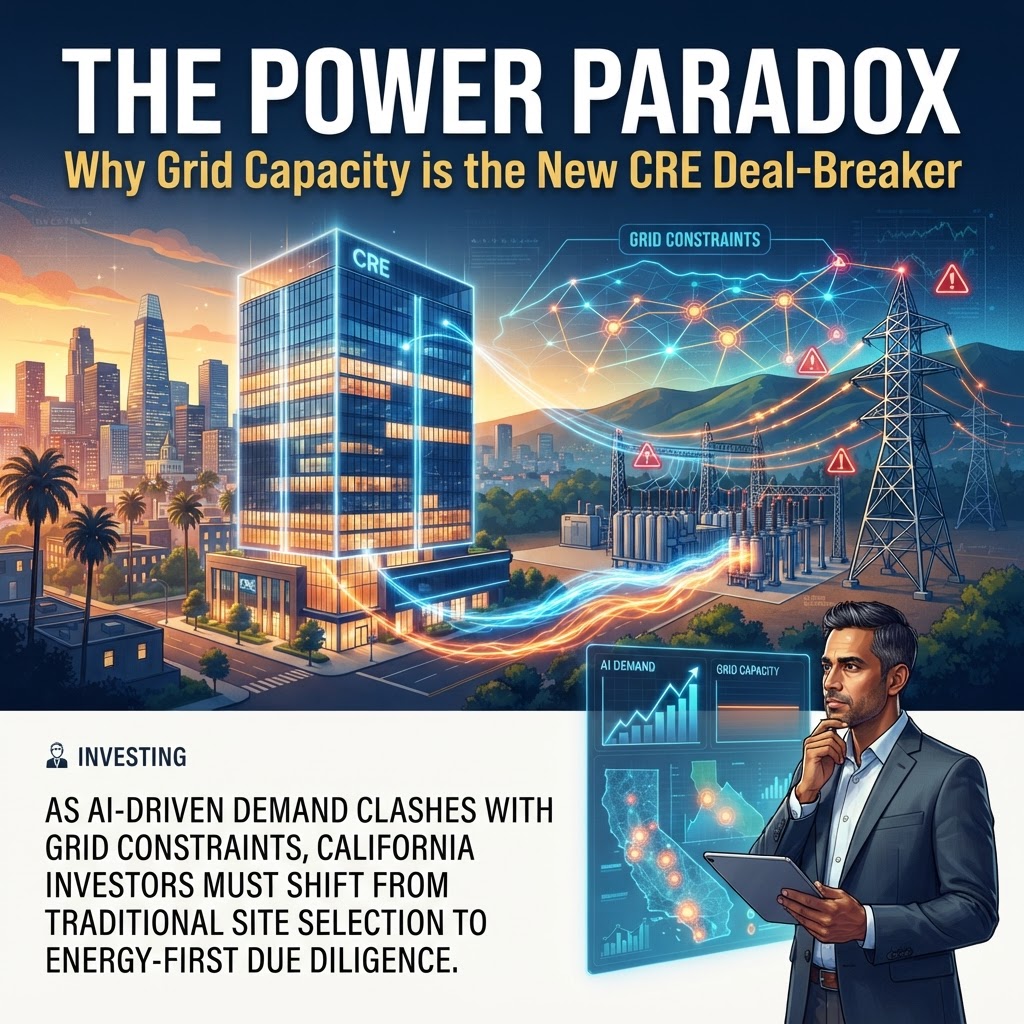
The Power Paradox: Why Grid Capacity is the New CRE Deal-Breaker
For decades, commercial real estate (CRE) investment was defined by the mantra of 'location, location, location.' In 2026, that has been superseded by a new, more rigid constraint: 'capacity, capacity, capacity.' As California faces a surge in power-intensive uses—ranging from AI-driven data centers to large-scale EV charging and cold storage—the ability to secure reliable electricity has evolved from an operational detail into a foundational investment risk.
The Shift from Utility Customer to Grid Partner
In traditional CRE development, developers viewed the local utility as a service provider responsible for meeting the load of a new project. Today, that model is obsolete. According to the California Energy Commission, data centers accounted for approximately 1,000 MW of peak electricity demand in early 2026, a figure projected to reach 4,500 MW by 2040. Connecting such massive loads can destabilize local grids, forcing developers to move beyond simple site selection and into the realm of grid partnership.
Investors must now conduct utility due diligence at the earliest stages of the acquisition process. As noted by industry research, failing to verify power availability before committing to a site can render a project unfeasible, regardless of the land's zoning or location.
The Regulatory and Community Headwinds
The path to development is further complicated by a growing 'data center backlash.' In September 2026, California enacted a suite of laws aimed at increasing transparency for new data center projects. Local communities are increasingly vocal, citing concerns over grid strain, water depletion, and air quality. This regulatory environment has created a 'hospitality-style' risk profile for industrial and tech-focused assets, where community opposition can lead to project delays, increased legal costs, and potential revaluation of assets.
Practical Takeaways for California Investors
- Prioritize Energy Due Diligence: Before closing on land, investors must perform rigorous interconnection studies. Do not assume that existing infrastructure can support high-load tenants.
- Factor in Infrastructure Costs: Developers are increasingly expected to fund grid upgrades themselves. These costs must be baked into the initial pro forma to avoid margin compression.
- Diversify Beyond 'Power-Hungry' Assets: Given the regulatory scrutiny and grid constraints, investors should evaluate the resilience of their portfolios. Assets that rely on massive, continuous power draws face higher exposure to local policy shifts than traditional industrial or office spaces.
- Monitor Local Policy: With cities across California beginning to pull the plug on new data center developments, investors must track municipal sentiment as closely as they track interest rates.
Ultimately, the 'power paradox' means that the most valuable real estate in California is no longer just about proximity to transit or labor; it is about proximity to a stable, scalable, and available power source. Investors who treat energy as a strategic asset rather than a utility connection will be the ones to navigate the 2026 landscape successfully.