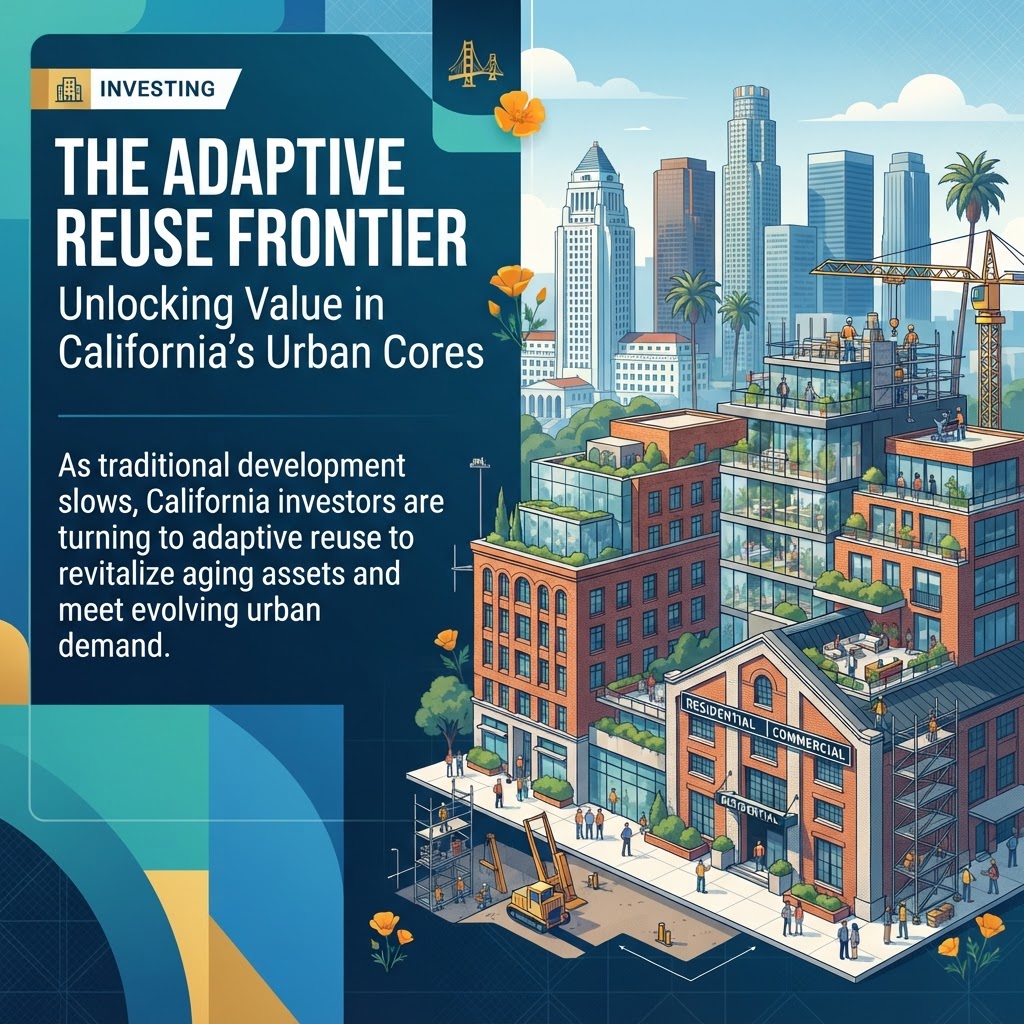
The Adaptive Reuse Frontier: Unlocking Value in California’s Urban Cores
As of October 2026, the California commercial real estate landscape is defined by a distinct shift away from speculative ground-up development. With high interest rates and a cautious lending environment, investors are increasingly looking toward adaptive reuse—the process of repurposing existing structures for new functions—as a primary strategy for value creation.
The Legislative and Economic Catalyst
The push for adaptive reuse is gaining momentum, supported by legislative efforts such as AB 2079, which aims to incentivize the revitalization of downtown areas through flexible zoning and development policies. For investors, this represents a strategic pivot. Rather than competing for scarce, expensive land, savvy capital is flowing into underutilized office and industrial assets that can be converted into high-demand residential or mixed-use spaces.
Market Analysis: Why Reuse Now?
The current market environment presents a unique set of challenges and opportunities:
- Structural Headwinds: While office assets face structural challenges, well-located, amenity-rich buildings remain resilient. However, older, B- and C-class office stock is increasingly becoming obsolete, making them prime candidates for conversion.
- Development Constraints: With multifamily housing starts hitting near-pandemic lows in some regions, the supply-demand imbalance remains acute. Adaptive reuse offers a faster path to market than traditional ground-up construction, which is currently hampered by high labor costs and financing hurdles.
- Submarket Divergence: Performance is no longer uniform. For instance, while Sacramento saw a slight uptick in multifamily vacancy to 6.7% in Q2 2026, urban cores in Southern California continue to see high demand for well-located, modern living spaces, as evidenced by the successful delivery of large-scale student housing projects near major universities.
Practical Takeaways for Investors
For those looking to capitalize on the adaptive reuse trend, success requires a disciplined approach:
- Underwrite Management Bandwidth: Similar to value-add hospitality deals, adaptive reuse projects require intense management. Investors must account for the complexity of retrofitting older systems (HVAC, plumbing, electrical) alongside the renovation budget.
- Focus on Hyper-Local Fundamentals: As the market bifurcates, macro-level data is less useful than hyper-local insights. Analyze the specific demand drivers—such as proximity to transit, university enrollment, or local employment hubs—before committing to a conversion project.
- Leverage AI for Underwriting: With the increasing use of AI in CRE, investors can now process larger datasets to identify potential conversion candidates faster, reducing the manual labor involved in initial site selection and feasibility studies.
The era of "easy" development is over. In 2026, the most successful California investors will be those who can see the potential in the existing built environment, transforming the challenges of yesterday’s office and retail spaces into the essential infrastructure of tomorrow.