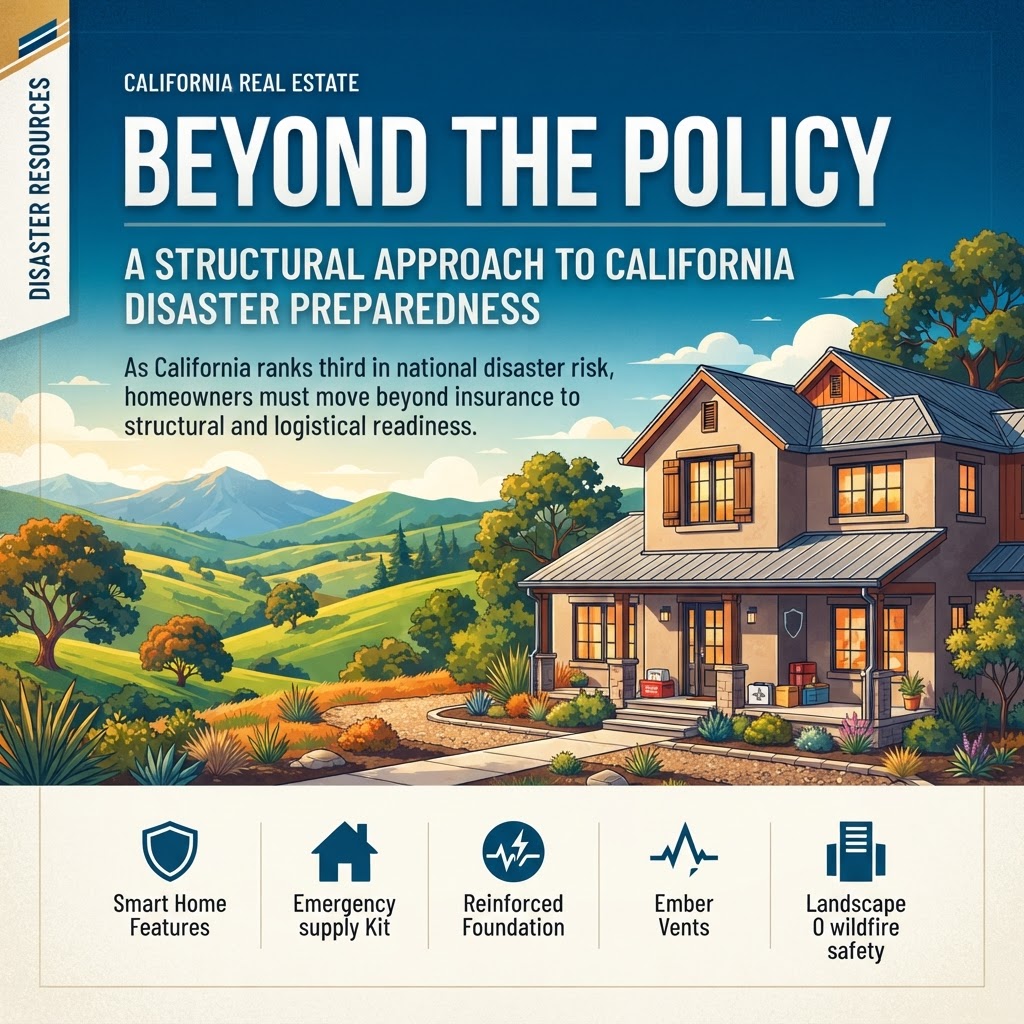
Beyond the Policy: A Structural Approach to California Disaster Preparedness
For California homeowners, the conversation around disaster preparedness has historically centered on insurance premiums and policy renewals. However, with California now ranking as the nation’s third-highest state for natural disaster risk [6], relying solely on financial indemnity is no longer a sufficient strategy. As major carriers continue to navigate a volatile market—often restricting coverage or relying on the California FAIR Plan as a last resort [8] [9]—homeowners must adopt a proactive, structural approach to property resilience.
The Shift from Financial to Physical Resilience
The current insurance crisis, driven by the high cost of rebuilding and the increasing frequency of catastrophic events, has forced a regulatory shift. Commissioner Ricardo Lara’s push to allow catastrophe modeling in rate setting [2] signals that the state is moving toward a more data-driven assessment of risk. For the homeowner, this means that physical mitigation is no longer just a safety choice; it is a financial imperative.
Practical Takeaways for Homeowners
- Digital Asset Inventory: Use your smartphone to conduct a comprehensive home inventory. Store this record in the cloud to ensure that, in the event of a total loss, your claims process is supported by verifiable data [5].
- Structural Hardening: Beyond clearing defensible space, focus on ember-resistant vents, multi-pane tempered glass windows, and fire-rated roofing materials. These upgrades are increasingly recognized by insurers as factors that may influence future insurability.
- Documentation Discipline: Maintain a physical or digital file of all contractor licenses and repair estimates. If a disaster occurs, the speed of your recovery will depend on your ability to mobilize verified professionals quickly [5].
Leveraging State Resources
The California Governor’s Office of Emergency Services (Cal OES) provides critical frameworks for community-level readiness. Programs like Listos California emphasize that disaster preparedness is a continuous process rather than a one-time task [3]. Homeowners should regularly consult the California Department of Insurance website to locate Disaster Recovery Centers and Local Assistance Centers, which serve as the primary hubs for post-event support [5].
The Investor’s Perspective
For real estate investors, the "insurability metric" is now a primary component of property valuation. As noted by experts at the USC Lusk Center for Real Estate, discouraging development in high-risk zones is becoming a standard market correction [4]. Investors should prioritize properties that have already undergone significant hardening, as these assets are better positioned to retain value in an era where insurance availability is the ultimate gatekeeper of liquidity.


