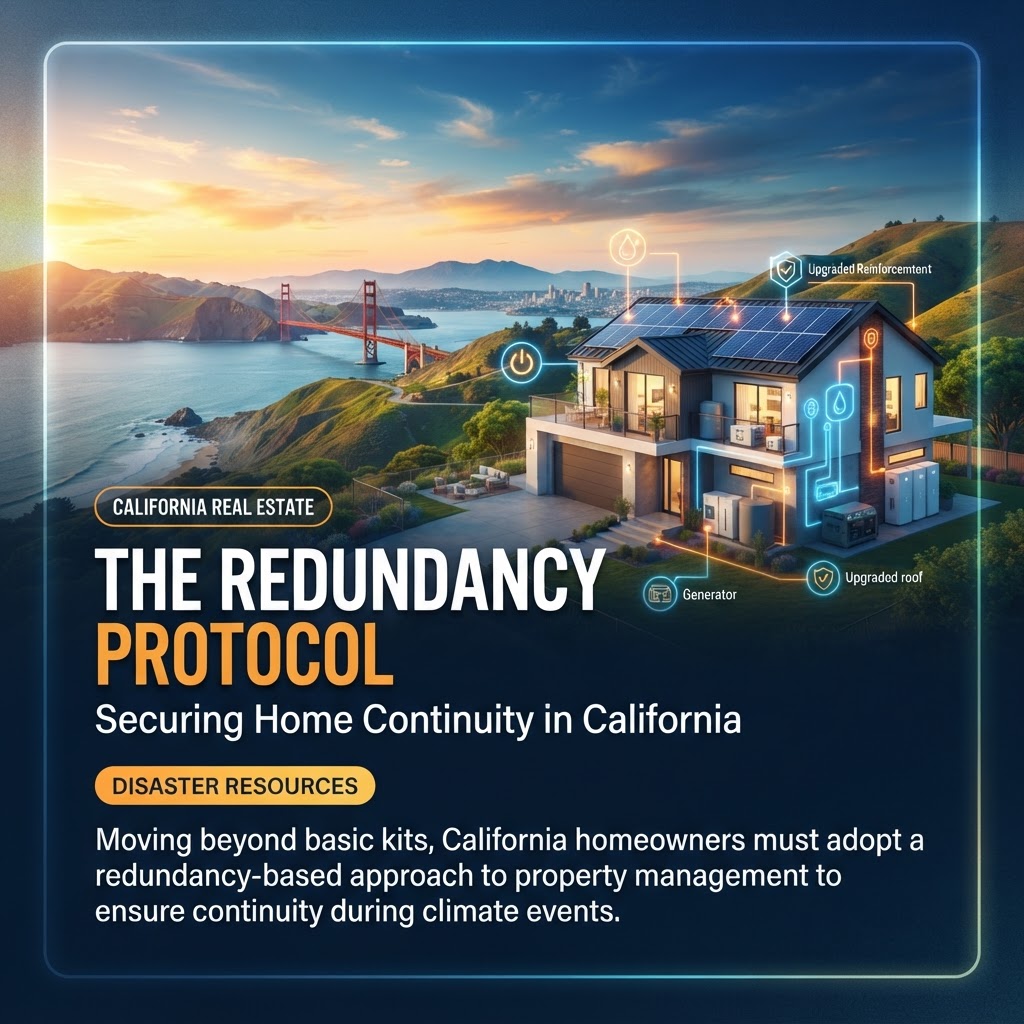
The Redundancy Protocol: Securing Home Continuity in California
For the California homeowner, disaster preparedness has evolved from a simple 'go-bag' mentality to a complex requirement for property continuity. As climate-related risks—ranging from wildfire-induced debris flows to seismic events—become more frequent, the traditional approach of reactive recovery is proving insufficient. To protect both physical assets and long-term property value, homeowners must adopt a Redundancy Protocol: a strategy that ensures critical home functions and documentation remain accessible even when primary systems fail.
The Data-Driven Risk Assessment
Before investing in mitigation, homeowners must move beyond general awareness. The California Governor’s Office of Emergency Services (Cal OES) provides the MyHazards tool, which allows residents to input specific addresses to identify localized risks. According to the 2024 California State Emergency Plan, population growth and development have significantly magnified the state's disaster risk profile, making hyper-local data essential for informed decision-making.
The Redundancy Framework
A robust continuity plan relies on three pillars of redundancy:
1. Documentation and Financial Continuity
Standard insurance policies often exclude earth movement, landslides, and floods. Homeowners must verify their coverage gaps and consider supplemental policies. Crucially, physical and digital copies of deeds, insurance policies, and home inventories should be stored in a 'Stay Kit'—a waterproof, fireproof container kept on-site—and a secondary cloud-based repository. This ensures that if a property is inaccessible, the recovery process can begin immediately without waiting for physical document retrieval.
2. Utility and Infrastructure Independence
With the increasing frequency of Public Safety Power Shutoffs (PSPS), homeowners should evaluate their reliance on the grid. Understanding the location and operation of manual utility shut-offs for gas, water, and electricity is a baseline requirement. For those in high-risk zones, investing in backup power solutions or water filtration systems creates a buffer that allows for 'shelter-in-place' capabilities when evacuation is not mandated but services are compromised.
3. The Communication Loop
When cellular networks fail, the 'out-of-state contact' remains the most reliable link. Establishing a communication plan where all household members check in with a designated contact outside of California ensures family reunification even if local infrastructure is overwhelmed. This is a low-cost, high-impact redundancy that requires no technology to execute.
Practical Takeaways for Homeowners
- Audit Your Policy: Contact the California Department of Insurance to understand the limitations of your current HO policy, particularly regarding 'demand surge'—the post-disaster spike in construction costs that often leaves homeowners underinsured.
- Leverage State Resources: Utilize the Listos California initiative for accessible, multi-language preparedness guides that cater to specific household needs, including those for seniors and individuals with disabilities.
- Annual Drills: Treat disaster planning like a home maintenance schedule. Conduct an annual 'utility shut-off' drill and update your emergency contact list every November to ensure information remains current.
By shifting the focus from mere survival to operational continuity, California homeowners can better insulate their investments against the state's inherent environmental volatility. Preparedness is not a one-time event, but a continuous cycle of assessment, mitigation, and refinement.