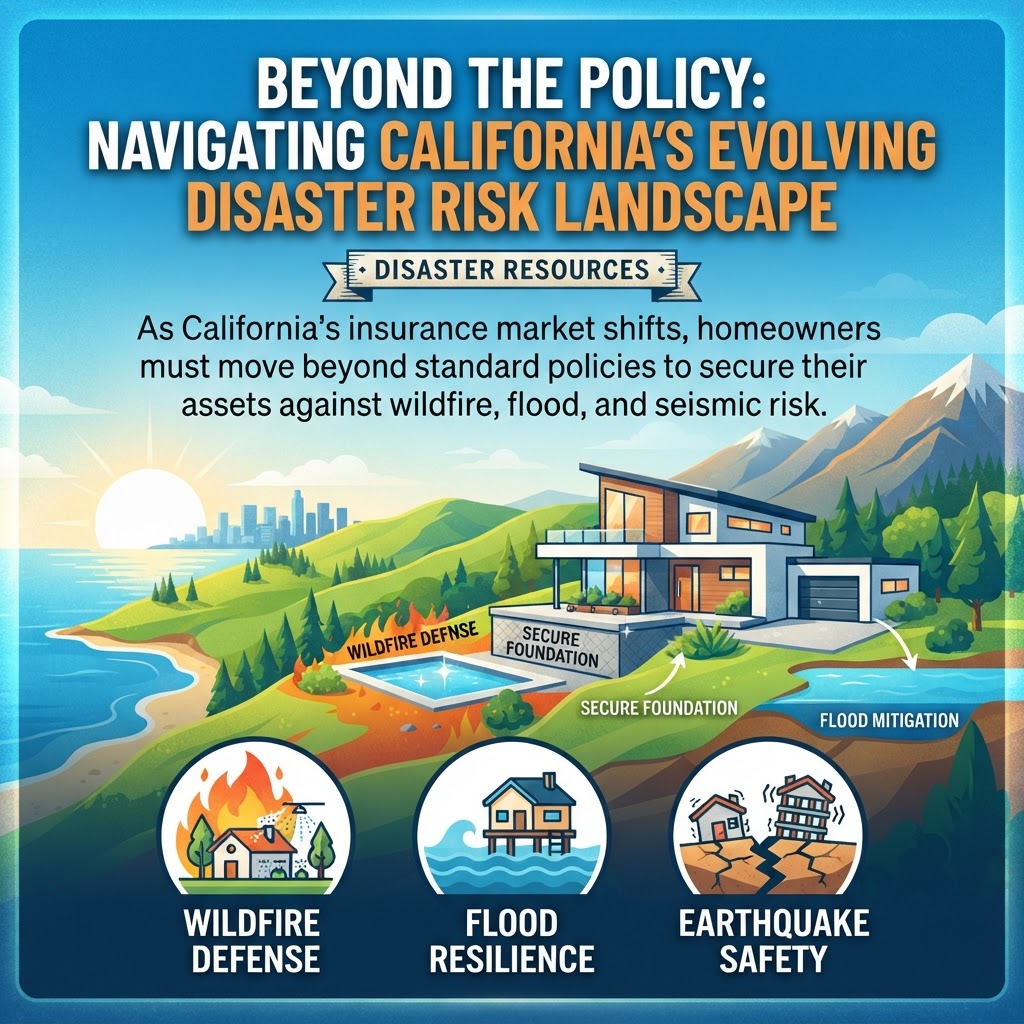
Beyond the Policy: Navigating California’s Evolving Disaster Risk Landscape
For California homeowners, the traditional approach to property protection—relying solely on a standard homeowners insurance policy—is increasingly insufficient. With insured losses from recent disasters projected in the tens of billions, the state’s real estate market is undergoing a fundamental shift in how risk is assessed, mitigated, and financed.
The Coverage Gap: Beyond Standard Policies
A critical vulnerability in the current market is the reliance on conventional insurance, which typically excludes two of California’s most significant threats: flooding and earthquakes. Data indicates that less than 2% of California homeowners carry flood insurance, despite the state’s exposure to atmospheric rivers and mega-catastrophe events. Similarly, while California experiences 90% of the nation’s earthquakes, only 10% of residents maintain earthquake coverage. Relying on government disaster relief is a precarious strategy, as such aid often covers only a fraction of total losses.
The Rise of Home Hardening as a Financial Asset
The state is moving toward a model where physical resilience directly influences financial viability. The "Safer from Wildfires" framework, developed by state agencies, provides a roadmap for property owners to reduce risk through ember-resistant materials and defensible space. Legislative efforts, such as the proposed Senate Bill 1076, aim to codify these standards, potentially requiring insurers to offer coverage or renewals for properties that meet specific wildfire safety benchmarks. For homeowners, this means that home hardening is no longer just a safety measure—it is becoming a prerequisite for maintaining insurability.
Practical Takeaways for Stakeholders
- Audit Your Coverage: Do not assume your standard policy covers all perils. Evaluate the need for standalone flood and earthquake policies, especially if your property is located in a high-risk zone.
- Leverage Mitigation Programs: The California Wildfire Mitigation Program (CWMP) offers financial assistance for retrofitting and hardening homes, particularly for low- and moderate-income households. Utilizing these programs can improve both safety and long-term insurability.
- Understand Tax Relief: Homeowners should be aware of disaster relief provisions, such as those managed by the California State Board of Equalization, which may provide property tax relief if a property sustains damage exceeding 50% of its full cash value.
- Prioritize "Zone Zero": Creating a 100-foot clearance from dry vegetation and removing combustible materials near the structure remains the most effective, low-cost strategy for reducing immediate wildfire risk.
As the insurance market continues to tighten, the most resilient homeowners will be those who treat disaster preparedness as a continuous, data-driven investment rather than a one-time administrative task. By integrating physical hardening with comprehensive financial planning, property owners can better navigate the volatility of the current California real estate environment.


