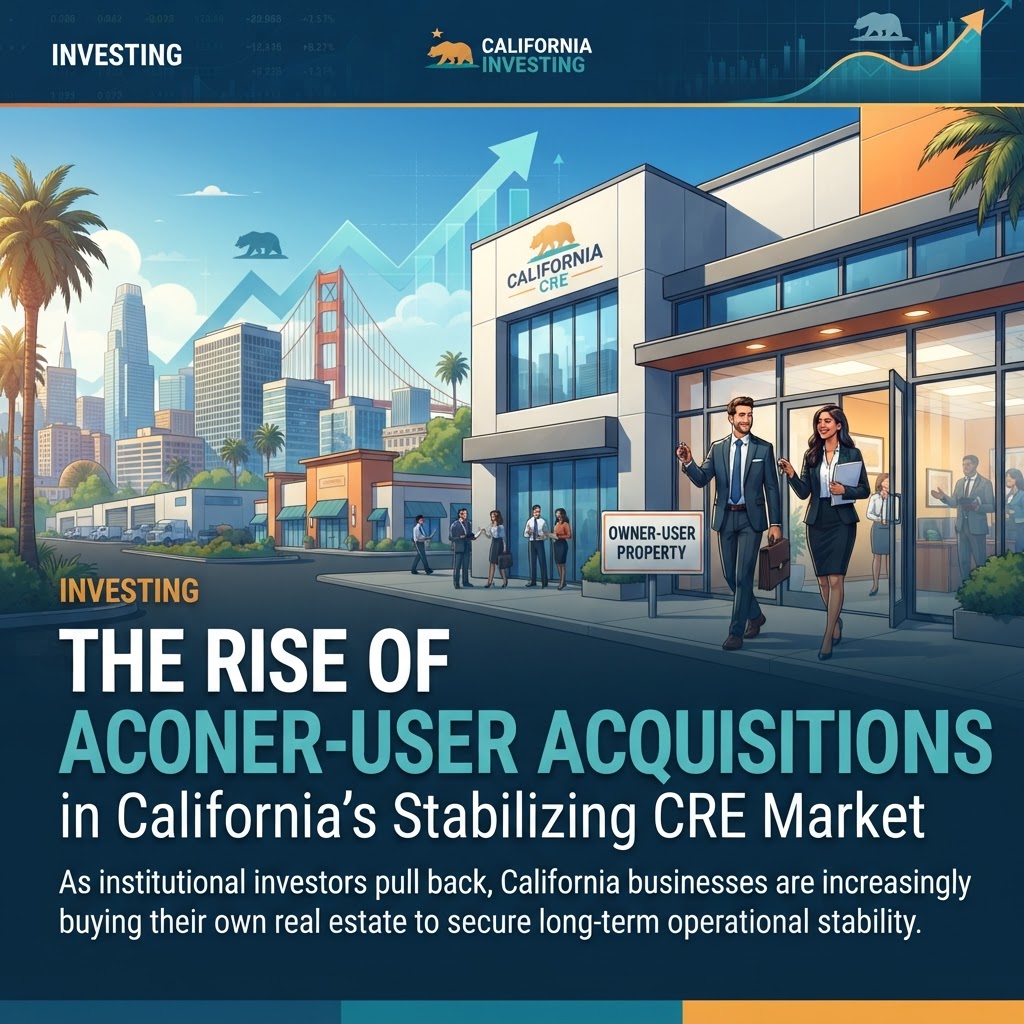
The Rise of Owner-User Acquisitions in California’s Stabilizing CRE Market
The California commercial real estate (CRE) landscape is undergoing a fundamental shift in 2026. While institutional capital remains cautious due to persistent interest rate volatility and refinancing hurdles, a new wave of activity is emerging from an unlikely source: the owner-user. As businesses move away from the uncertainty of long-term leasing, they are increasingly opting to acquire their own office and industrial footprints, signaling a unique stabilization in the state's market dynamics [2].
The Shift from Tenant to Owner
For years, the California office market struggled with high vacancy rates and a lack of institutional confidence. However, recent data suggests that when occupants decide to purchase their buildings, it serves as a strong indicator that pricing has reached a point of perceived long-term value [2]. This trend is particularly visible in major hubs like Downtown Los Angeles, where companies are prioritizing control over their physical environment to facilitate renovations, such as adding fitness centers and collaborative meeting spaces, which are essential for modern workforce retention [2].
Selective Development in a High-Rate Environment
The Summer 2026 Allen Matkins/UCLA Anderson Forecast highlights that while developers are facing a prolonged higher-rate environment, they are becoming increasingly selective [4]. The market is no longer driven by speculative growth but by "needs-based" sectors. Industrial and multifamily assets continue to show resilience, while the office sector is experiencing a bifurcated recovery—where high-quality, well-located assets are outperforming older, less efficient stock [4].
Strategic Takeaways for Investors
- Focus on Needs-Based Assets: Investors should prioritize properties that serve essential functions, such as logistics, neighborhood-serving retail, and modern industrial spaces, which remain the most stable asset classes in the current climate [4].
- Monitor Owner-User Trends: Keep an eye on areas where businesses are transitioning to ownership. This often precedes a broader market recovery in those specific submarkets, as it demonstrates a commitment to the location's long-term viability [2].
- Adapt to Higher Rates: With the consensus that higher interest rates are here to stay, underwriting must shift from growth-based models to those that emphasize operational efficiency and long-term cash flow stability [4].
As the market continues to recalibrate, the most successful California investors will be those who move away from broad-market speculation and toward the specific, high-utility assets that businesses are choosing to own themselves [7].