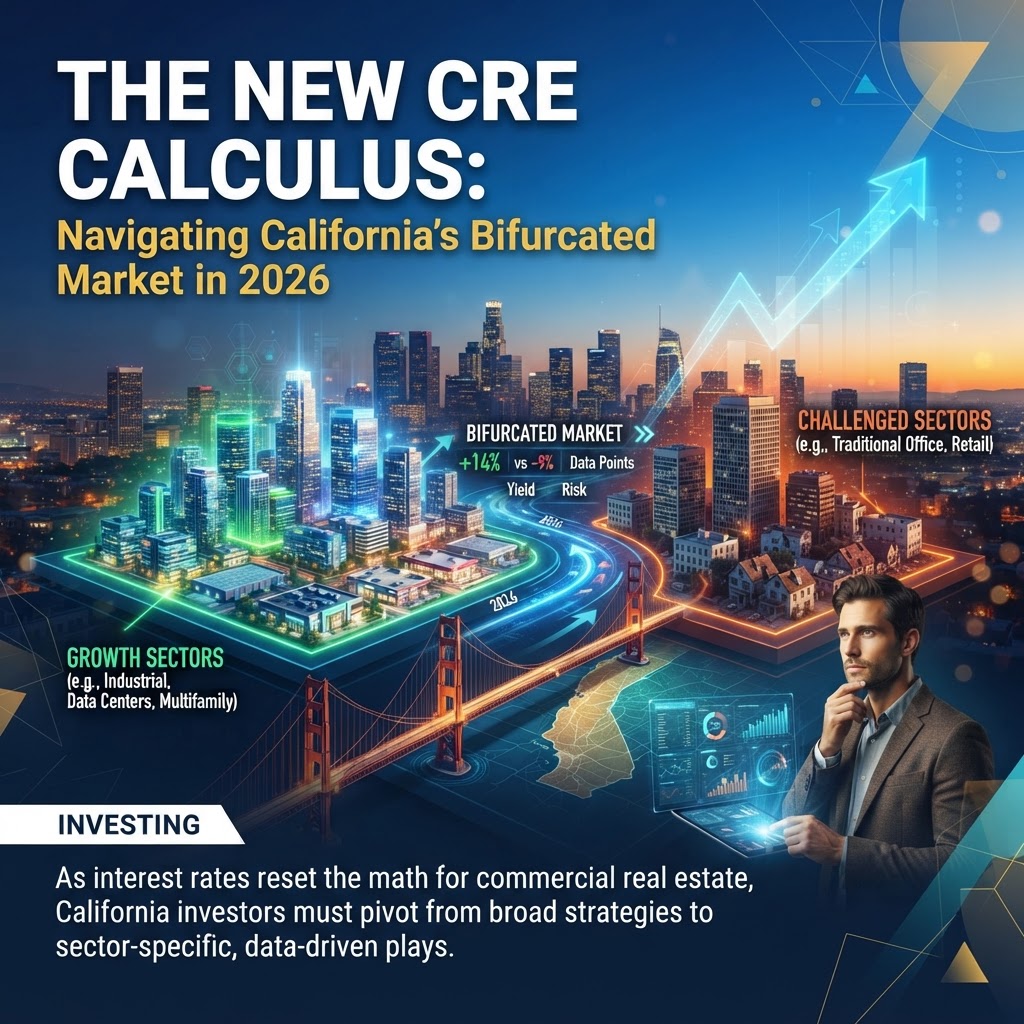
The New CRE Calculus: Navigating California’s Bifurcated Market in 2026
The commercial real estate (CRE) landscape in California has undergone a fundamental shift as of late 2026. The era of cheap debt is firmly in the rearview mirror, forcing a recalibration of cap rates and investment strategies. For investors, the market is no longer a monolith; it is a highly bifurcated environment where success depends on identifying specific growth drivers rather than relying on broad market appreciation.
The Interest Rate Reset
Elevated interest rates have fundamentally altered the valuation model for commercial assets. As noted by industry experts, cap rates that were viable when debt costs hovered near 3% simply do not pencil out at current levels above 6% [7]. This has created a persistent bid-ask gap, slowing transaction volume as buyers and sellers struggle to find common ground on pricing [7].
Sector-Specific Divergence
While the broader market faces headwinds, specific sectors are showing resilience driven by technological and structural shifts:
- Industrial and R&D: Industrial remains a high-conviction play. Recent activity, such as the $1.2B acquisition of a 2-million-square-foot R&D portfolio in Silicon Valley, underscores the continued demand for specialized space [6]. Investors are increasingly looking at logistics and R&D hubs that support the state's tech ecosystem [8].
- Data Centers and AI Infrastructure: Artificial intelligence is acting as a primary catalyst for demand. Markets like San Francisco are seeing increased activity in data center development, as technology firms prioritize proximity to talent and infrastructure [4, 5].
- Office Evolution: The office sector is experiencing a "flight to quality." Tenants are leveraging elevated vacancy rates to secure favorable lease terms in upgraded, modern spaces [3]. Meanwhile, adaptive reuse—converting underutilized office space into residential units—is gaining traction as a viable strategy to address housing shortages and revitalize urban cores [1].
Implications for California Investors
For those looking to deploy capital in the current environment, the "wait and see" approach is being replaced by a more surgical strategy. Key takeaways for the current market include:
- Focus on Zoning and Entitlements: In California, where regulatory hurdles are significant, value-add opportunities are increasingly found in projects with clear paths to zoning relief [7].
- Prioritize Cash Flow Over Speculation: With the cost of capital remaining high, investors should prioritize assets with stable, long-term credit tenants rather than relying on aggressive exit cap rate compression.
- Monitor Tech-Driven Demand: Keep a close watch on submarkets tied to AI and climate-tech firms, as these sectors are currently driving the most significant leasing and acquisition activity in the state [4, 8].
Ultimately, the 2026 California CRE market rewards the disciplined investor. By focusing on sectors with structural tailwinds—such as industrial, R&D, and AI-adjacent infrastructure—investors can navigate the current interest rate environment while positioning their portfolios for long-term growth.