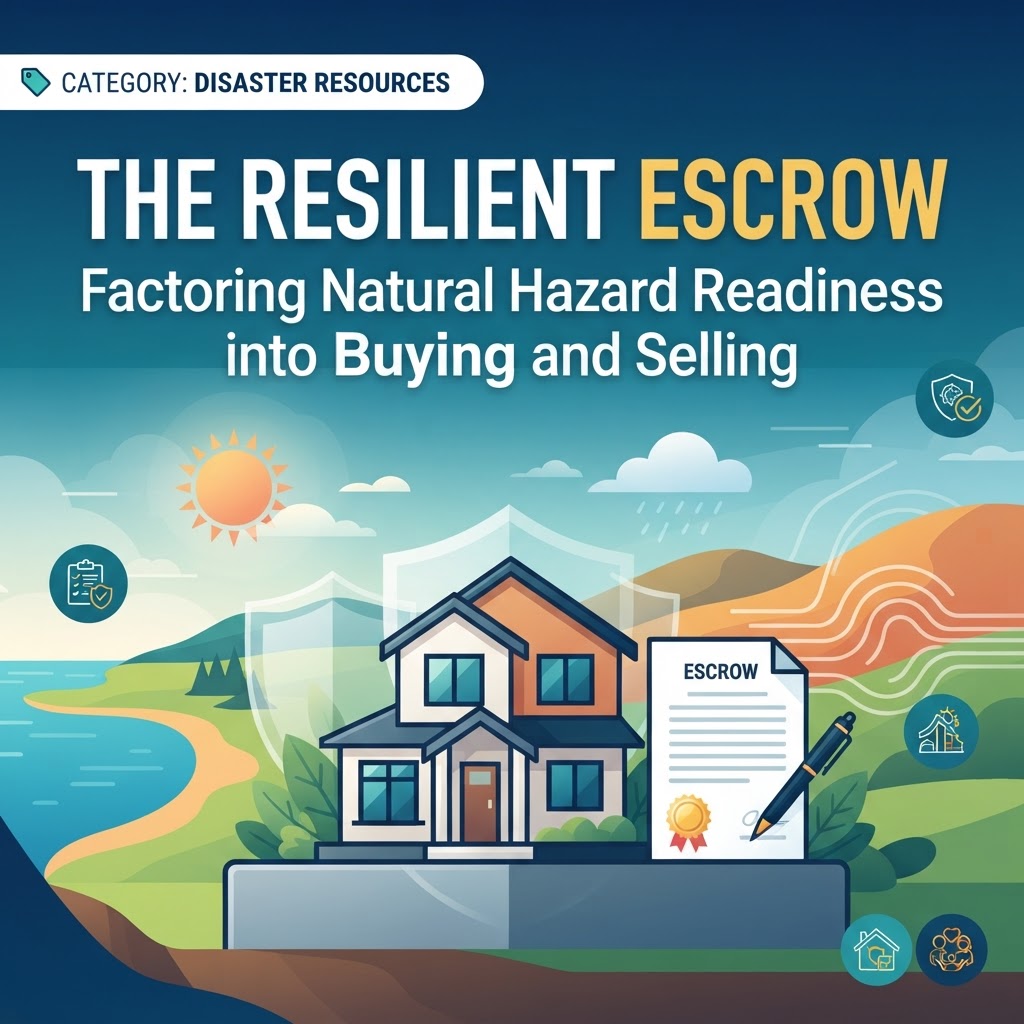
In California real estate, emergency preparedness is no longer simply a post-closing homeowner consideration—it has become a core determinant of whether a residential transaction successfully closes. With California ranking among the top three states nationally for overall natural hazard exposure according to recent natural disaster assessments, property resilience now dictates insurance insurability, lender compliance, and closing timelines across the Golden State.
The Escrow Bottleneck: Why Preparedness Precedes Closing
Data from the California Association of Realtors (CAR) indicates that financing contingencies and insurance procurement continue to represent primary friction points during the escrow process. Historically, the Natural Hazard Disclosure (NHD) statement was treated as boilerplate documentation signed off during standard review periods. In today's market, institutional lenders and insurers examine the specific risk perimeter—including high-severity fire zones, seismic hazard zones, and dam failure inundation areas—before underwriting commitments are issued.
As property casualty carriers re-evaluate their exposure footprints, properties lacking physical and administrative resilience features face steep delays. For buyers and sellers alike, closing escrow now requires an affirmative operational defense against regional risks.
California-Specific Hazards: A Multi-Vector Approach
Unlike regions contending with single seasonal perils, California properties face overlapping threat vectors that require comprehensive physical mitigation:
- Wildfire and Embers: Maintaining strict defensible space zones under CAL FIRE guidelines, including Zone 0 (0 to 5 feet from the structure), is increasingly required for both insurance qualification and local transfer compliance. Ember-resistant venting (1/8-inch or smaller mesh) and noncombustible perimeter landscaping protect against the primary mechanism of home ignition.
- Seismic Shaking: The California Earthquake Authority (CEA) emphasizes foundational bolting, cripple wall bracing, and automatic seismic gas shutoff valves (SGSVs). Beyond life safety, active seismic shutoffs prevent the catastrophic post-quake structural fires that historically cause extensive property losses.
- Precipitation and Mudflow: Post-burn soil degradation frequently transforms hillside parcels into debris flow conduits during atmospheric river events. Evaluating downslope retaining integrity and certifying exterior surface drainage away from footings protects the foundational asset value.
Insurance Navigation: Aligning Market Realities with Contingency Timelines
Securing adequate property and casualty coverage is now critical to timeline risk management. Standard homeowner forms (HO-3) routinely exclude land movement and flood perils, leaving unaddressed exposures if endorsements or standalone policies are not arranged early.
Investors and prospective purchasers must navigate several strategic parameters:
- Immediate Insurance Verification: Rather than waiting for appraisal sign-off, initiate insurance procurement within the first 48 to 72 hours of an accepted offer. Obtain hard binders that verify both dwelling replacement costs and building ordinance or law coverage.
- Managing the FAIR Plan: If utilizing the California FAIR Plan for basic property coverage, account for extended underwriting turnarounds. A companion "Difference in Conditions" (DIC) policy must be sourced simultaneously to backfill liability, theft, and water damage exclusions.
- Earthquake and Flood Endorsements: For financed assets, evaluate CEA or private seismic capacity alongside National Flood Insurance Program (NFIP) or private flood policies, particularly if the parcel sits in an alluvial fan or downslope basin.
Emergency Resources and Regional Infrastructure Integration
Operational preparedness extends to local and statewide infrastructure coordination. Homeowners and community associations should integrate official resources into household continuity plans:
- Cal OES and Listos California: The Governor’s Office of Emergency Services (Cal OES) provides localized emergency alerts and preparedness frameworks via Listos California, offering actionable checklists for emergency evacuations and neighborhood-level resource mobilization.
- CalHHS Open Data: Public health and social service tracking portals via the California Health and Human Services Agency (CalHHS) provide public health guidance, medical device contingency recommendations, and shelter capacity tracking during active regional emergencies.
- Local Utility & GIS Mapping: Homeowners should subscribe to county emergency notification systems (e.g., AlertSanDiego, AlertSCC) and identify secondary egress routes through municipal GIS hazard maps before seasonal red flag warnings.
Practical Investor and Homeowner Takeaways
- Perform a Hazard Due Diligence Audit: Before removing property contingencies, cross-reference the NHD report with on-site conditions—focusing on foundation anchoring, vegetation clearance, and drainage conduits.
- Formalize Administrative Access: Maintain digitized, cloud-encrypted records of deeds, property tax receipts, insurance declaration pages, and serial numbers of mechanical equipment to accelerate potential claim settlements.
- Inspect and Certify Safety Cutoffs: Ensure all occupants know how to manually isolate water and electric services, and verify that gas lines are fitted with certified seismic shutoff mechanisms.
- Budget for Ongoing Mitigation: Factor recurring fire-hardening maintenance, drainage clearance, and HOA special hazard reserve funding into long-term cash flow models.


