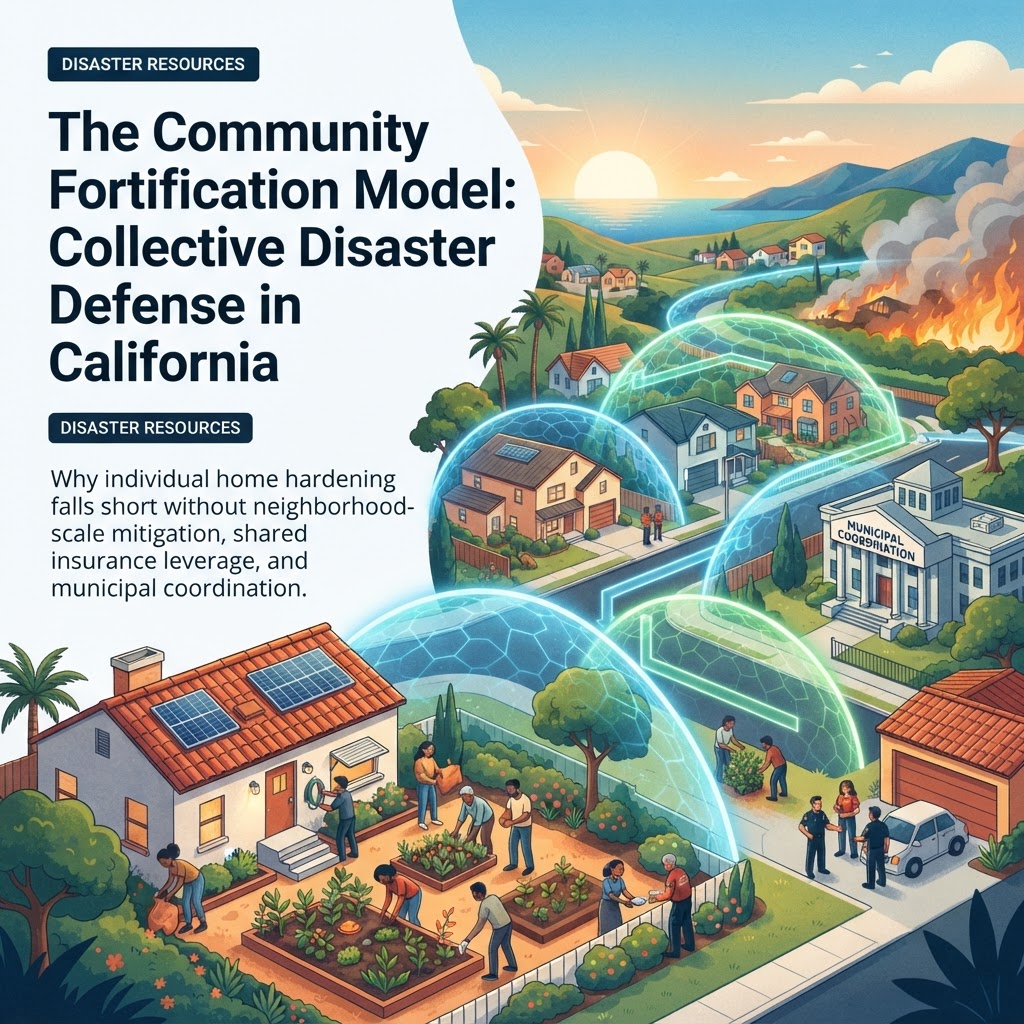
For years, disaster preparedness guidance for California homeowners has focused on the individual parcel: clearing five feet of non-combustible defensible space, installing 1/8-inch ember-resistant mesh over vents, and bolting sill plates to concrete foundations. Yet recent catastrophic wildfire and severe weather events across the state have underscored a sobering physical reality: a hardened home surrounded by unmitigated parcels remains acutely vulnerable to radiant heat, wind-driven ember storms, and community infrastructure collapse.
As fire officials and mitigation specialists frequently observe, property owners share collective physical and financial risk. In 2026, disaster resilience is pivoting from single-home isolationism to community-scale fortification. For California buyers, sellers, and real estate investors, understanding and organizing neighborhood-level disaster defense has become an essential strategy for preserving property values, securing property insurance, and ensuring life safety.
The Limits of the Standalone Hardened Home
The physics of modern wildfires—amplified by prolonged drought cycles, complex terrain, and severe wind dynamics—demonstrate that structure-to-structure ignition is one of the primary drivers of suburban and wildland-urban interface (WUI) losses. According to post-fire damage evaluations conducted across California communities, radiant heat from an adjacent burning home can shatter standard double-pane windows and ignite exterior eaves more than 30 feet away, rendering individual parcel clearing ineffective if adjoining lots are neglected.
A similar dynamic governs urban flood, debris flow, and seismic hazards. Runoff diversion, shared retaining walls, unmaintained neighborhood drainage culverts, and above-ground utility corridors link the structural destiny of each home to its broader block. True resilience requires coordinating risk reduction across boundaries.
The Insurance Imperative: Neighborhood Aggregation and Market Access
California’s residential property insurance landscape remains intensely pressured. As private carriers increasingly rely on advanced catastrophe modeling, individual property owners face escalating premiums or are relegated to the California FAIR Plan, which caps residential coverage limits at $3 million—a threshold frequently exceeded by median home values in high-cost coastal and mountain regions.
However, regulatory frameworks and insurance reform initiatives under the California Department of Insurance (CDI) continue to incentivize community-level risk reduction. Homeowners who participate in recognized neighborhood-scale initiatives unlock tangible advantages:
- Firewise USA® Recognition: Neighborhoods designated as Firewise USA sites through the National Fire Protection Association (NFPA) demonstrate verified, community-wide risk mitigation. Several major private carriers in California offer mandatory or discretionary premium discounts (typically between 5% and 10%) for properties situated in certified communities.
- Insurer Return Commitments: State regulatory adjustments require carriers seeking approval to use catastrophe modeling to maintain specified coverage footprints (such as writing up to 85% of market share) in distressed, wildfire-prone areas. Communities that can collectively document contiguous defensible space and structural hardening represent the lowest-risk tranches within these zones, making them first in line for private market re-entry.
- Appraisal and Liquidity Retention: Data from the California Association of Realtors (CAR) shows that homes in regions plagued by non-renewals suffer extended days-on-market (DOM) and heightened contingency fallout due to insurance delays. Certified fire-safe communities provide buyers and lenders with greater transaction certainty.
Actionable Framework: Building the Community Defense Playbook
For investors managing multi-property portfolios, HOAs overseeing common-interest developments, and residential civic leaders, operationalizing community resilience involves concrete steps:
1. Form or Join a Local Fire Safe Council
Rather than managing risk individually, partner with regional organizations such as county Fire Safe Councils. These non-profit community organizations act as conduits for municipal risk evaluations, aggregate equipment rentals (such as community chipper days), and coordinate directly with local fire departments to conduct free street-by-street home hardening inspections.
2. Synchronize Perimeter Buffer Zones
Contiguous risk reduction is exponentially more protective than sporadic mitigation. Homeowners should coordinate with neighboring lots to establish uninterrupted:
- Zone 0 (0–5 feet): Uniform elimination of combustible materials directly adjacent to all home foundations, wooden fences, and perimeter gates.
- Zone 1 (5–30 feet): Coordinated thinning of canopies to ensure a minimum 10-foot tree-to-tree clearance across property lines.
- Zone 2 (30–100 feet): Removal of ladder fuels along property perimeters and shared access corridors to maintain clear passage for emergency response vehicles.
3. Establish Mutual Early-Warning and Evacuation Systems
Municipal alerts such as Genasys Protect (formerly Zonehaven) divide counties into hyper-local evacuation zones. Neighborhoods should integrate localized communication protocols (including text trees and neighborhood apps) to ensure real-time notification during red flag warnings or flood watches. Ensuring that vulnerable or elderly neighbors have designated evacuation support prevents traffic congestion and bottlenecking along narrow community egress routes.
4. Leverage State and Local Emergency Support Infrastructure
Homeowners should familiarize themselves with state-level emergency structures coordinated via the California Governor’s Office of Emergency Services (Cal OES Emergency Support Functions) and connect with regional 2-1-1 networks (Kabateck Strategies). Tapping into local community emergency response team (CERT) training builds localized capability for the initial 72 hours following an earthquake, landslide, or fire before municipal mutual aid units can fully deploy.
The Long-Term ROI of Collective Hardening
In the evolving California real estate market, disaster resilience is no longer a solitary weekend chore—it is an economic necessity that dictates property liquidity, insurance solvency, and personal safety. By shifting focus from parcel-level defense to coordinated neighborhood fortification, homeowners can insulate their properties from both natural hazards and insurance-market disruptions.


