The Shift from Hardening to Functional Autonomy
For the past decade, California disaster preparedness focused heavily on "hardening" the home—installing ember-resistant vents, Class A roofing, and maintaining 100 feet of defensible space. However, as of September 2026, the risk profile has shifted. While a home may survive a wildfire or a localized flood, the surrounding infrastructure often does not. Homeowners are increasingly facing "functional displacement," where the structure remains intact, but the failure of the centralized power, water, and communication grids renders the property uninhabitable for weeks or months.
According to data from the California Public Utilities Commission (CPUC), the number of Public Safety Power Shutoff (PSPS) events and unplanned outages related to extreme weather has increased by 18% year-over-year. Consequently, the 2026 market is placing a premium on "Infrastructure Autonomy"—the ability of a property to operate as a self-sustaining island during regional systemic failures.
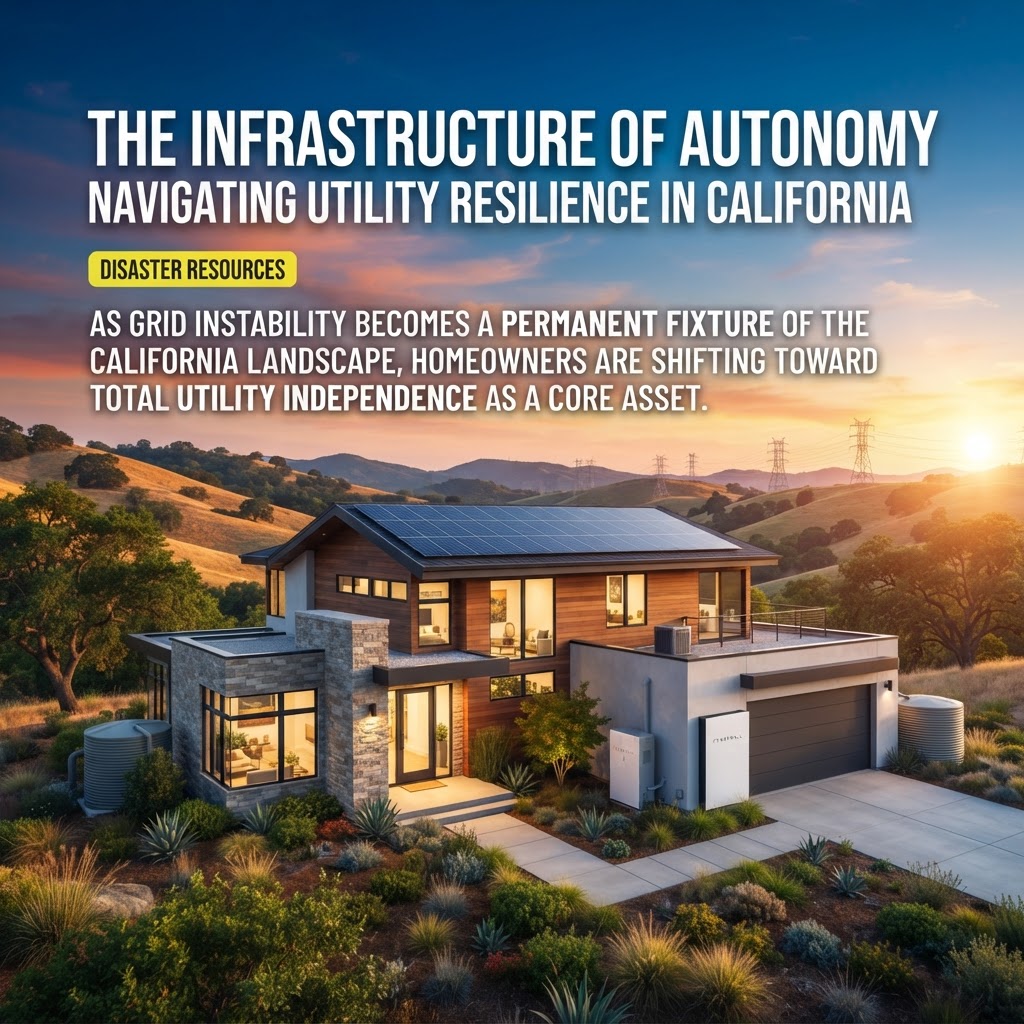
The Energy Island: Solar, Storage, and Microgrids
In the current real estate climate, a simple rooftop solar array is no longer a differentiator; it is the baseline. The National Association of Realtors (NAR) 2026 Sustainability Report indicates that homes equipped with integrated battery storage (minimum 20kWh) and a manual transfer switch for generator backup sell for a 4.5% premium compared to those without.
For homeowners, the focus is now on "essential load management." This involves wiring critical circuits—refrigeration, well pumps, medical equipment, and basic HVAC—into a dedicated sub-panel. In high-risk zones, we are seeing a rise in "Microgrid Communities," where shared storage systems allow neighborhoods to maintain street lighting and security systems even when the main PG&E or SCE grid is de-energized.
Water Security in the Age of Scarcity
Utility failure isn't limited to electricity. California’s aging water conveyance systems are increasingly vulnerable to seismic events and soil subsidence during extreme drought-flood cycles. Homeowners are moving toward onsite water resilience through two primary avenues:
- Advanced Graywater Harvesting: New 2026 state building codes have eased the permitting process for whole-home graywater systems, which can reduce outdoor potable water demand by up to 40%, ensuring landscaping and defensible space remain hydrated even during municipal restrictions.
- Atmospheric Water Generation (AWG): In coastal and high-humidity regions of California, high-end residential builds are now incorporating AWG systems that can produce 5 to 10 gallons of potable water daily from ambient air, providing a critical safety net when local pipes fail.
Insurance Implications: The "Loss of Use" Clause
A critical gap in many standard California FAIR Plan or surplus lines policies is the nuance of "Loss of Use." Many homeowners assume that if their home is standing but the power is out for two weeks, their insurance will cover temporary housing. This is rarely the case unless a mandatory evacuation order was in place for a covered peril.
Investors and buyers should look for Utility Interruption Endorsements. These specific riders provide coverage for displacement and food spoilage resulting from utility failures, even if the physical structure of the home has not suffered direct damage. As insurance premiums in California have climbed to represent nearly 15% of the average monthly carrying cost, verifying these specific triggers is essential for fiscal resilience.
Practical Takeaways for the Prepared Homeowner
Actionable Resilience Steps
- Audit Your Energy Load: Identify the "Survival Circuit." Ensure your battery storage system is programmed to prioritize these loads over luxury consumption (e.g., pool pumps) during a grid failure.
- Secure Off-Grid Communications: As cellular towers often fail during extended power outages, invest in satellite-based internet (such as Starlink) with a dedicated battery backup to maintain access to emergency resources and CalOES updates.
- Verify Insurance Triggers: Review your policy for the specific language regarding "Civil Authority" and "Utility Interruption." If your home is in a Tier 3 fire threat area, these riders are as important as the dwelling coverage itself.
- Install a "Smart" Water Meter: Devices like Phyn or Moen Flo can detect micro-leaks caused by seismic shifts and automatically shut off the main valve, preventing catastrophic internal water damage during an earthquake.
Resilience in 2026 is no longer just about preventing the house from burning down; it is about ensuring the house remains a functional shelter when the modern world around it temporarily ceases to function. For California homeowners, autonomy is the new gold standard of value.