The Shift from Structural Hardening to Operational Mobility
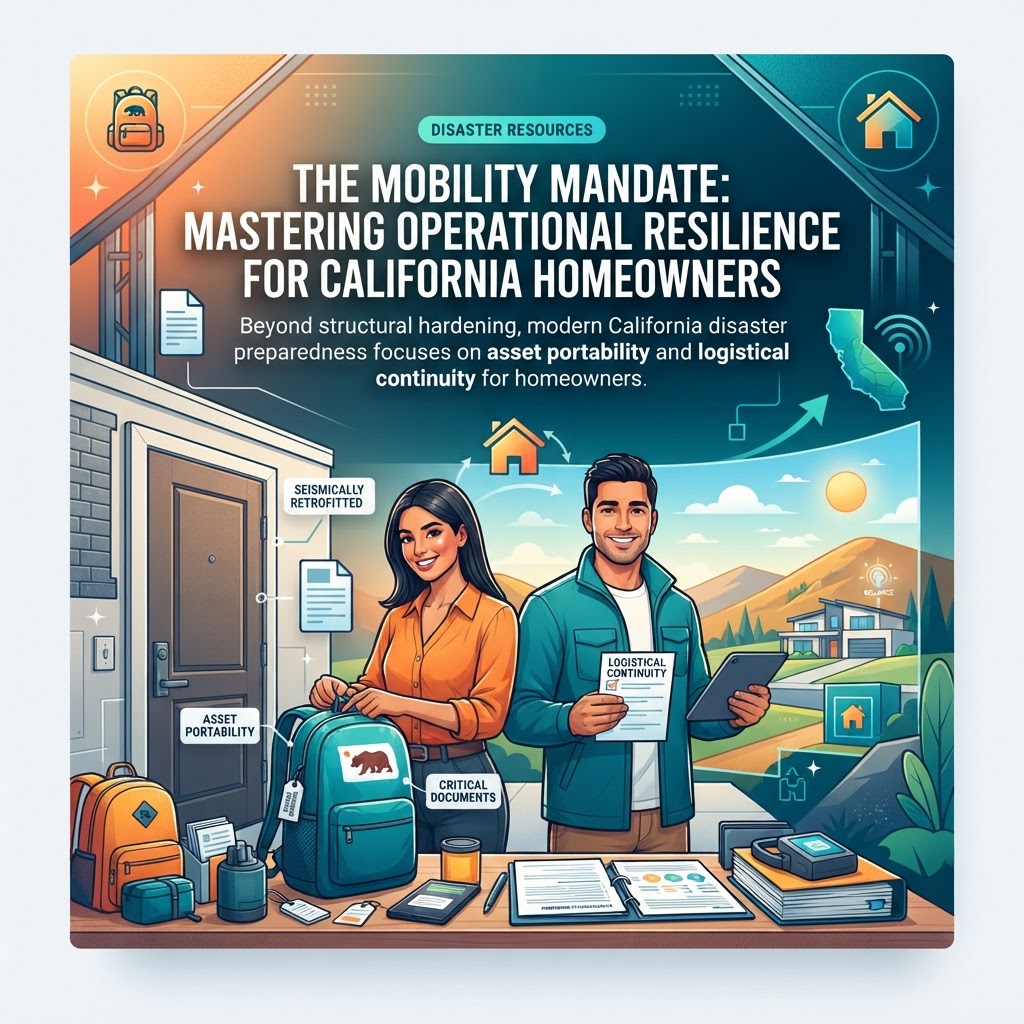
In the California real estate landscape of 2026, the definition of disaster preparedness has evolved. While previous years focused heavily on the physical hardening of assets—such as Ember-resistant vents and seismic retrofitting—the current risk environment demands a focus on operational mobility. As the California Department of Forestry and Fire Protection (CAL FIRE) and the California Governor’s Office of Emergency Services (Cal OES) continue to refine evacuation protocols, the homeowner’s greatest vulnerability is no longer just the structure, but the logistical and financial friction of displacement.
The Digital Asset Vault: Ensuring Continuity
Data from the 2025 National Association of Realtors (NAR) Property Resilience Report indicates that homeowners who maintained cloud-synchronized digital inventories of their assets experienced a 35% faster claims processing cycle compared to those with traditional documentation. In an era where physical deeds and insurance policies can be lost in seconds, the 'Digital Twin' of one’s property is essential. This involves maintaining encrypted, multi-regional cloud storage containing not only high-resolution imagery of every room but also verifiable proof of upgrades, appraisals, and maintenance logs. This digital infrastructure ensures that the financial identity of the home remains intact even if the physical structure is inaccessible.
The Displacement Liquidity Buffer
A critical, yet often overlooked, aspect of preparedness is the 'Displacement Liquidity Buffer.' According to 2026 market analysis from CBRE, the cost of temporary housing in low-risk 'buffer zones' (areas adjacent to disaster-impacted regions) can spike by as much as 200% during a state of emergency. Standard Loss of Use coverage in homeowners' insurance policies often operates on a reimbursement basis, creating a significant cash-flow gap. Prepared homeowners are now establishing dedicated 'Resilience Lines of Credit' or liquid reserves equivalent to three months of local market rent to navigate the immediate aftermath of an evacuation without financial distress.
Logistical Redundancy and the Communication Pivot
The 2024-2025 wildfire seasons highlighted a new risk: the collapse of local telecommunications infrastructure. The California Public Utilities Commission (CPUC) has noted that while PSPS events are more targeted, mass evacuations can still lead to 'digital blackout' zones. Resilience now includes redundant communication channels, such as satellite-linked internet for residential use and high-frequency radio networks at the neighborhood level. For the investor or homeowner, this means ensuring that property management and emergency services can communicate regardless of cellular tower status.
Practical Takeaways for the California Market
- Audit the Digital Trail: Ensure all property titles, insurance binders, and asset inventories are stored in a SOC-2 compliant digital vault with offline access capabilities.
- Calculate the Displacement Gap: Review your 'Additional Living Expense' (ALE) coverage and compare it against current short-term rental rates in neighboring counties; maintain a liquidity bridge to cover the delta.
- Establish a 15-Minute Protocol: Practice a 'Zero-Notice' evacuation drill focused on securing portable hard drives, essential medications, and legal identifiers, prioritizing data over physical objects.
- Invest in Localized Intelligence: Subscribe to hyper-local risk monitoring services that utilize real-time satellite telemetry rather than relying solely on municipal sirens or standard emergency broadcasts.
Ultimately, California homeowners in 2026 must view their property not just as a static asset, but as part of a dynamic system. True resilience is the ability to decouple the family and the finances from the physical address at a moment's notice, ensuring that while the house may be stationary, the homeowner's life and legacy remain mobile.