The Shift from Emergency Backup to Perpetual Readiness
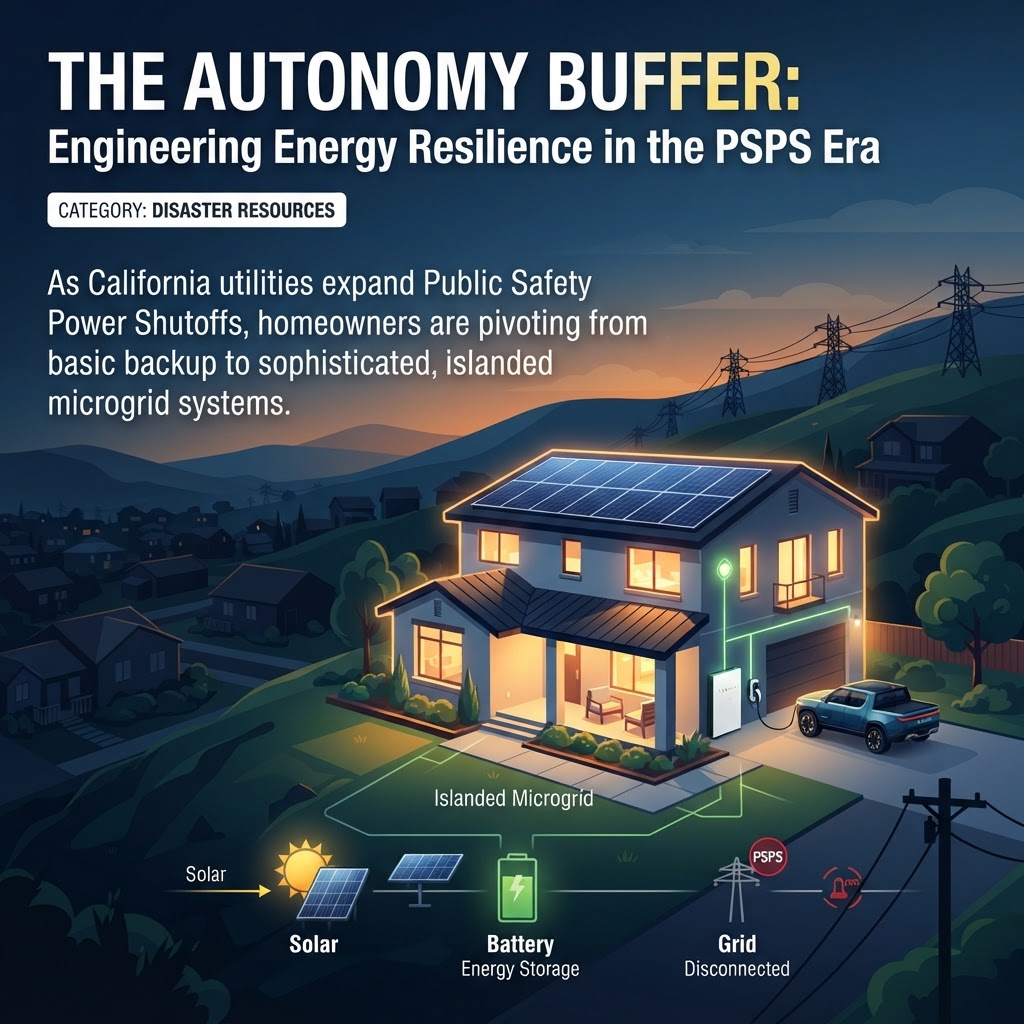
In the summer of 2026, California homeowners no longer view power outages as mere inconveniences but as systemic risks to property safety and communication. With the California Public Utilities Commission (CPUC) reporting a 14% increase in Public Safety Power Shutoffs (PSPS) over the last rolling three-year period, the paradigm of disaster preparedness has shifted. The focus has moved beyond the 'Go-Bag' toward the 'Stay-Live' infrastructure: the home microgrid.
The Data Behind the Decentralized Grid
Recent data from the California Energy Commission (CEC) indicates that as of early 2026, over 1.8 million residential properties have integrated Battery Energy Storage Systems (BESS). This surge is driven by more than just high utility rates; it is a response to the Wildland-Urban Interface (WUI) risk profile. According to the National Association of Realtors (NAR) 2025 Green Home Trends report, California homes equipped with 'islanding-capable' energy systems—those that can operate independently of the grid during a blackout—command a 4.5% price premium over non-resilient counterparts in high-fire-threat districts.
Defining the Modern Energy Vault
Disaster preparedness in the California context now requires a three-tiered technical approach to energy resilience:
- Islanding Inverters: Standard solar arrays without specialized inverters shut down during grid failures to prevent backfeeding. Homeowners are now retrofitting systems with MID (Microgrid Interconnection Device) technology to ensure solar production continues when the grid is dark.
- LFP Chemistry Dominance: Lithium Iron Phosphate (LFP) has overtaken traditional Nickel Manganese Cobalt (NMC) in the residential sector due to its higher thermal stability and longer cycle life—critical during extended multi-day disaster events.
- Critical Load Sub-Paneling: Homeowners are increasingly isolating essential circuits—refrigeration, well pumps, medical equipment, and security systems—to extend battery duration from hours to days.
Practical Takeaways for Homeowners and Investors
To achieve true resilience, homeowners should audit their properties against the following 2026 standards:
- Sizing for Autonomy, Not Just Savings: Ensure the storage capacity (kWh) is sized to 120% of the home's critical 24-hour load. Data shows that during the 2025 'Atmospheric River' events, homes with under-sized batteries failed after 14 hours of cloud cover.
- The Dual-Fuel Bridge: While battery storage is the primary resilience tool, the most resilient California properties utilize a 'tri-brid' approach: solar, battery, and a small, propane-integrated backup generator to handle peak loads during winter storm duration.
- Redundant Communication: Energy autonomy is useless without data. Integration of satellite-based internet (such as Starlink) powered directly by the DC-coupled battery system ensures connectivity when local cellular towers lose power or fiber lines are compromised.
The Resilience ROI
The investment in energy autonomy serves a dual purpose. Beyond the immediate safety during a wildfire or seismic event, these systems mitigate the 'Relocation Risk' identified by major California insurers. Properties that can maintain climate control and security independently are increasingly viewed as lower-risk assets in the secondary mortgage market. As we navigate the 2026 fire season, the ability to 'island' is no longer a luxury—it is a fundamental requirement for California property preservation.