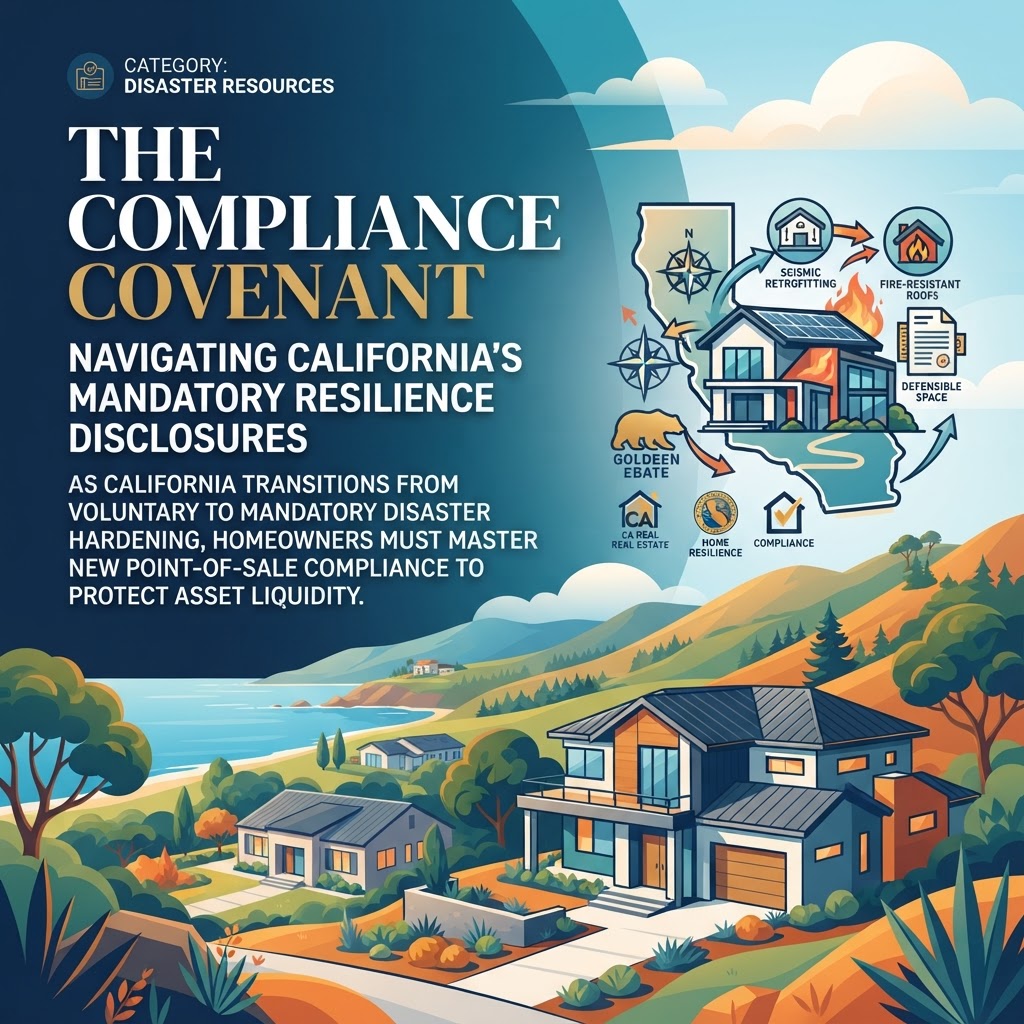
The New Baseline for California Transactions
By July 2026, the California real estate landscape has undergone a fundamental shift. Disaster preparedness is no longer a localized concern or a voluntary weekend project; it has become a rigid legal framework governing the transfer of property. With the California Department of Insurance (CDI) reporting that nearly 3.5 million homes now reside within High or Very High Fire Hazard Severity Zones (VHFHSZ), the state has moved aggressively to standardize 'home hardening' as a prerequisite for marketability.
The Evolution of Point-of-Sale Audits
Building upon the foundations of AB 38, the 2026 regulatory environment requires more than just a self-certification of defensible space. Sellers in designated zones must now provide a verified 'Resilience Compliance Certificate' (RCC) prior to the close of escrow. According to recent data from the National Association of Realtors (NAR), transactions in California’s wildland-urban interface (WUI) that lack pre-certified hardening measures face an average 18% longer time-on-market and a 12% valuation haircut compared to compliant peers.
This 'Compliance Covenant' ensures that buyers are not inheriting immediate liability. The audit covers critical vulnerabilities: multi-pane tempered glass requirements, non-combustible zone zero (0-5 feet from the structure) adherence, and ember-resistant venting. For the 2026 homeowner, these are no longer 'upgrades' but essential maintenance items required to preserve the home’s status as a transferable asset.
The Insurance Nexus: Beyond the FAIR Plan
The California FAIR Plan, once a temporary safety net, has tightened its underwriting guidelines. To secure even basic coverage in 2026, homeowners must demonstrate a Tier 2 hardening status—a standard that includes specific roof assemblies and enclosed eaves. A 2025 study by the California Association of Realtors (CAR) found that 65% of all cancelled policies in high-risk zones were due to 'mitigation failure' rather than general risk appetite. In this environment, resilience is the only currency that buys traditional insurance access.
The Multi-Hazard Reality: Seismic and Hydrologic Shifts
While wildfire dominates the legislative agenda, the 2026 market is also pricing in 'Secondary Peril' resilience. The California Earthquake Authority (CEA) has noted that homes with a 'Brace and Bolt' retrofit now command a 4-6% premium in seismic-prone zip codes. Simultaneously, new flood disclosure maps updated in late 2025 have expanded the definition of flood risk beyond traditional plains, requiring homeowners to document permeable landscaping and localized drainage efficiency to maintain 'insurability ratings.'
Strategic Imperatives for the 2026 Homeowner
For investors and homeowners, the path to protecting equity involves a proactive compliance strategy rather than a reactive repair cycle. The following actions are now considered standard practice for maintaining residential liquidity in California:
- Execute a Bi-Annual Resilience Audit: Engage a certified Wildfire Mitigation Specialist to perform a gap analysis between current property conditions and the evolving CAL FIRE standards.
- Zone Zero Monetization: Replace all combustible mulch and woody vegetation within five feet of the structure with rock, gravel, or pavers. This move is currently the single highest ROI activity for passing point-of-sale inspections.
- Digital Compliance Vaults: Maintain a verifiable log of all retrofits, including receipts and time-stamped photos of ember-resistant mesh installations and vent upgrades. This documentation is now requested by 90% of lenders during the appraisal process.
- Secondary Risk Hardening: In seismic zones, prioritize the anchoring of water heaters and the installation of automatic gas shut-off valves, which have become a 'soft' requirement for many private insurance carriers.
The Future of California Equity
The gap between 'hardened' and 'vulnerable' assets is widening into a permanent valuation divide. As we move through 2026, the most successful homeowners will be those who view disaster preparedness not as an emergency response, but as a continuous regulatory obligation. In the modern California market, a home that cannot prove its resilience is a home that cannot be sold.


