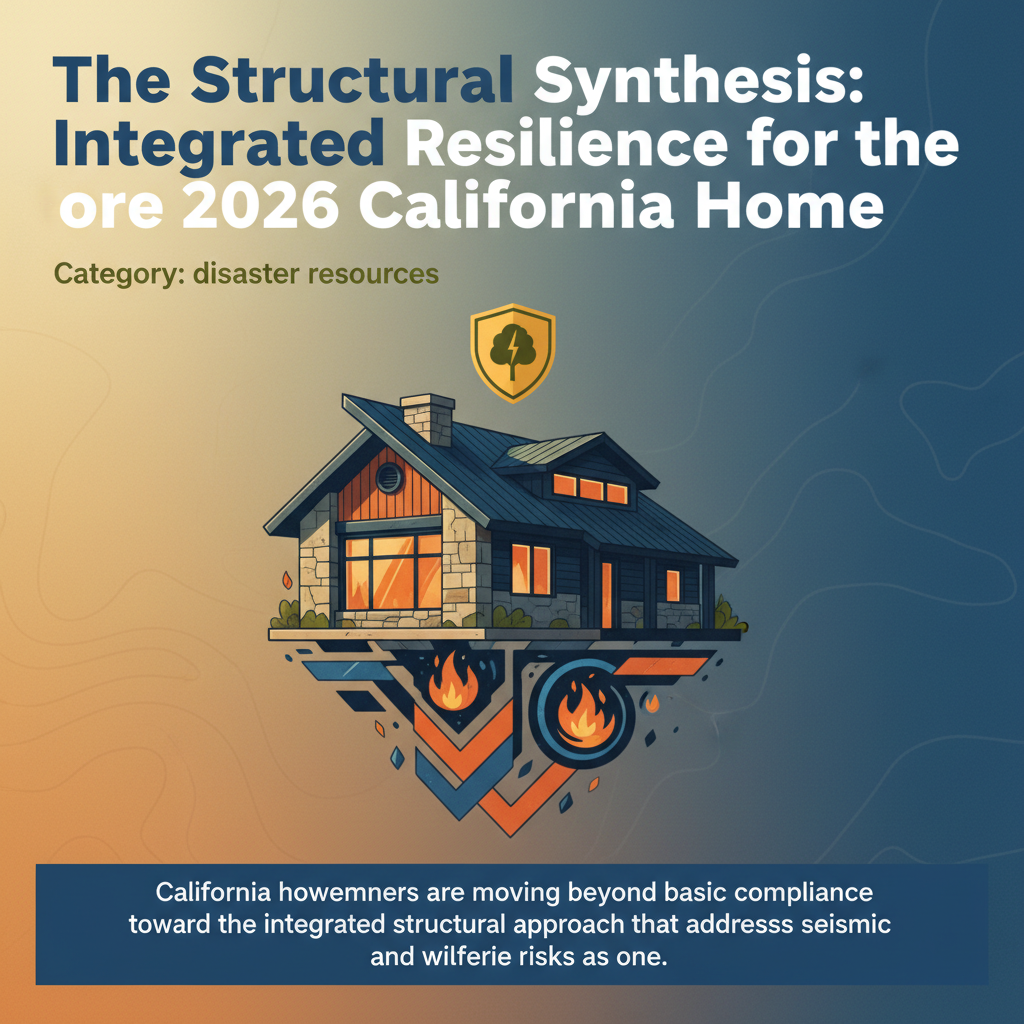
The 2026 Regulatory Landscape: Beyond Piecemeal Mitigation
As of mid-2026, California’s real estate market has reached a critical inflection point where disaster preparedness is no longer a seasonal checklist but a structural requirement for asset liquidity. Following the 2025 updates to Title 24 of the California Building Standards Code, the emphasis has shifted from singular hazard mitigation to an integrated structural synthesis. For the modern homeowner, this means aligning seismic retrofitting with wildfire-hardening protocols to create a unified 'defensive envelope' that protects both equity and occupancy.
The Convergence of Risk: Why Dual Hardening is Essential
Historically, California homeowners treated earthquake and wildfire preparations as disparate projects. However, data from the California Earthquake Authority (CEA) suggests that approximately 1.1 million pre-1980 homes remain structurally vulnerable to 'soft-story' or 'cripple wall' failure. Simultaneously, CAL FIRE reporting indicates that ember intrusion remains the primary cause of home loss in the Wildland-Urban Interface (WUI). In 2026, the market is penalizing homes that address one while ignoring the other.
An integrated approach is now a financial necessity. According to 2026 California Association of Realtors (CAR) market sentiment data, homes with certified dual-hazard retrofits (Seismic + Wildfire) are seeing a 7.5% valuation premium over homes with singular or no upgrades. This 'Resilience Synergy' reflects a buyer pool that is increasingly wary of the high cost of post-disaster reconstruction in a labor-constrained economy.
Practical Takeaways for the Integrated Envelope
- The Foundation-to-Roof Audit: Homeowners should move away from general inspections toward specialized 'Integrated Resilience Audits.' These audits assess the interplay between seismic anchors and vents. For example, ensuring that foundation bolting doesn't compromise the installation of ember-resistant sub-floor venting.
- Concurrent Upgrading: When retrofitting a 'cripple wall' for seismic safety, homeowners should simultaneously install non-combustible skirting and fire-rated sheathing. Doing these projects concurrently reduces labor costs by an estimated 20% compared to separate mobilizations.
- The 2026 Venting Standard: Replace all traditional 1/4-inch mesh vents with ASTM E2886-compliant vents. These are designed to block both embers and radiant heat while maintaining the airflow necessary to prevent moisture buildup—a common side effect of over-insulating for fire.
- Glazing as a Structural Link: Upgrading to multi-paned, tempered glass serves a dual purpose: it resists the thermal shock of a wildfire and is less likely to shatter during moderate seismic oscillations, maintaining the home's airtight seal during a disaster.
Navigating the 2026 Subsidy and Resource Environment
The financial barrier to these upgrades has been mitigated by expanded state-level programs. The Earthquake Brace + Bolt (EBB) program has recently expanded its 'supplemental grants' for low-income households, which can now be stacked with Wildfire Prepared Home tax credits. Furthermore, many California municipalities are now offering 'Resilience PACE' (Property Assessed Clean Energy) financing specifically for integrated structural hardening.
Investors and homeowners should also leverage the California Department of Insurance (CDI) 'Safer from Wildfires' framework. By 2026, insurance carriers are required to provide transparency on how specific structural hardening measures—such as Class A roofing combined with seismic bolting—impact premium stability. This transparency allows for a clearer calculation of the Internal Rate of Return (IRR) on resilience investments.
Strategic Resilience: The Competitive Edge
In the current market, disaster preparedness is the new 'curb appeal.' For sellers, providing a 'Resilience Dossier' that includes certificates of compliance for both seismic and wildfire standards is as crucial as a clean title. For buyers, identifying homes that have already undergone this structural synthesis is a hedge against the rising costs of insurance and future mandatory retrofits. As California’s climate and geological risks evolve, the most valuable assets will be those that have integrated safety into their very bones.