The ADU Portfolio: Institutional Scalability in California’s Backyard Revolution
As of mid-2026, the California real estate landscape has moved beyond the initial novelty of Accessory Dwelling Units (ADUs). What began as a legislative push to ease the housing crisis through homeowner-led construction has matured into a sophisticated investment vehicle. Institutional capital is no longer just buying single-family rentals (SFRs); it is aggressively seeking ‘ADU-maximized’ portfolios to capture a yield premium that traditional residential assets can no longer provide in a high-interest-rate environment.
The Yield Disparity: Why ADUs Are Winning
Data from the California Department of Housing and Community Development (HCD) shows that ADU permits accounted for nearly 22% of all residential permits issued in the state in 2025. In 2026, the market has seen a pivotal shift: the 'Triple-Play' strategy. By utilizing a combination of Senate Bill 9 and existing ADU laws, investors are converting single-family lots into three- or four-unit cash-flow engines (main house, detached ADU, and Junior ADU).
According to recent MLS data and internal cap rate analyses, a standard SFR in the Inland Empire or Sacramento might yield a 4.5% cap rate. However, once an ADU and JADU are integrated, the effective cap rate on the total cost of basis frequently jumps to 7.2% or higher. This spread represents the 'ADU Alpha' that is currently driving private equity interest in California’s coastal and suburban rings.
The Institutionalization of Modular Construction
One of the primary barriers to ADU scalability—construction timeline and site disruption—has been largely solved by the 2026 modular boom. Companies specializing in prefabricated steel-frame ADUs can now deliver and install a unit in under 30 days once permits are secured. For institutional investors, this means the 'lease-up' period is drastically shortened compared to traditional stick-built additions.
Large-scale operators are now partnering directly with modular manufacturers to secure volume pricing, effectively lowering the cost per square foot of new rental inventory by 15-20% compared to the 2023-2024 average. This vertical integration is allowing funds to bypass the traditional labor shortages that have plagued California’s construction sector for a decade.
Strategic Takeaways for Investors and Owners
In this high-utility, high-density era, the following actions are becoming standard for market participants:
- Focus on 'Entitlement Upside': When evaluating acquisitions, prioritize lots over 6,000 square feet with favorable setbacks. The value is no longer just in the existing structure, but in the 'shadow' density permitted by right.
- Utility Infrastructure Audit: Before purchasing for an ADU conversion, verify electrical panel capacity and sewer lateral condition. In 2026, the cost of grid upgrades can be the difference between a high-yield asset and a break-even project.
- The Portfolio Play: Smaller investors should look to aggregate 3-5 ADU-ready properties in a single municipality. Managing multiple builds simultaneously allows for better leverage with contractors and more efficient property management once units are occupied.
The 2026 Outlook: From Backyards to Asset Class
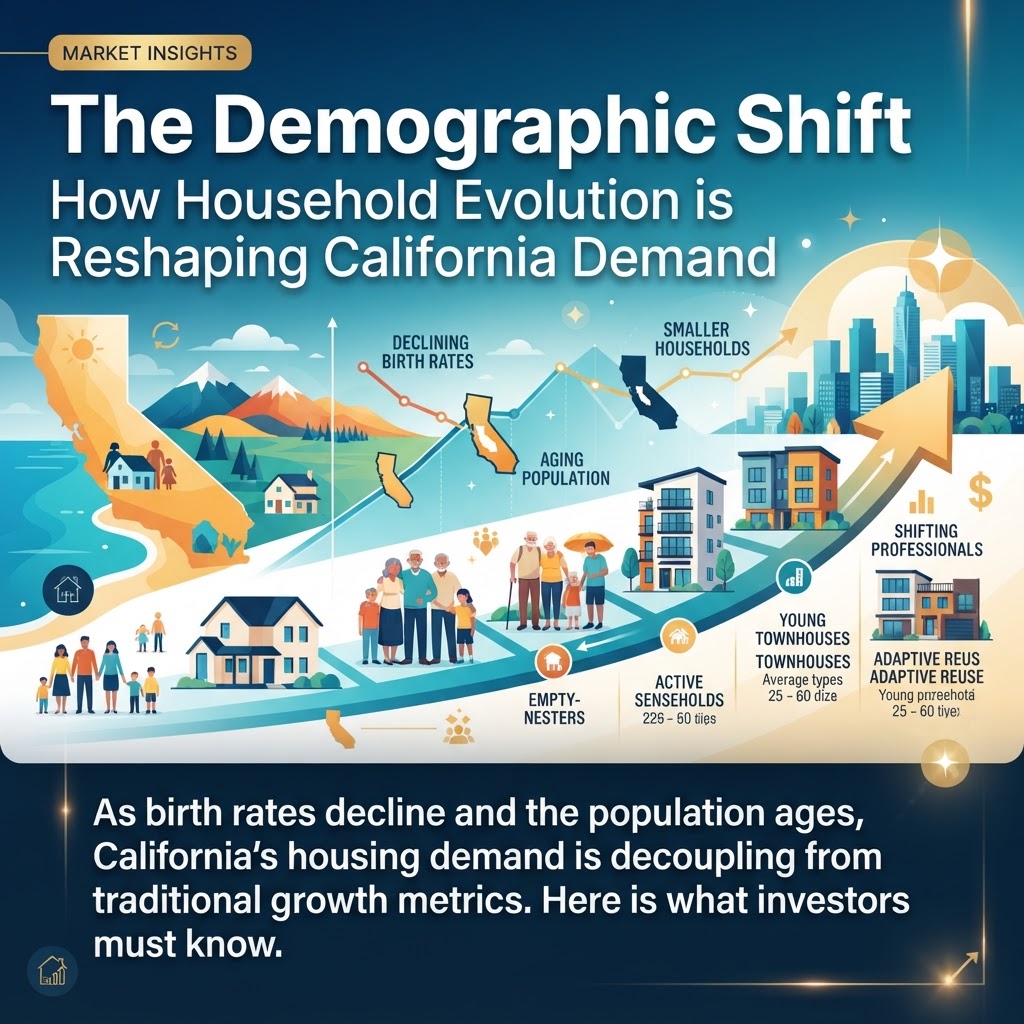
The maturation of the ADU market signifies a broader shift in California’s economic trend: the 'de-suburbanization' of the state. As the yield gap between luxury SFRs and multi-unit lots widens, the traditional single-family home is being redefined as a multi-generational or multi-tenant hub. For the savvy investor, the opportunity lies in recognizing that in 2026, the most valuable part of a California home is often the empty space behind it.