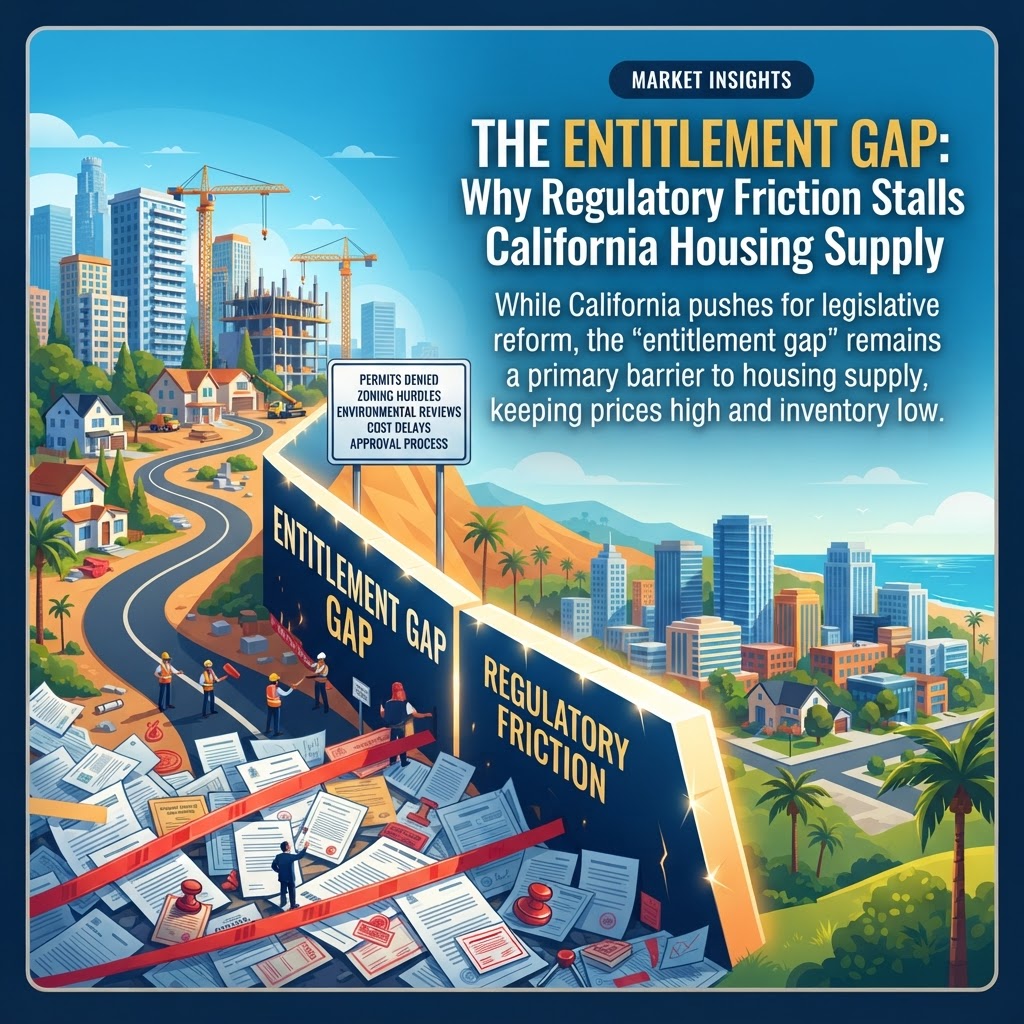
The Entitlement Gap: Why Regulatory Friction Stalls California Housing Supply
As of late 2026, California’s housing market remains defined by a persistent paradox: despite a flurry of state-level legislative efforts to streamline development, the actual delivery of new housing units continues to lag behind demand. While much of the market discourse focuses on interest rates and affordability, the true bottleneck lies in the 'entitlement gap'—the complex, costly, and time-consuming process of securing legal permission to build.
The Regulatory Friction Point
Recent legislative packages have aimed to reduce regulatory constraints and incentivize construction, yet the California Environmental Quality Act (CEQA) remains a significant hurdle. According to recent analysis, CEQA continues to provide avenues for project opponents to initiate lengthy legal challenges, effectively stalling projects even when they align with state-level density goals. This regulatory friction creates a 'hidden cost' that developers must factor into every project, often rendering middle-income housing projects financially unviable in a high-interest-rate environment.
The Cost of Capital and Construction
The intersection of high interest rates and the entitlement process has created a double-bind for the industry. High rates increase the cost of capital for developers, while the extended timeline required to navigate local zoning and environmental reviews compounds these costs. As noted by industry observers, when the time-to-entitlement stretches into years, the risk profile of a project rises, forcing developers to pivot toward luxury units to ensure a return on investment, which in turn fails to address the broader affordability crisis.
Practical Takeaways for Stakeholders
- For Investors: Focus on 'shovel-ready' projects or those in jurisdictions with proven, streamlined entitlement processes. The risk premium on projects currently stuck in the environmental review phase is at an all-time high.
- For Developers: Leverage new state laws that exempt specific multifamily projects from traditional CEQA reviews. Understanding the nuances of these exemptions is now a core competency for navigating the 2026 landscape.
- For Policy Observers: Monitor the effectiveness of the new task force on manufactured housing and federal efforts to lower interest rates for specific programs, as these may provide the only near-term relief for supply-side constraints.
Conclusion
California’s housing shortage is not merely a product of land scarcity, but of a complex regulatory ecosystem that prioritizes process over production. Until the entitlement process is fundamentally shortened, the state will likely continue to see a mismatch between the legislative intent to build and the physical reality of new housing starts. For the market to stabilize, the focus must shift from simply authorizing growth to actively removing the procedural barriers that prevent that growth from reaching the ground.