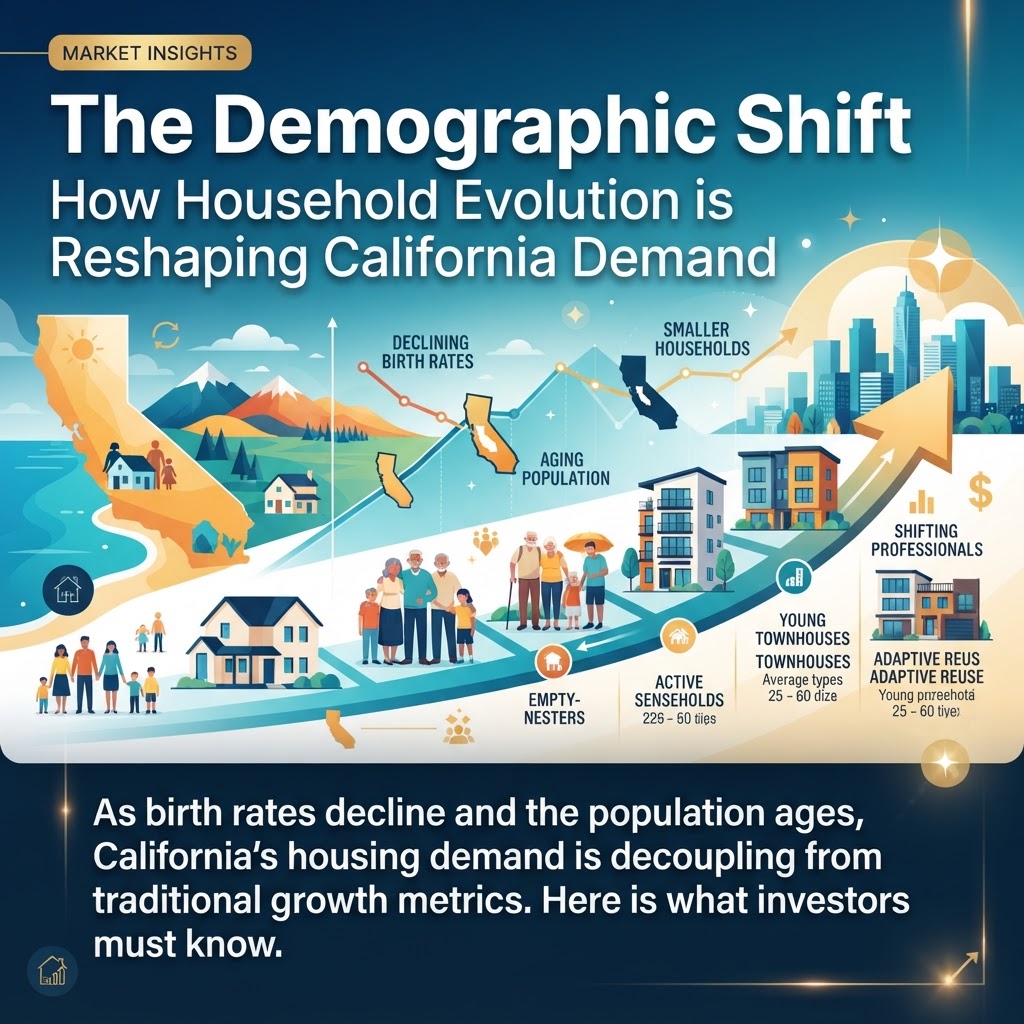
The Demographic Shift: How Household Evolution is Reshaping California Demand
For decades, California real estate analysis relied on a simple formula: population growth equals housing demand. However, as of late 2026, that correlation has fractured. While the state's total population growth has plateaued, the demand for housing units remains robust, driven by a fundamental shift in how Californians live.
The Rise of the Smaller Household
Data from the Public Policy Institute of California indicates that lower birth rates and an aging population are significantly reducing the average household size. When the same number of people are spread across more, smaller units, the demand for housing inventory increases even in the absence of net population growth. This phenomenon is creating a persistent floor for housing demand that defies traditional migration-based forecasts.
The Aging Transition
With the oldest Baby Boomers turning 80 in 2026, the state is entering a decade of significant housing turnover. Research from PwC suggests that as homeowners reach age 75 and beyond, there is a marked transition from homeownership to rental, multigenerational, or assisted living arrangements. This shift is expected to unlock inventory in established neighborhoods, though it may not necessarily align with the preferences of younger, first-time buyers seeking entry-level product.
Investment Perspectives: Beyond the Metro Core
Investors are increasingly looking toward secondary markets that offer relative affordability. While coastal metros remain the primary focus for institutional capital, areas like Sacramento, Riverside, and the Sierra foothills are seeing positive domestic migration as households seek relief from the extreme price points of the Bay Area and Southern California. This 'inward migration' to more affordable California regions is a critical trend for 2026.
Practical Takeaways for Market Participants
- For Buyers: Focus on 'missing middle' housing. As household sizes shrink, demand for smaller, efficient units—such as those created through ADU conversions and lot splits—is outpacing the supply of traditional single-family homes.
- For Sellers: Recognize that the 'turnover trap'—where existing homeowners are locked in by low mortgage rates—is keeping inventory tight. If you are looking to downsize, the current market environment may offer a premium for well-maintained, smaller-footprint homes that appeal to both retirees and younger, smaller households.
- For Investors: Prioritize markets with diverse economic bases that are attracting domestic inflows. The shift toward smaller households suggests that rental properties in suburban, transit-accessible areas will likely see more durable demand than luxury, large-format properties.
Ultimately, the California market is no longer just about how many people move in; it is about how the existing population is reorganizing itself. Understanding these demographic nuances is now more critical than tracking headline interest rate fluctuations alone.