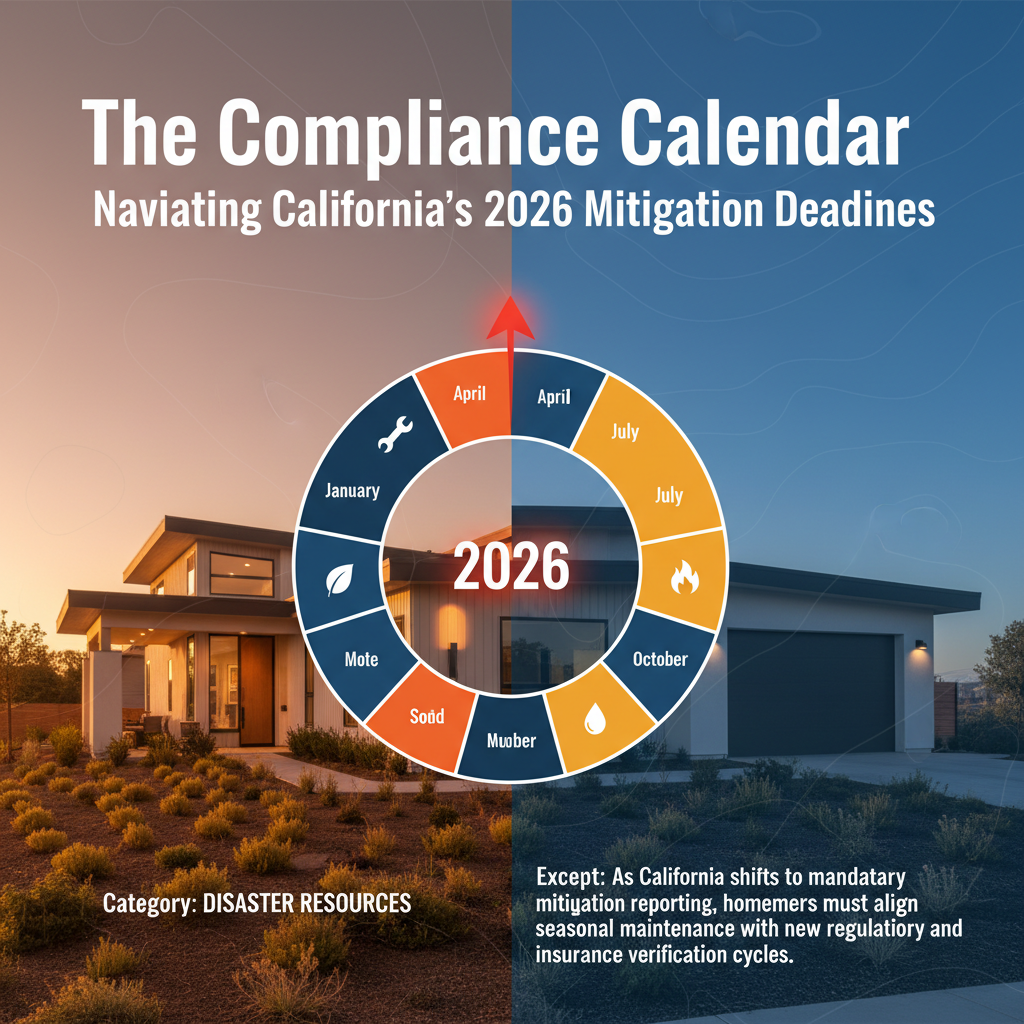
The Shift from Voluntary to Mandatory Mitigation
As of May 2026, California’s approach to disaster preparedness has transitioned from recommended best practices to a rigid framework of mandatory compliance. Following the legislative updates of 2025, homeowner eligibility for state-backed insurance programs and federal disaster assistance is now strictly tethered to a verifiable mitigation calendar. Data from the California Department of Insurance (CDI) indicates that properties failing to meet the April 30th defensible space verification deadline saw a 14% increase in premium surcharges in the second quarter of 2026 alone.
The May 1st Compliance Threshold
The centerpiece of the 2026 regulatory landscape is the May 1st 'Ready for Wildfire' threshold. This is no longer a mere awareness campaign; it is a hard deadline for digital self-certification. Under the current Risk-Managed Property Standards, homeowners in High and Very High Fire Hazard Severity Zones (VHFHSZ) must upload time-stamped, geolocated imagery of Zone 0 (the 0-5 foot ember-resistant zone) to the state’s centralized portal. According to the National Association of Realtors (NAR) 2026 Impact Report, homes with a 'Verified Compliant' status now command a 4.2% price premium over unverified counterparts, as buyers increasingly prioritize immediate insurability.
Data-Driven Verification and the Digital Audit
Preparation in 2026 is driven by the 'Digital Twin' of risk management. CAL FIRE’s latest reporting confirms that over 85% of defensible space inspections are now initiated via satellite or aerial LIDAR scans. If the automated system detects a breach in the 100-foot buffer—such as tree canopy encroachment or improper fuel breaks—homeowners receive an automated 'Notice of Non-Compliance.' Failure to remediate within 30 days can trigger a referral to the California FAIR Plan for immediate policy re-rating. This shift necessitates that homeowners treat disaster preparedness not as a weekend project, but as a documented administrative requirement.
The Multi-Peril Timeline: Beyond Wildfire
While fire remains the primary driver of California policy, the 2026 Preparedness Framework includes strict timelines for atmospheric river mitigation. Homeowners in low-lying or alluvial fan regions are now required to complete 'Hydrologic Clearance' by October 15th each year. This includes the professional inspection of private culverts and the verification of sump pump battery backups. Failure to document these steps can result in the denial of 'secondary water ingress' claims, a policy nuance that has left many uninsured following the record-breaking 2025 winter season.
Practical Takeaways for the 2026 Market
- Schedule Verification Early: To avoid the 'Certification Crunch' in April, homeowners should schedule professional brush clearing and structural assessments no later than February.
- Maintain a Digital Ledger: Store all receipts for vegetation management and structural upgrades (such as multi-pane glazing or non-combustible fencing) in the state-sanctioned compliance portal to ensure real-time underwriting updates.
- Audit the Zone 0 Perimeter: Ensure that the five-foot perimeter around the structure is entirely free of organic mulch or woody plants. In 2026, this 'Zero Zone' is the single most scrutinized factor in insurance renewals.
- Monitor the State Risk Index (SRI): Quarterly updates to the SRI can change a property’s hazard designation. Homeowners should check their status every 90 days to see if new mitigation requirements have been triggered by nearby land-use changes.


