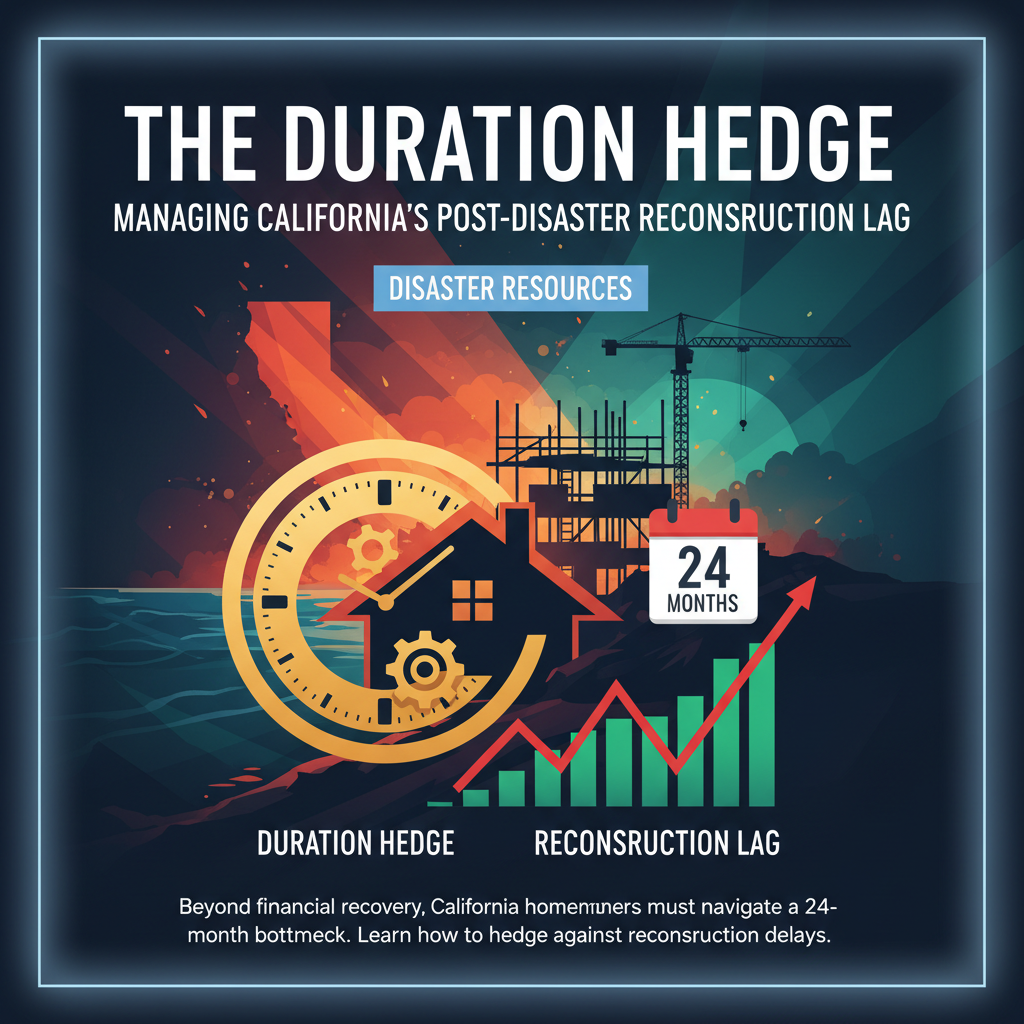
The New Disaster Metric: Time-to-Occupancy
In 2026, the conversation around California disaster preparedness has shifted from 'if' a property can be rebuilt to 'how long' that process will take. While previous strategies focused on securing liquidity and hardening structures, a new crisis has emerged: the reconstruction bottleneck. According to data from the Bureau of Labor Statistics (BLS) and the California Department of Industrial Relations, the state currently faces a deficit of over 80,000 skilled construction tradespeople. For homeowners, this means that even with a full insurance payout, the path to re-occupancy now averages 18 to 30 months following a major wildfire or seismic event.
The "Loss of Use" Deficit
Standard homeowners’ insurance policies typically provide Loss of Use (LOU) coverage, which pays for additional living expenses while a home is uninhabitable. Historically, a 12-to-24-month LOU provision was sufficient. However, the National Association of Realtors (NAR) reports that in high-risk zones (WUI - Wildland-Urban Interface), the compounding effects of material inflation and labor scarcity have extended rebuilding timelines past the 24-month mark. This creates a "duration gap" where homeowners are forced to pay out-of-pocket for temporary housing while still servicing a mortgage on a red-tagged lot.
The Pre-Disaster Vendor Registry
To mitigate this risk, savvy California homeowners are adopting a "first-in-line" strategy. This involves establishing pre-disaster relationships with licensed contractors who specialize in insurance recovery. Practical Takeaway: Investors and homeowners should maintain a pre-vetted list of at least three Class B General Building Contractors. In the immediate aftermath of a disaster, the window to secure a slot in a reputable contractor’s queue closes within 72 hours. Verification of a contractor's workers' compensation and liability insurance via the CSLB (Contractors State License Board) should be an annual audit task.
Strategic Housing Continuity
The 2026 market has seen a rise in the use of Accessory Dwelling Units (ADUs) as a resilience tool. Under current California legislation, including refinements to SB 9, rebuilding an ADU can often be fast-tracked through local jurisdictions compared to a primary residence. Practical Takeaway: Consider the "ADU-First" recovery model. By prioritizing the construction of a pre-fabricated or modular ADU on-site, homeowners can return to their property sooner, eliminating the cost of external rentals and providing a staging ground for the primary residence’s multi-year reconstruction.
Quantifying the Resilience Gap
Data from recent California Department of Insurance filings indicates that nearly 60% of homeowners in high-risk counties remain underinsured for the actual costs of 2026 labor rates. To protect equity, homeowners must move beyond basic replacement cost estimates and factor in a 'scarcity premium.'
- Audit Coverage: Ensure your policy includes 'Extended Replacement Cost' of at least 50% above the dwelling limit.
- Review LOU Limits: Negotiate for a 36-month Loss of Use provision to account for the current labor environment.
- Inventory Pre-Fabrication Options: Identify regional modular home providers that can bypass local labor shortages through factory-built components.
Resilience in 2026 is no longer just about surviving the event; it is about surviving the recovery. By addressing the reconstruction lag before a disaster strikes, California homeowners can protect both their financial solvency and their long-term housing security.


