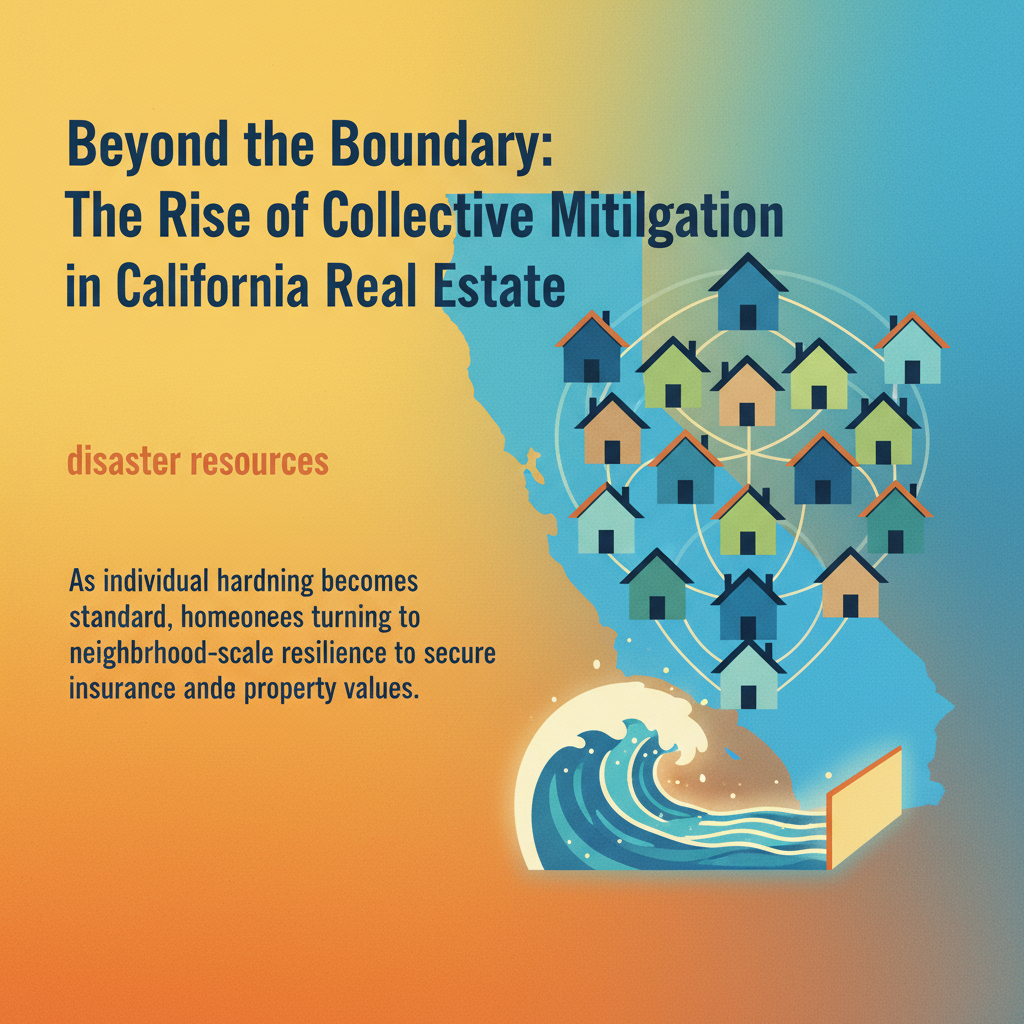
The Shift from Individual Hardening to Community Resilience
By May 2026, the 'hardened home' has transitioned from a competitive advantage to a baseline requirement for California real estate. However, as the 2026 fire season approaches, a new frontier in disaster preparedness has emerged: Collective Mitigation. For homeowners and investors, the focus has shifted beyond the property line to the surrounding 100-acre radius. In the current market, a fortified home situated within an unmitigated neighborhood is increasingly viewed by insurers as a high-risk asset, regardless of its individual upgrades.
The Insurability Link: Why Collective Action Matters
Data from the California Department of Insurance (CDI) and recent 2025 industry reports indicate a widening gap between 'Firewise USA' recognized sites and unorganized high-risk tracts. Under the 'Safer from Wildfires' framework, while individual retrofits earn mandatory discounts, it is the community-level certification that often determines whether a property qualifies for the voluntary insurance market or is relegated to the FAIR Plan.
According to 2025 NAR data, properties in neighborhoods with active Community Wildfire Protection Plans (CWPPs) see a 4.2% higher retention in value during market corrections compared to isolated hardened homes. Insurers are now utilizing satellite-derived 'neighborhood fuel load' metrics to price risk. This means your neighbor’s overgrown brush or a neglected municipal easement can directly impact your premium and your property's liquidity.
The Financial Impact of Neighborhood-Scale Mitigation
In 2026, the resilience of a community is a primary factor in mortgage eligibility for secondary market buyers. Large-scale institutional investors and REITs are increasingly performing 'vicinity audits' before acquisitions. The logic is simple: in a wind-driven ember event, a single vulnerable structure acts as a heat source that can overwhelm even the most robust home defenses nearby.
Key Benefits of Community-Level Preparedness:
- Insurance Eligibility: Access to the voluntary market often hinges on the community’s collective Firewise status.
- Grant Resource Access: Federal and state mitigation grants (such as BRIC and HMGP funds) are prioritized for communities with established CWPPs.
- Marketability: Disclosure of a 'Resilient Community' certification has become a top-tier selling point in the Sierra Foothills and Coastal Ranges.
Practical Takeaways for California Homeowners
To protect equity and ensure long-term insurability, homeowners must move beyond their own parcels. The following actions are critical for the 2026 landscape:
1. Formalize a Firewise USA Site
Work with neighbors to achieve Firewise USA recognition. This requires a community risk assessment and a minimum investment in wildfire education and brush clearance. In 2026, many carriers require this certification to even quote a new policy in Tier 2 or Tier 3 fire threat areas.
2. Audit Collective Fuel Loads
Identify 'dead zones'—abandoned lots, overgrown canyons, or poorly maintained public easements. Use the local Fire Safe Council to advocate for targeted grazing or controlled burns. Real estate data shows that proximity to maintained fuel breaks adds a measurable 'safety premium' to home valuations.
3. Leverage HOA Reserves for Mitigation
For those in managed communities, 2026 is the year to pivot reserve fund spending toward common-area hardening. Prioritizing non-combustible landscaping and ember-resistant vents for shared clubhouses and perimeter fences is no longer an aesthetic choice; it is a fiduciary duty to protect the membership’s collective equity.
4. Document the 'Neighborhood Buffer'
When listing a property, include a 'Resilience Dossier' that highlights not just the home’s features, but the neighborhood’s collective efforts. Providing a map of nearby fuel breaks and a history of community workdays can significantly reduce buyer friction regarding insurance concerns.
The Bottom Line
In the California market of 2026, disaster preparedness is a team sport. Individual resilience provides the shield, but community mitigation provides the sanctuary. Homeowners who lead neighborhood-wide initiatives are not just protecting their families; they are actively defending their most significant financial investment against the evolving landscape of climate-driven risk.


