The Evolution of the Insurance Lag in 2026
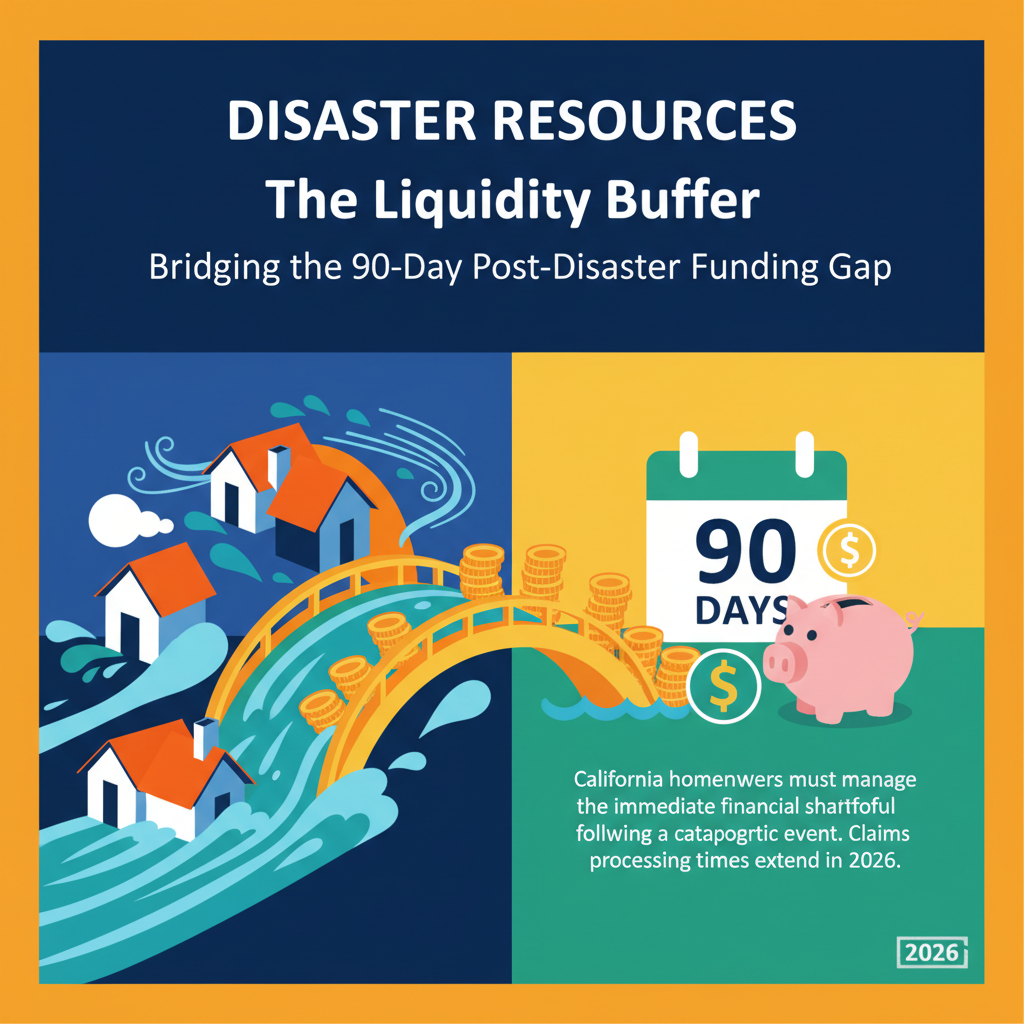
In the California real estate landscape of April 2026, disaster preparedness has moved beyond structural hardening and policy limit audits. While those measures protect equity and long-term recovery, a new vulnerability has emerged: the liquidity gap. Data from the California Department of Insurance (CDI) indicates that while the industry has stabilized since the volatility of 2024, the median time to receive a significant progress payment for catastrophic wildfire or atmospheric river damage has stretched to 72 days. For many homeowners, this two-to-three-month window represents a period of extreme financial fragility.
Quantifying the Immediate Financial Burden
The immediate aftermath of a disaster requires rapid capital deployment that insurance policies—designed for reimbursement rather than upfront funding—often fail to provide. According to 2025 MLS data and construction cost indices, the average out-of-pocket expenditure for a displaced California household in the first 30 days includes:
- Temporary Housing Deposits: With short-term rental demand spiking 400% in disaster zones, security deposits and first-month rents for comparable housing now average $12,000 in coastal and high-risk WUI (Wildland-Urban Interface) zones.
- Emergency Debris Mitigation: To prevent secondary mold or structural collapse, professional mitigation often requires upfront payments of $5,000 to $15,000 before an adjuster even visits the site.
- Insurance Deductibles: With many California policies now carrying a 2% to 5% hazard deductible to manage premium costs, a median-priced $850,000 home may require a $17,000 to $42,500 contribution from the owner before coverage begins.
The Liquidity Buffer Strategy
To navigate this period, savvy homeowners are moving away from traditional savings accounts and toward more sophisticated liquidity tools. Financial planners now recommend a "Disaster Liquidity Buffer" equal to 10% of the home's replacement value, held in highly liquid, capital-preservation vehicles.
1. The Dormant HELOC
A Home Equity Line of Credit (HELOC) established prior to a disaster serves as a primary liquidity source. However, 2026 lending standards often trigger a freeze on credit lines once a disaster declaration is made. Homeowners are advised to draw down a portion of the credit line if a threat (such as an active wildfire) is within a 20-mile radius, ensuring cash is on hand before the bank restricts access.
2. Parametric Insurance Integration
Unlike traditional indemnity insurance, parametric insurance pays out a fixed sum based on the occurrence of a specific event (e.g., a 6.0 earthquake or a wildfire crossing a specific geofence) regardless of actual damage. Data from CBRE's 2026 Risk Report shows a 22% uptick in parametric adoption among California homeowners, specifically to cover the 90-day lag in traditional claims processing.
Actionable Takeaways for Homeowners and Investors
- Audit the Loss of Use Clause: Ensure your policy includes "Additional Living Expenses" (ALE) with a "Direct Pay" option to vendors, which bypasses the homeowner and reduces the personal liquidity requirement.
- Establish a 'Go-Capital' Fund: Maintain a minimum of $25,000 in a dedicated high-yield money market account, separate from general emergency funds, specifically earmarked for immediate disaster-related displacement costs.
- Pre-Contract with Mitigation Firms: In a 2026 market characterized by labor shortages, some mitigation firms offer "priority response" retainers for a small annual fee, guaranteeing service and price-capping emergency work.
Resilience in 2026 is no longer just about surviving the event; it is about surviving the financial recovery. By bridging the 90-day liquidity gap, California homeowners can ensure that a physical disaster does not become a permanent financial insolvency event.


