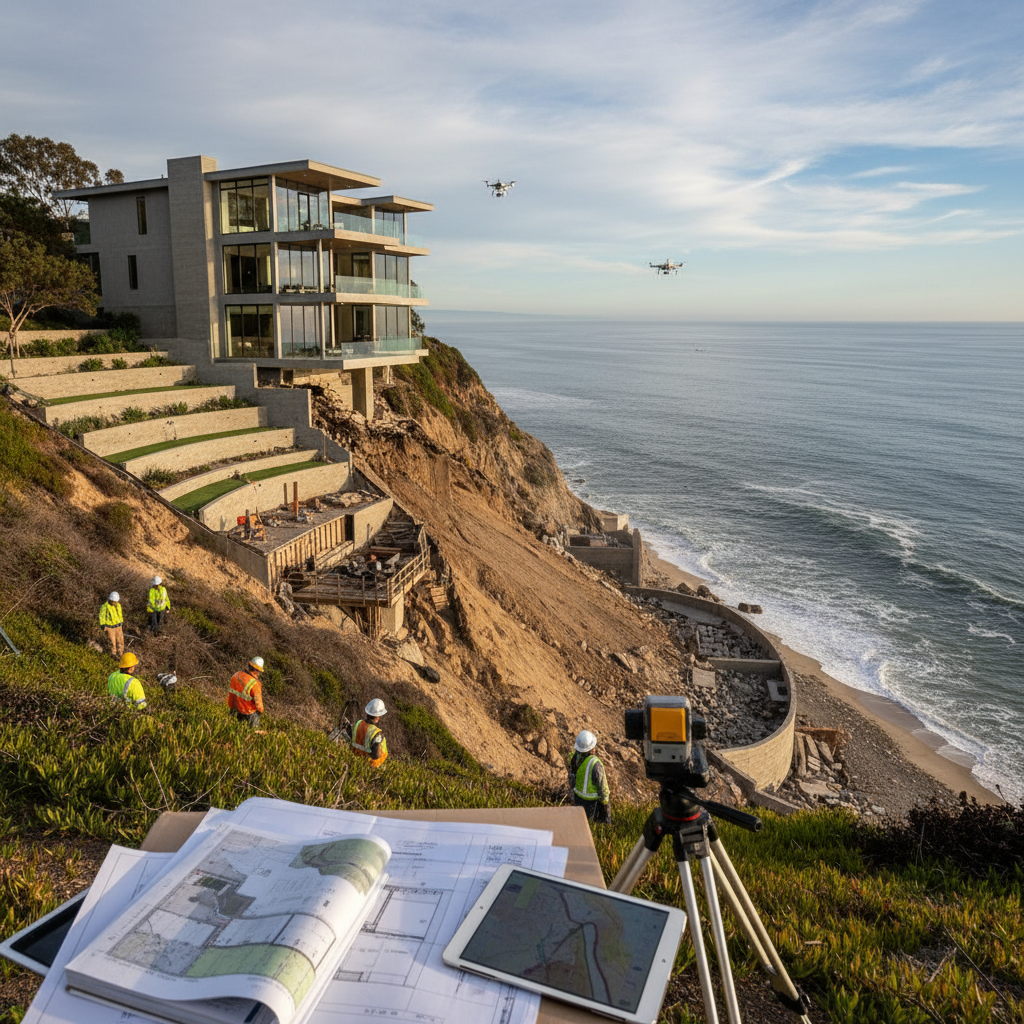
Beyond the Burn: The Rising Geomorphological Risk
As we move into the second quarter of 2026, California homeowners have become adept at wildfire mitigation. However, a different, more insidious threat is emerging in the wake of recent atmospheric river cycles: soil instability and post-fire debris flows. While 'hardening' a home against embers is now standard practice, the ground beneath the structure is increasingly becoming the primary point of failure for properties in hillside and coastal regions.
According to the California Geological Survey (CGS), nearly 10% of the state’s residential land is classified as having high landslide susceptibility. This risk is exacerbated by the 'California Seesaw'—the rapid transition from extreme drought to record-breaking precipitation. For homeowners and investors, understanding the geomorphology of a parcel is no longer an optional due diligence step; it is a fundamental requirement for equity preservation.
The Fire-Flood Cycle and Debris Flow Mechanics
The relationship between wildfire and land stability is a critical factor in the 2026 real estate market. When a wildfire strips vegetation and creates hydrophobic (water-repellent) soil, the risk of debris flows—fast-moving landslides that can carry boulders and trees—increases exponentially for up to five years post-fire. Data from the USGS Landslide Hazards Program indicates that even modest rainfall (as little as 0.5 inches per hour) can trigger devastating flows in burned watersheds.
Homeowners in 'WUI' (Wildland-Urban Interface) zones must look beyond their own property lines. If the slope 500 yards above your home burned last season, your property is in a high-risk debris path, regardless of your personal defensible space efforts. Potential buyers should utilize the USGS Post-Fire Debris Flow Hazard Assessments to evaluate terrain-specific risks before closing.
The Insurance Gap: Earth Movement Exclusions
One of the most significant financial risks for California homeowners is the 'Earth Movement' exclusion found in standard HO-3 and HO-5 insurance policies. Most homeowners mistakenly believe that if a wildfire causes a landslide, the damage will be covered. However, unless the fire was the 'proximate cause'—a legal standard that is often difficult and expensive to prove—insurers frequently deny claims related to soil subsidence or mudslides.
To mitigate this, sophisticated owners are increasingly seeking Difference in Conditions (DIC) insurance or specific earthquake policies that include earth movement endorsements. While these premiums have risen by an average of 14% year-over-year in 2026, they represent the only viable backstop against total loss in landslide-prone corridors like the Santa Cruz Mountains, Malibu, and the Sierra Foothills.
Practical Takeaways for Property Resilience
For those currently owning or looking to purchase in California’s varied terrain, the following actions are critical for 2026 preparedness:
- Hydro-Technical Audits: Hire a licensed geomorphologist or civil engineer to conduct a drainage audit. In California, 'water is the enemy of the slope.' Ensuring that runoff is piped to the street or a stable drainage basin—rather than allowed to saturate a hillside—is the single most effective way to prevent localized failure.
- Retaining Wall Integrity: Many residential retaining walls are aged or under-engineered for current saturation levels. Inspect walls for 'weep hole' clogs or tilting, which are early indicators of hydrostatic pressure buildup.
- Real-Time Monitoring: Utilize the California Department of Conservation’s 'Recent Landslides' interactive map and the NOAA National Weather Service's flash flood watches as leading indicators for evacuation.
- Vegetation Management: While clearing brush is essential for fire, maintaining deep-rooted, native groundcover is essential for soil stability. Consult a specialist to balance fire-safe landscaping with erosion control.
The Resilience Value Proposition
In the 2026 market, properties with documented geological stability and professional drainage systems are commanding a 'stability premium.' As climate volatility continues to redefine the California landscape, the most prepared homeowners are those who recognize that disaster readiness starts from the ground up. Protecting your home requires looking past the facade and the roofline to the very earth that supports the foundation.


