The Shift from Vacancy to Velocity in California’s Tech Corridors
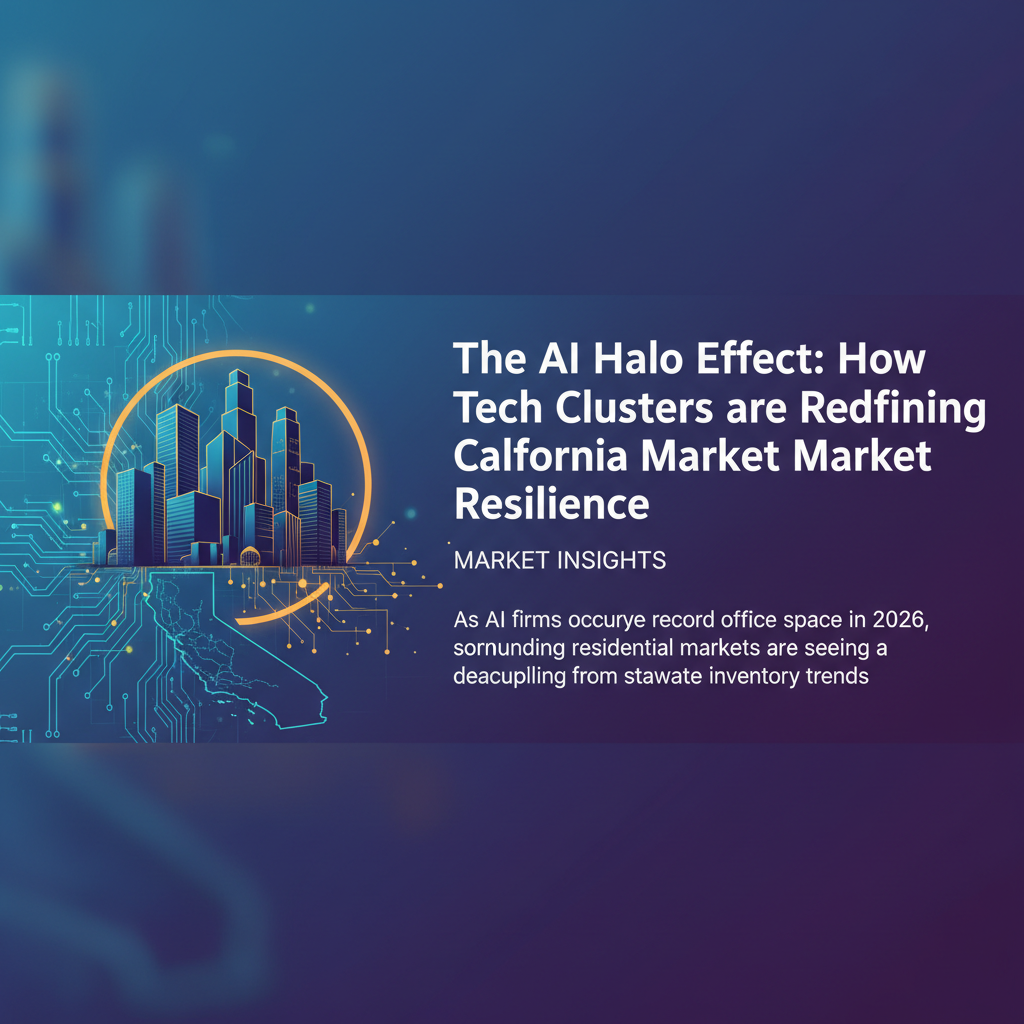
By April 2026, the narrative of California’s real estate market has pivoted from a general recovery to a hyper-localized boom driven by the generative AI sector. While the 'Great Rate Thaw' of 2025 normalized inventory across the state, 2026 is witnessing a specific phenomenon: the AI Halo Effect. This trend is characterized by a significant decoupling of property values in tech-dense clusters—specifically the 'AI Row' in San Francisco’s SoMa and the Silicon Beach corridor in Los Angeles—from the broader statewide averages.
Commercial Absorption as a Residential Leading Indicator
According to Q1 2026 data from CBRE, office absorption in San Francisco has reached its highest levels since 2019, with AI-related firms accounting for nearly 42% of all new leases by square footage. This commercial resurgence is acting as a primary driver for the residential market. In ZIP codes within a 5-mile radius of these emerging tech hubs, the National Association of Realtors (NAR) reports a 12% year-over-year price appreciation, nearly double the 6.4% statewide average recorded in March 2026.
For investors, this signals a shift back to the 'proximity premium.' The remote-work-induced sprawl of 2021-2023 has reversed in these specific sectors, as the collaborative nature of rapid AI development necessitates physical presence. This has led to a 15% decrease in residential days-on-market (DOM) in Palo Alto, Mountain View, and Santa Monica compared to April 2025.
Economic Trends: The Infrastructure-Led Premium
Beyond the tech workforce, a new value driver has emerged in 2026: proximity to compute-dense infrastructure. As California invests heavily in localized data centers and high-capacity electrical grids to support the AI boom, nearby residential and light-industrial real estate is seeing a valuation lift. Data from the California Department of Finance suggests that regions with 'Priority Power Status'—zones where the grid has been hardened for tech usage—are seeing a 5% 'stability premium' in property appraisals due to superior utility reliability.
Practical Takeaways for the 2026 Market
- For Investors: Focus on 'second-tier' tech hubs. While Palo Alto and San Francisco have seen the initial surge, areas like Culver City and parts of San Jose are showing signs of the next absorption wave. Look for properties with upgraded electrical service and fiber-optic readiness.
- For Sellers: In high-growth tech clusters, emphasize proximity to major AI employers. With the return of the 'commute-centric' buyer, highlighting walkable access to corporate shuttles or high-speed transit is yielding higher closing prices.
- For Buyers: Monitor the 'Commercial Pipeline.' Residential price spikes are lagging 4-6 months behind major commercial lease announcements. Tracking large-scale office move-ins via local business journals can provide a window for entry before the residential market fully adjusts.
Conclusion: A Bifurcated Recovery
The California market in 2026 is no longer a monolithic entity. We are seeing a distinct bifurcation between regions relying on traditional economic drivers and those anchored by the AI revolution. For the strategic real estate participant, the opportunity lies in identifying the boundaries of these 'Halos' before the premium becomes fully priced into the inventory.