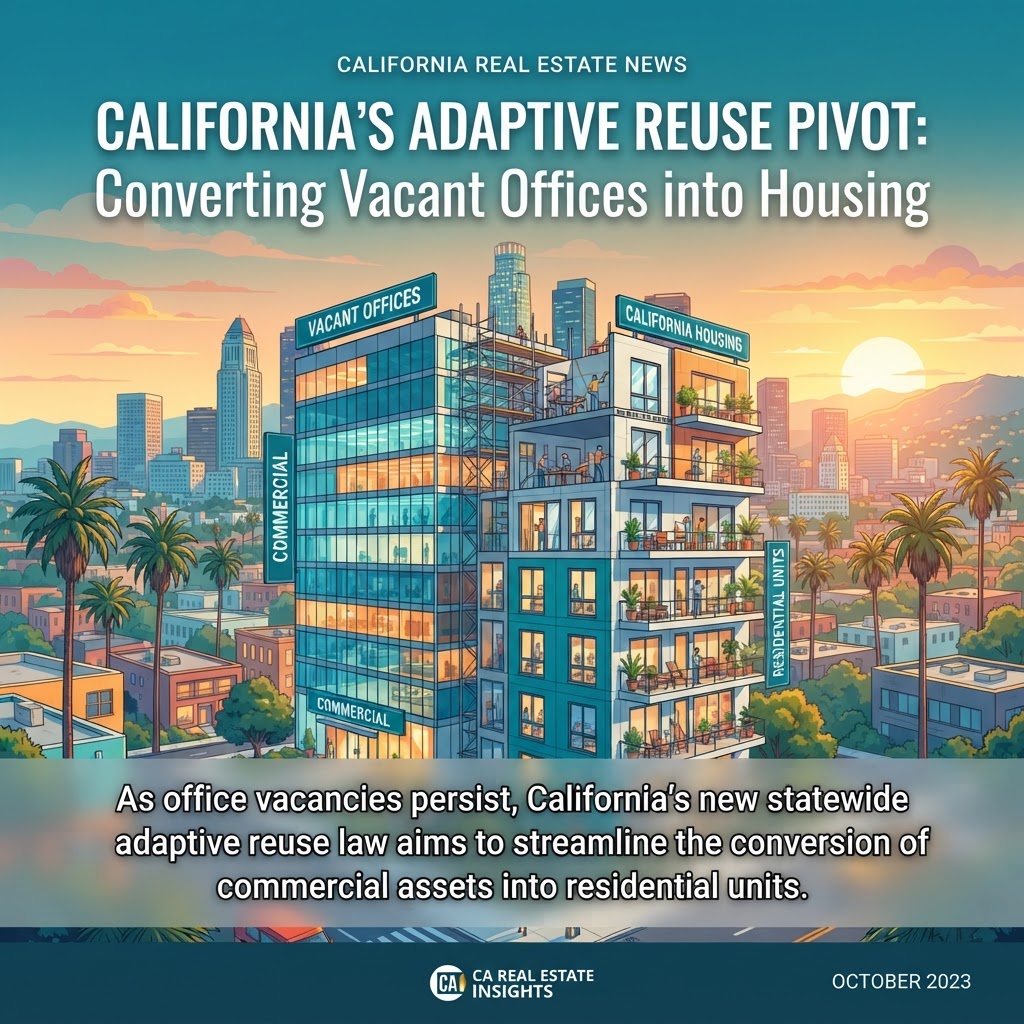
California’s Adaptive Reuse Pivot: Converting Vacant Offices into Housing
California’s real estate landscape is undergoing a structural transformation as the state pivots toward adaptive reuse to address two persistent challenges: a surplus of underutilized commercial office space and a critical shortage of housing. With the statewide Office to Housing Conversion Act becoming operative on July 1, 2026, developers and investors are finding a more defined, albeit complex, path to repurposing aging urban assets.
The New Regulatory Framework
The statewide law provides a streamlined, ministerial approval process for qualifying commercial-to-residential conversions [1]. This legislation complements existing local programs, such as Los Angeles’ long-standing adaptive reuse ordinance and San Francisco’s targeted downtown revitalization incentives [1, 5]. By reducing the bureaucratic friction that historically stalled such projects, the state aims to accelerate the delivery of housing units in high-demand urban cores [1, 6].
However, the law is not a universal solution. It excludes industrial zones that prohibit residential use and does not preempt local ordinances that offer alternative procedures [1]. Projects must still adhere to Title 24 building codes, though historic structures may leverage the California Historical Building Code to navigate renovation requirements [1].
Market Realities and Financial Hurdles
While the policy environment is improving, the financial feasibility of these conversions remains a significant hurdle. Data from the West Los Angeles industrial and flex market shows that while vacancy rates hover around 8.5%, investors are demanding lower prices per square foot to account for high financing costs and regulatory uncertainty [2].
Successful conversions, such as the Bank of Italy tower in San Jose, demonstrate that securing large-scale financing—in this case, $74.1 million—is possible when projects align with local housing incentive programs [9]. Yet, experts warn that there is no "one-size-fits-all" approach; the success of a conversion depends heavily on a city’s specific fiscal structure and the architectural viability of the existing building [6].
Practical Takeaways for Stakeholders
- For Investors: Focus on assets in transit-oriented districts where state-level ministerial approval (SB 79) can significantly reduce entitlement timelines [4, 8].
- For Developers: Leverage the new "express lane" provisions for projects under 150 units, which can limit review processes to as little as 60 days under specific state guidelines [10].
- For Buyers and Sellers: Be aware that the "insurance-escrow gap" and rising FAIR Plan rates (which saw a 29.1% average increase in October 2026) continue to impact the total cost of ownership, even as inventory levels show signs of stabilizing [8].
As the market moves into late 2026, the focus is shifting from simple price adjustments to the long-term viability of urban real estate. Adaptive reuse represents a strategic, if capital-intensive, effort to reestablish value in downtown corridors that have struggled to return to pre-pandemic occupancy levels [6, 9].