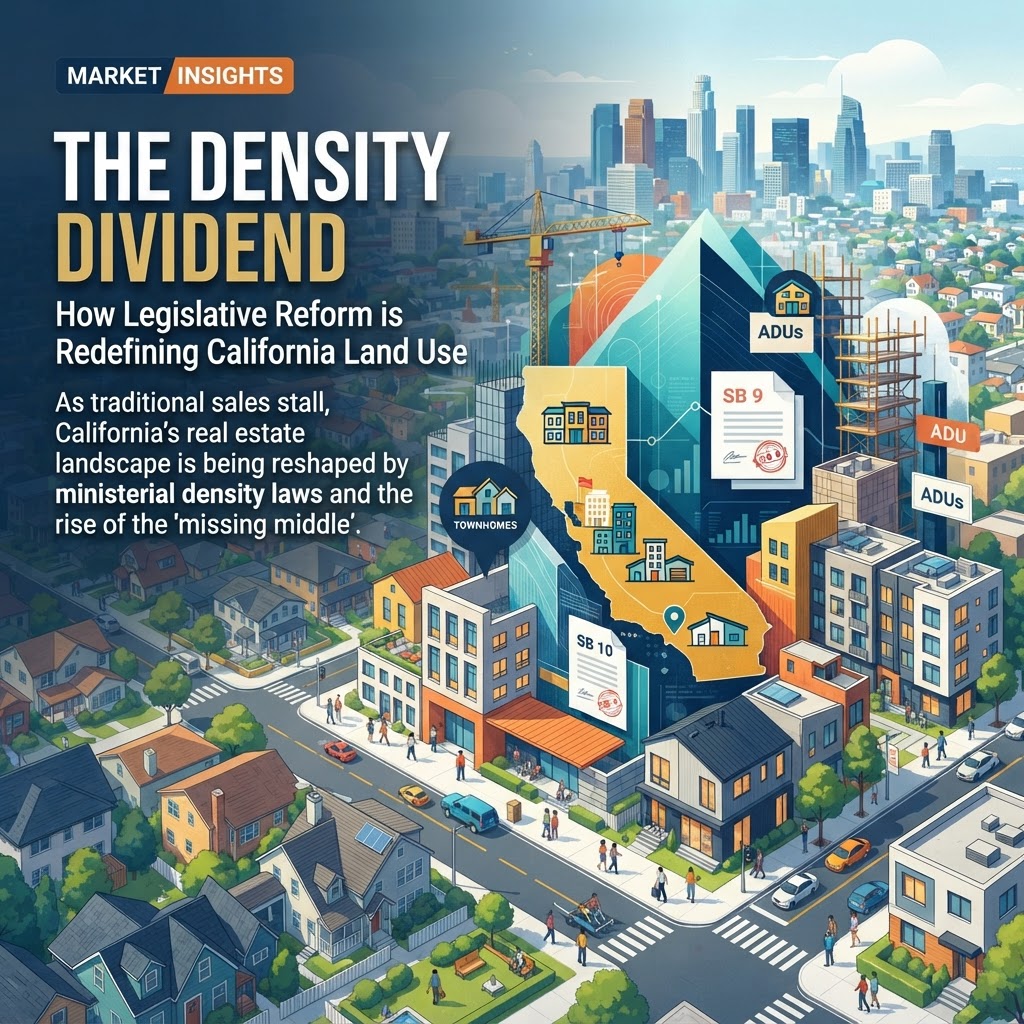
The Density Dividend: How Legislative Reform is Redefining California Land Use
For years, the California real estate narrative has been dominated by a simple, binary struggle: high prices versus low inventory. However, as of late 2026, the market is undergoing a structural transformation that transcends simple supply-and-demand metrics. While existing home sales remain suppressed by elevated mortgage rates—with statewide sales falling for 48 consecutive months below the 300,000-unit benchmark—a quiet revolution in land-use policy is fundamentally altering the state's development pipeline.
The Shift Toward Ministerial Development
The most significant trend in California real estate is the transition from discretionary, project-by-project approvals to ministerial, by-right development. Legislative efforts, most notably the Starter Home Revitalization Act (SHRA) and its recent expansion via SB 1116, are stripping away the local zoning hurdles that historically stifled housing production. By mandating 60-day ministerial timelines and exempting qualifying projects from CEQA, the state is effectively creating a new asset class: the "missing middle" starter home.
For investors and developers, this represents a pivot away from high-risk, long-cycle urban infill projects toward streamlined, smaller-scale subdivisions. The new statutory framework allows for more predictable underwriting, as the risk of local political interference is significantly mitigated by state-level mandates.
ADUs and the Decentralization of Density
Beyond large-scale subdivisions, the proliferation of Accessory Dwelling Units (ADUs) continues to reshape residential density. What was once an informal "granny flat" market has matured into a sophisticated construction sector. According to recent industry analysis, the policy environment—capped impact fees and shortened permit reviews—has turned the single-family lot into a multi-unit income generator. This shift is critical for homeowners and small-scale investors, as it provides a mechanism to increase property yield without the need for large-scale land acquisition.
Investment Perspectives in a High-Rate Environment
With mortgage rates hovering above 7%, the traditional "buy-and-hold" strategy for single-family homes faces significant headwinds. Investors are increasingly looking toward cash-heavy strategies or properties that offer inherent density potential. As noted in recent market reports, the current "frozen" state of the resale market is not merely a result of buyer caution, but a reflection of a fundamental disconnect between current pricing and the cost of debt.
Practical Takeaways for Market Participants:
- For Developers: Focus on sites that qualify under the expanded SHRA/SB 1116 guidelines. The ability to bypass discretionary review is now the most valuable "amenity" a parcel can offer.
- For Investors: Evaluate properties not just on current rental income, but on their "density potential." A standard single-family lot with the legal capacity for an ADU or a lot split now commands a premium that traditional valuation models may overlook.
- For Buyers: With sales volume down and inventory rising slightly, the market has shifted from a seller’s frenzy to a more deliberate environment. The lack of competition allows for more rigorous due diligence and negotiation, particularly in regions where inventory is beginning to accumulate.
As California enters 2027, the market is moving toward a more regulated, yet more predictable, development environment. While the macro-economic pressures of interest rates and global instability remain, the legislative "density dividend" is providing a new path forward for those willing to navigate the state's evolving land-use landscape.