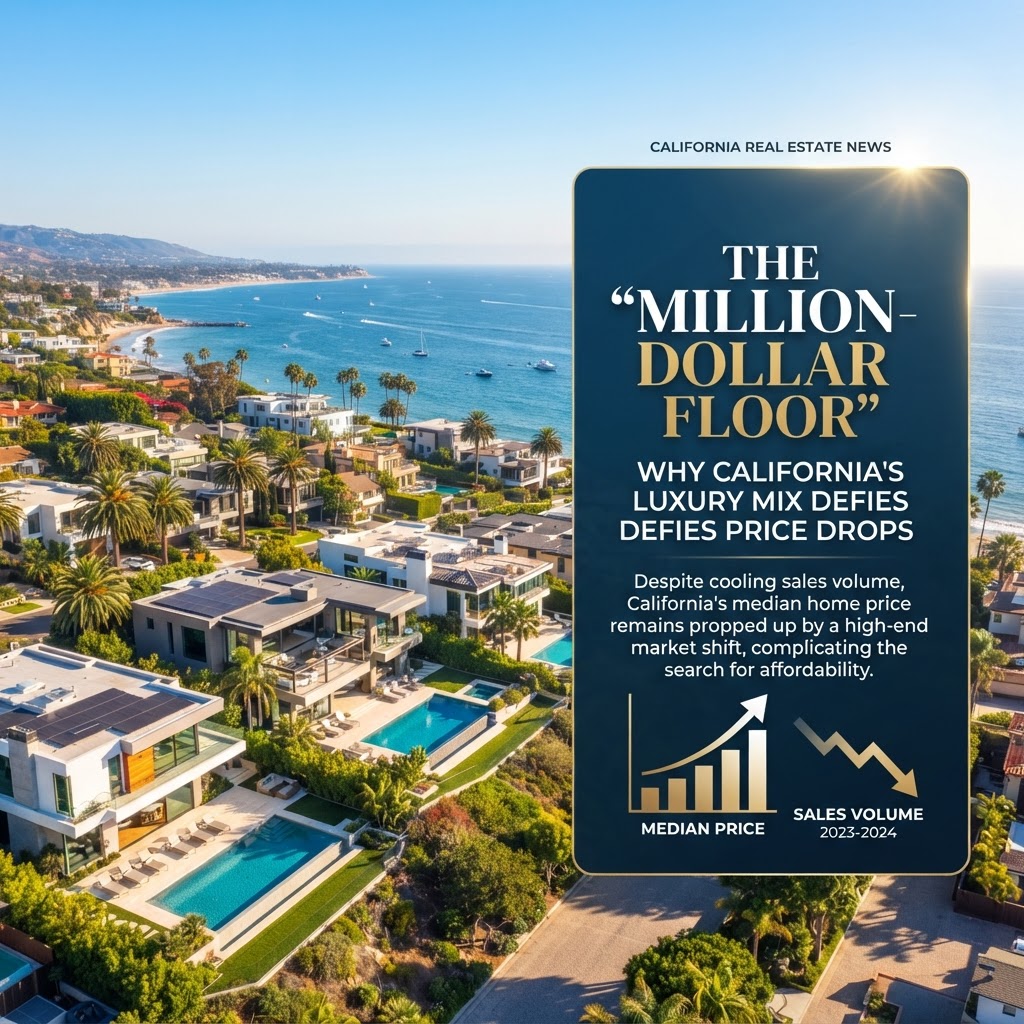
The 'Million-Dollar Floor': Why California's Luxury Mix Defies Price Drops
As California enters the final stretch of 2026, the state's housing market is presenting a counterintuitive narrative. While transaction volumes have dipped—with statewide sales falling 6.5% in recent reporting—the expected broad-based price relief has failed to materialize. The reason lies in a structural shift in the market: the increasing dominance of high-end transactions.
The Luxury Skew
Data from the California Association of Realtors (C.A.R.) indicates that homes priced at $1 million or higher now account for nearly 36% of all sales. This 'million-dollar floor' acts as a stabilizer for the statewide median price, masking the softening that may be occurring in entry-level and mid-tier segments. For prospective buyers, this means that while the headline median price may show minor fluctuations, the actual cost of entry for a standard family home remains stubbornly high.
Market Dynamics and Regulatory Oversight
The current environment is further complicated by a tightening regulatory landscape. The California Department of Real Estate (DRE) has ramped up enforcement, conducting 39 separate actions in September alone to combat trust fund improprieties and licensing violations. For investors and buyers, this underscores the necessity of rigorous due diligence. Working with licensed, compliant professionals is no longer just a best practice—it is a critical safeguard against the financial risks inherent in a high-stakes, low-inventory market.
Practical Takeaways for Market Participants
- For Buyers: Do not rely solely on statewide median price reports. Because the market is heavily skewed by luxury sales, local neighborhood data is essential. Focus on 'days on market' and 'sale-to-list-price' ratios in your specific zip code to gauge actual seller motivation.
- For Sellers: The market is not uniform. While high-end properties are maintaining value, properties in the mid-tier are seeing longer listing times. Pricing your home based on recent, comparable sales within the last 60 days is more important than ever as interest rates hover near 6.8%.
- For Investors: With the state continuing to push for density, look toward properties with ADU potential. As traditional inventory remains tight, the ability to add value through permitted accessory units remains one of the few reliable ways to improve yield in the current interest rate environment.
As we look toward 2027, the interplay between persistent high-end demand and the state's ongoing affordability crisis suggests that the 'fragile equilibrium' will continue. Buyers and sellers should prepare for a winter season that, while traditionally slower, will likely remain competitive for well-priced, turnkey inventory.