Buying real estate in California is governed by transaction customs and statutory frameworks distinct from nearly every other state in the country. From bilateral escrow customs to local tax mechanisms under Proposition 13, navigating a California home purchase requires operational preparation well ahead of contract execution.
Understanding California's Independent Escrow Framework
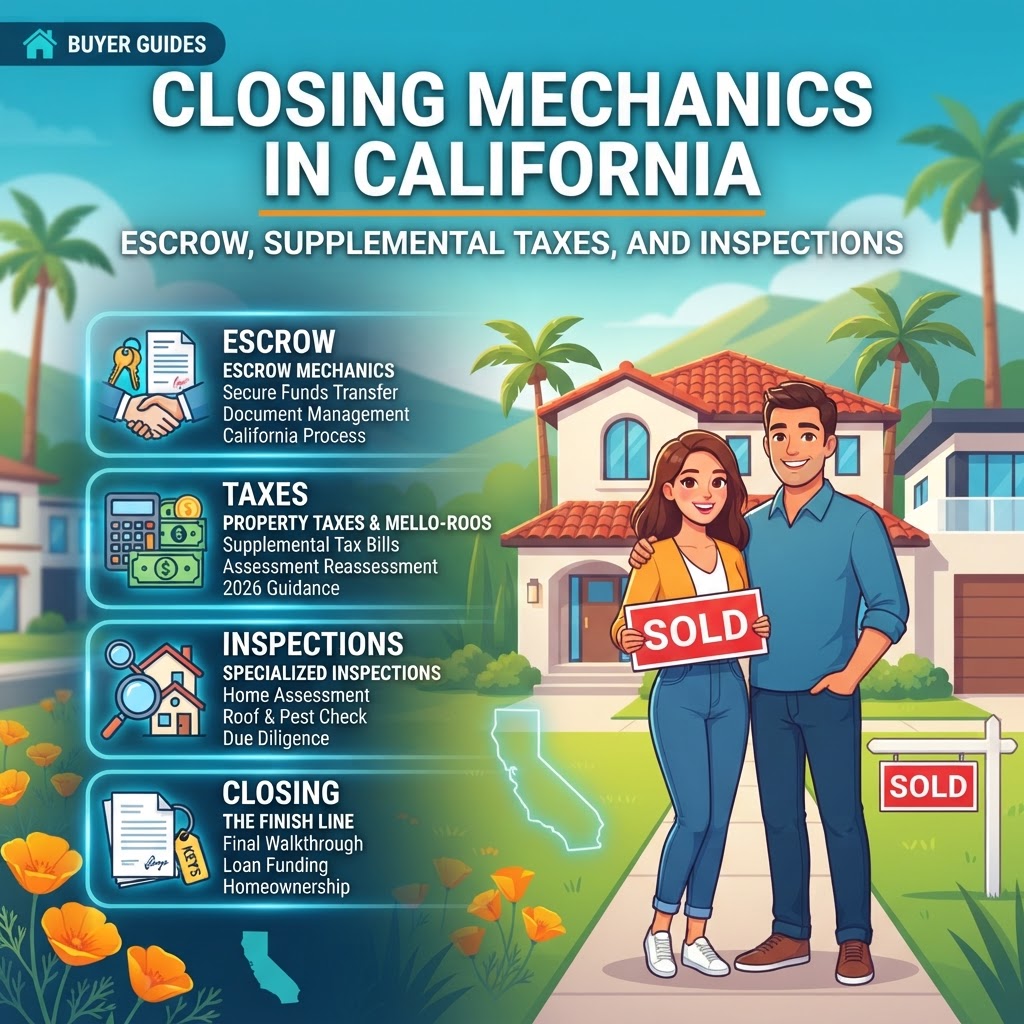
Unlike East Coast and Midwestern jurisdictions where title closings are handled in attorney-supervised roundtable meetings, California transactions run almost exclusively through independent escrow holders. Regulated under the California Department of Real Estate (DRE) and the Department of Financial Protection and Innovation (DFPI), an escrow agent functions as a neutral stakeholder adhering strictly to bilateral written instructions signed by both buyer and seller (Sammamish Mortgage).
Key escrow elements include:
- Earnest Money Deposit (EMD): Under standard California Association of Realtors (C.A.R.) purchase agreements, buyers must deliver an initial deposit—typically 1% to 3% of the purchase price—via wire transfer within three business days of mutual acceptance into the designated escrow trust account.
- Bilateral Closing Costs: Closing expenses typically range from 2% to 5% of the total purchase price, covering lender fees, title insurance policies (the standard split assigns the owner's policy and transfer taxes depending on regional county custom), and escrow service fees (Sammamish Mortgage).
- Title and Encumbrance Verification: The escrow company coordinates with a title insurer to pull a preliminary title report, identifying easements, mechanic liens, and property-specific covenants before title insurance is bound.
The Realities of California Property Tax: Reassessment and Mello-Roos
A common misconception among new buyers is relying on the seller's current property tax bill to estimate future carrying costs. Under California's Proposition 13 framework, the base property tax is statutory at 1% of the assessed value, capped at a maximum annual assessment increase of 2% (reAlpha).
However, upon a change in ownership, the county assessor reassesses the property to current market value (typically the purchase price). Buyers must account for two critical fiscal factors:
- Effective Tax Rates & Supplemental Bills: Once local school bonds, parcel measures, and regional assessments are added, the effective tax rate for new buyers in 2026 generally lands between 1.1% and 1.3% of the contract purchase price, rather than the statewide blended average of ~0.71% to 0.76% (reAlpha). Months after closing, the county will issue a separate Supplemental Property Tax Bill reflecting the difference between the seller's prior assessed value and the newly established purchase price.
- Mello-Roos (Community Facilities Districts): In master-planned developments and subdivisions across areas like Riverside, Sacramento, Irvine, and Chula Vista, properties often carry special Mello-Roos parcel taxes to service municipal bonds for schools, water infrastructure, and roads. Unlike ad valorem taxes, Mello-Roos amounts are not tied to property value and do not follow Proposition 13 caps (reAlpha).
Critical California-Specific Physical Inspections
While standard general home inspections cover roofs, electrical panels, and HVAC systems, California’s geographic profile demands targeted physical due diligence during the contingency period (The Bienstock Group):
- Sewer Lateral & Drain Line Inspections: Given the extensive age of infrastructure in coastal metros and mature suburbs, root intrusions, cracked cast-iron, or offset clay pipes are frequent. Many Northern California municipalities now mandate private sewer lateral compliance certificates prior to title transfer.
- Termite and Pest Inspections (Structural Pest Control): California's environment accommodates subterranean and drywood termites. A licensed Structural Pest Control Board inspection generates a Section 1 (active infestation/damage) and Section 2 (conditions conducive to infestation) report, often used during repair or credit requests (The Bienstock Group).
- Seismic and Foundation Evaluations: In hillside developments or pre-1979 builds, inspecting foundation anchoring, unreinforced masonry, and cripple-wall bracing is essential for long-term structural safety and earthquake insurance underwriting.
- Septic System Evaluations: In rural and unincorporated foothill parcels, an explicit inspection of the tank, baffles, and leach field is essential, as replacing a failed septic layout often exceeds $25,000 to $30,000 (The Bienstock Group).
Buyer Action Checklist for the Escrow Window
- Calculate Taxes on Contract Price: Never budget property taxes using the seller’s current tax installments. Multiply the planned purchase price by 1.25% to build an accurate holding budget, and reserve funds for the county’s supplemental tax bill arriving 3 to 9 months post-closing (reAlpha).
- Audit the Preliminary Title Report: Examine Schedule B exceptions for special tax assessments (1915 Act bonds, Mello-Roos CFD lines), utility easements, and restrictive covenants before signing off on title contingencies.
- Schedule Specialized Trades Immediately: Within the contractual inspection window, schedule trade-specific contractors (sewer scopes, pest inspectors, chimney specialists) concurrently with the general home inspector to ensure all comprehensive repair findings are delivered before contingency deadlines.