The Affordability Chasm
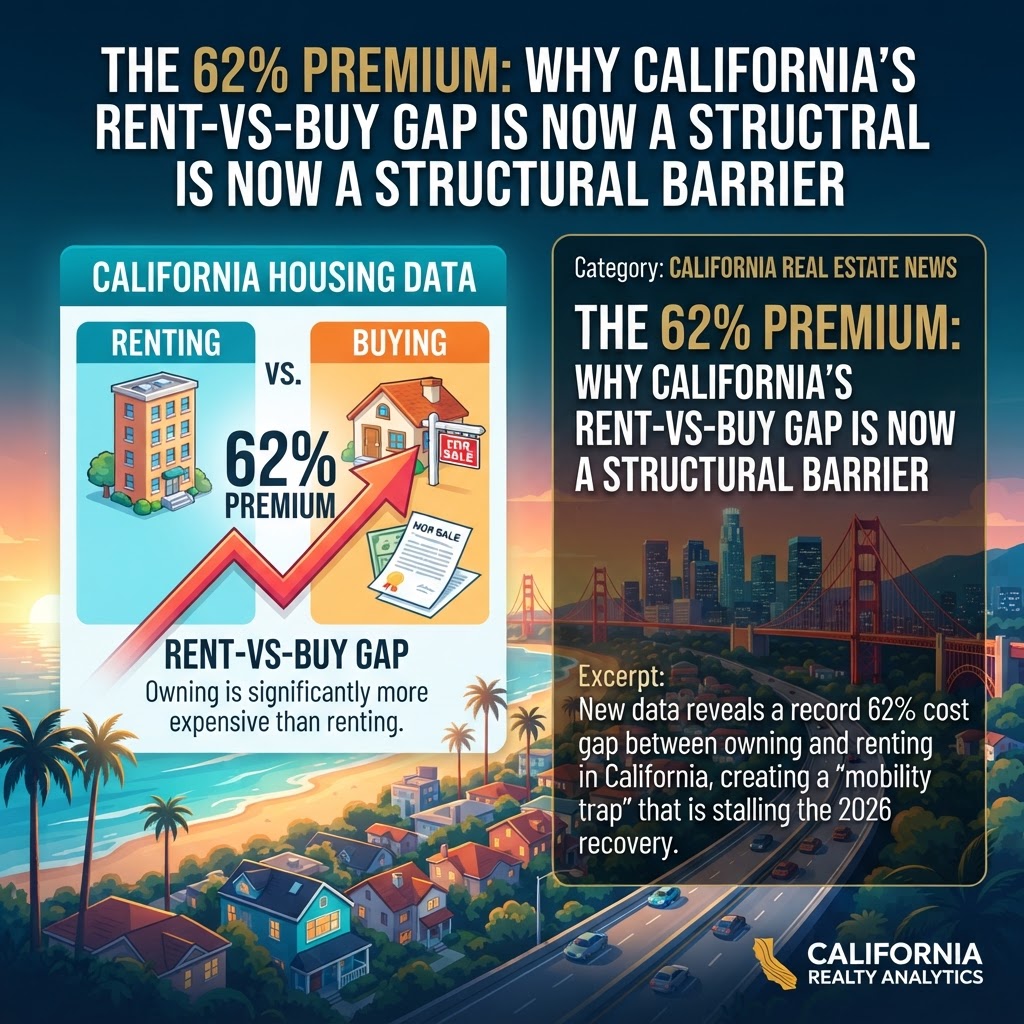
As of late August 2026, the California real estate market is grappling with a structural imbalance that transcends simple interest rate fluctuations. While recent mortgage rate dips have provided some relief, a new report from the California Legislative Analyst’s Office (LAO) and ManageCasa highlights a staggering 62% monthly cost premium for homeownership over renting. This gap has effectively created a "mobility trap," keeping potential buyers in the rental market and preventing the traditional churn of the housing ladder.
The $1,700 Monthly Penalty
According to the California Association of Realtors, the statewide median home price stood at $904,640 in June 2026. While this is a slight retreat from the May peak of $930,260, the financial barrier remains immense. For a household paying a median rent of $2,800, the jump to a comparable owned home—costing roughly $4,500 per month when factoring in taxes, insurance, and maintenance—represents a $1,700 monthly penalty.
This disparity has pushed California’s housing affordability index down to 18%, meaning fewer than one in five households can qualify for a median-priced home. Data from Realtor.com suggests that while inventory has improved slightly, up 5.5% year-over-year in some regions, the sheer cost of entry is keeping active listings stagnant compared to pre-pandemic norms.
Regional Divergence and the 'Mobility Trap'
The impact of this gap is not uniform across the Golden State. In supply-constrained coastal markets like San Diego, the market remains "very competitive" with a median price of $984,000, according to Redfin. Conversely, the Bay Area is seeing a unique bifurcation: while residential sales are slow, rental demand is surging. CBRE reports that Bay Area rent growth accelerated to 5.4% in early 2026 as would-be buyers are forced to remain tenants.
Furthermore, the "lock-in effect" for current homeowners remains potent. With many owners holding sub-4% mortgages, the prospect of trading up into a 6.7% rate environment while facing a 62% price premium is a non-starter. This has led to a sharp decline in building permits in high-demand areas; for instance, Newport Beach has seen permit activity drop 43% from its recent peak.
Practical Takeaways for the 2026 Market
- For Investors: The ownership gap is a tailwind for Class B and C rental assets. With the "buy" option out of reach for most, tenant retention in mid-tier housing is at historic highs. Investors should focus on submarkets with low vacancy rates, such as Silicon Valley and San Diego, where vacancy remains below 5%.
- For Homeowners: If your property value has dipped below its assessed value due to the recent price softening from the May peak, consider a Proposition 8 "Decline in Value" appeal to temporarily lower your property tax burden.
- For Buyers: Look for "stale" listings. With sellers increasingly outnumbering buyers in certain inland segments, negotiating power is shifting. Focus on sellers who are forced to move for relocation, as they are more likely to offer rate buy-downs to bridge the 62% affordability gap.