The Shifting Sands of 2026
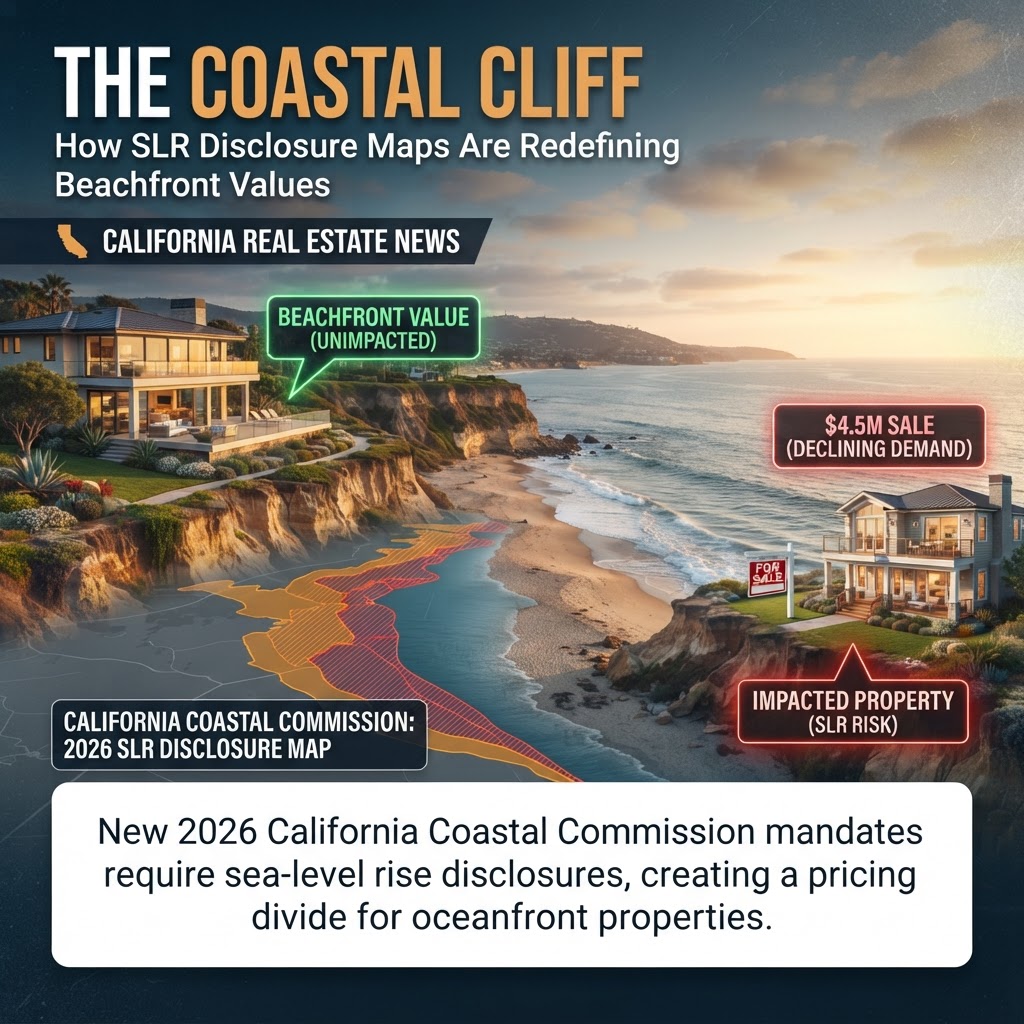
As of August 2026, the California real estate market has reached a critical inflection point regarding its most iconic asset: the beachfront home. Under the California Coastal Commission’s (CCC) 2026 Sea Level Rise (SLR) Policy Guidance, every property transfer within the Coastal Zone now requires a 'Vulnerability Assessment Disclosure.' This regulatory shift is no longer a theoretical concern for the next generation; it is actively dictating loan-to-value ratios and buyer appetite in markets from Malibu to Mendocino.
The Data: A Tale of Two Coastlines
Recent data from the California Association of Realtors (CAR) and the First Street Foundation indicates a widening 'resilience gap.' Since the disclosure mandate took effect in January, properties categorized as 'High Risk' (projected 1-foot inundation by 2050) have seen a 14% increase in days-on-market compared to 2025 averages. Conversely, 'Setback Secure' homes—those located at elevations 50 feet or more above current sea levels—are commanding a 19% price premium over adjacent lower-lying parcels.
According to CBRE’s Q2 2026 Coastal Report, institutional investors have pivoted away from 'Shoreline Protection Dependent' assets. The cost of maintaining private sea walls, now subject to stricter state mitigation fees and 'public beach encroachment' taxes, has added an estimated $12,000 to $45,000 in annual carry costs for luxury oceanfront estates.
The Regulatory Ripple Effect
The core of this market movement stems from the CCC's refusal to grant new 'hard armoring' (sea wall) permits for residential structures built or significantly remodeled after 2023. For owners of older homes, the 'Managed Retreat' protocols mean that if a home is damaged beyond 50% of its appraised value by a storm event, reconstruction may be prohibited if the site is deemed unsustainable by 2060 projections. This has led to the emergence of the 'Insurable Life Expectancy' (ILE) score, a new metric being used by secondary market lenders to determine 15-year versus 30-year mortgage eligibility in the Coastal Zone.
Practical Takeaways for Stakeholders
- For Buyers: Prioritize properties with existing, certified sea walls that have 'pre-Coastal Act' status. These remain the most legally protected assets against managed retreat mandates, as they are often 'grandfathered' into current protection schemes.
- For Sellers: Commission an independent SLR vulnerability study before listing. Providing a clear mitigation plan or proof of elevation can prevent buyers from negotiating 'climate risk' discounts that often exceed actual repair costs.
- For Investors: Focus on the 'Coastal Second Tier'—properties three to five blocks inland that sit outside the 2050 inundation zone but retain ocean views. These assets offer the coastal lifestyle without the looming threat of the 2050 disclosure maps or the 'uninsurable' designation.
As the state continues to grapple with the rising Pacific, the 2026 disclosure era marks the end of speculative beachfront buying and the beginning of a data-driven, risk-adjusted coastal market where elevation is the new luxury.