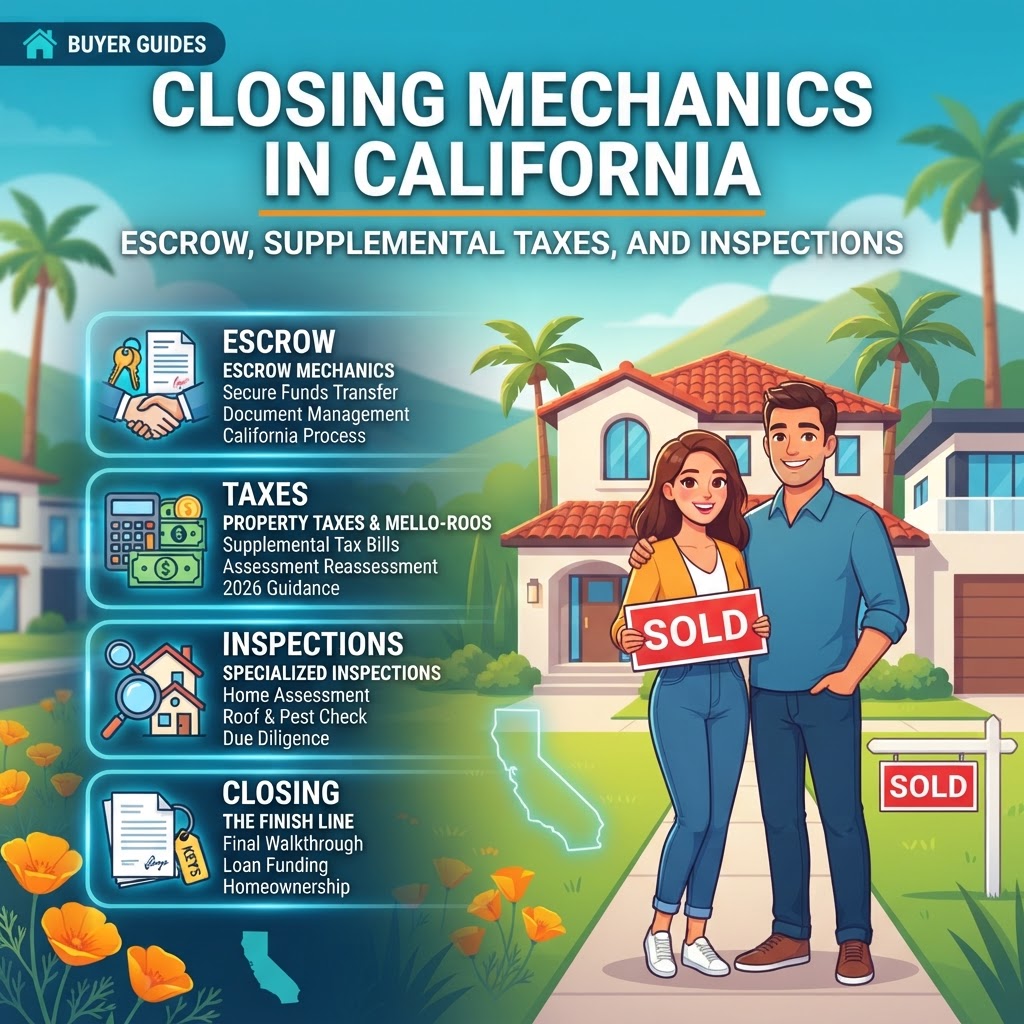
Navigating the California Tax Landscape in 2026
Buying a home in California involves more than just the purchase price and the mortgage rate. In 2026, as the California Association of Realtors (CAR) reports a median home price exceeding $920,000, the long-term cost of ownership is increasingly defined by property tax structures and localized assessments. Unlike many states where property taxes are straightforward, California’s system—anchored by Proposition 13 but complicated by modern legislation—requires a specific ‘Assessment Audit’ before you sign the closing papers.
The Mello-Roos Reality: Community Facilities Districts (CFDs)
For buyers looking at newer developments (typically built after 1982) or master-planned communities in the Inland Empire, Central Valley, or South Orange County, Mello-Roos is a critical factor. These are special taxes used to fund infrastructure like schools, roads, and police services. According to data from the California State Controller’s Office, these assessments can add $2,000 to $5,000 annually to a tax bill, often lasting for 20 to 40 years.
Practical Takeaway: Never rely on the previous year’s tax bill shown on listing sites. Request the ‘Natural Hazard Disclosure’ (NHD) report early in the contingency period; it contains a specific ‘Notice of Special Tax’ section that details the exact expiration date and maximum annual increase for Mello-Roos liens.
The Supplemental Tax Bill: The 'Welcome Stranger' Tax
One of the most common surprises for first-time California buyers is the supplemental tax bill. Because property taxes are tied to the purchase price (roughly 1% to 1.25% plus local assessments), and the county assessor takes time to update records, you will receive one or two 'catch-up' bills several months after closing. If you buy a home for $1 million that was previously assessed at $400,000, the supplemental bill will cover the tax difference for the portion of the year you owned the home.
Practical Takeaway: Set aside 1.2% of your purchase price in a high-yield savings account immediately after closing. Do not assume your mortgage escrow account will cover the supplemental bill; most lenders only escrow for the *previous* owner's tax rate initially.
The Geographic Divide: Transfer Tax Nuances
Who pays the documentary transfer tax depends heavily on where you are buying. In Northern California (e.g., San Francisco, Alameda), it is common for the buyer to pay the transfer tax. In Southern California (e.g., Los Angeles, Orange County), the seller typically covers it. However, in 2026's competitive market, these roles are increasingly negotiated. Furthermore, cities like Los Angeles and Berkeley have 'mansion taxes' or tiered transfer taxes for high-value properties that can significantly alter the net cost.
Proposition 19 Portability in 2026
If you are an existing California homeowner over 55, disabled, or a victim of a wildfire, 2026 is an opportune time to utilize Proposition 19. This allows you to transfer your current (lower) tax basis to a new primary residence anywhere in the state, regardless of the new home's value. Data from the California Board of Equalization shows that this portability can save eligible buyers upwards of $10,000 per year in property taxes compared to a fresh assessment.
The 2026 Buyer’s Tax Checklist
- Verify the Tax Rate Area (TRA): Each neighborhood has a specific TRA code. Use the county assessor’s portal to see the breakdown of voter-approved bonds that might increase your rate above the 1% base.
- Review the Preliminary Title Report: Look for PACE (Property Assessed Clean Energy) liens. These stay with the property and must be paid off or assumed, often affecting your debt-to-income ratio.
- Calculate the Assessment Gap: Subtract the current assessed value from your offer price to estimate your upcoming supplemental tax burden.