The Rise of the 'Missing Middle' Asset Class
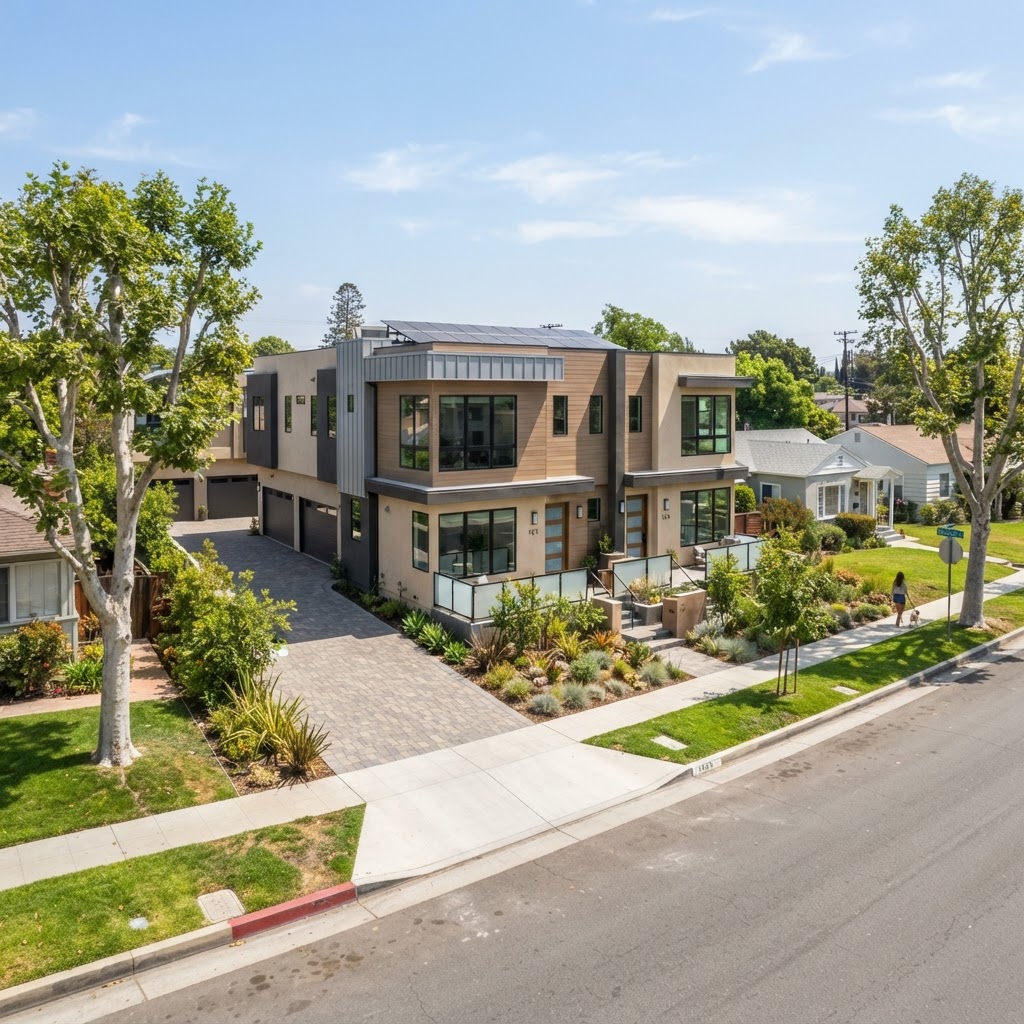
As of mid-July 2026, the California residential landscape is undergoing its most significant structural shift since the mid-century suburban boom. While the previous two years focused on Accessory Dwelling Units (ADUs), the implementation of Senate Bill 9.2—the 'Middle Density Expansion Act'—has officially ushered in the era of the neighborhood quad-plex. According to data released this week by the California Association of Realtors (CAR), permits for small-scale multi-family conversions have risen by 22.4% year-over-year, outpacing traditional single-family home (SFH) sales volume in eight of the state's ten largest counties.
The SB 9.2 Catalyst: Equity Bridge Loans
The primary driver behind this 2026 surge is the state-backed 'Equity Bridge' program. Unlike the fragmented lending environment of 2024, the California Housing Finance Agency (CalHFA) now provides low-interest, secondary-market liquidity specifically for R1-to-Quadplex conversions. This has allowed mom-and-pop investors to bypass the high-interest construction loans that previously stifled middle-density growth.
Recent MLS data indicates that properties zoned for these conversions are commanding a 'development premium' of 15% to 18% over standard residential comps. In the Inland Empire and Sacramento suburbs, where lot sizes are historically larger, this premium has allowed sellers to exit at peak valuations even as broader mortgage rates hover near 6.5%.
Market Data: Yields vs. Valuations
For the first time in California history, the cap rate for converted residential quad-plexes is outperforming traditional multi-family complexes. In Q2 2026, the average cap rate for a stabilized quad-plex in Los Angeles County reached 6.1%, compared to 4.8% for 20+ unit apartment buildings. This yield gap is drawing institutional 'lite' capital—mid-sized private equity groups—into neighborhoods previously reserved for individual homeowners.
- Construction Costs: Prefabricated modular kits for quad-plex interiors have dropped costs by 12% since 2025.
- Rental Demand: 2026 Census pulse surveys show a 30% increase in demand for 'neighborhood-integrated' housing over high-rise apartments.
- Tax Incentives: The '2026 Green-Fill Credit' provides up to $45,000 in rebates for conversions that incorporate solar-plus-storage for all units.
Practical Takeaways for 2026 Market Participants
For Sellers: If your lot exceeds 7,500 square feet in a transit-adjacent R1 zone, you are no longer selling a house; you are selling a development site. Ensure your listing highlights the 'SB 9.2 Ready' status to capture the developer premium.
For Investors: Focus on 'cluster acquisition.' Purchasing adjacent SFH lots allows for shared utility trenching and unified modular delivery, reducing conversion costs by an additional 8-10% per unit.
For Buyers: The 'owner-occupant quad' is the new starter home. By living in one unit and leasing the other three under current 2026 market rates, many first-time buyers are seeing their net monthly mortgage obligation drop to near-zero levels—a strategy becoming known as 'Extreme House Hacking.'
Conclusion
The 2026 market is no longer defined by the scarcity of the single-family dream, but by the utility of the multi-unit lot. As the Middle Density Expansion Act matures, the distinction between residential and commercial investing in California continues to blur, offering a rare window of high-yield opportunity for those who can navigate the new zoning landscape.