The New Standard: Thermal Efficiency Ratings
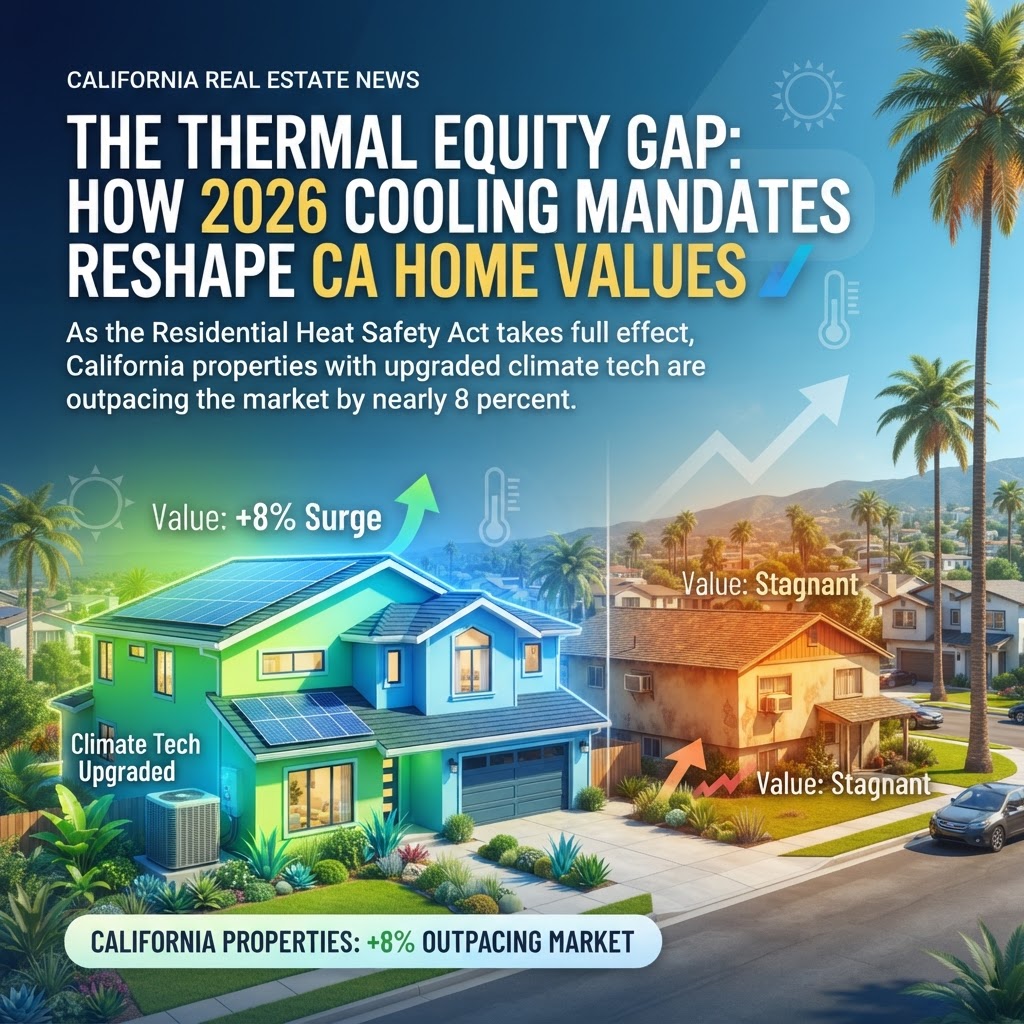
As of July 2026, the California real estate landscape is no longer defined solely by school districts or square footage. Following the full implementation of the Residential Heat Safety Act (SB-1048), a new metric has emerged as the primary driver of domestic value: the Thermal Efficiency Rating (TER). This state-mandated disclosure, which ranks a home's ability to maintain habitable temperatures during extreme heat events without excessive grid reliance, has created a stark 'Thermal Equity Gap' between modernized properties and aging 'heat traps.'
Market Data: The Premium for Cool Living
Recent data from the California Association of Realtors (CAR) reveals a significant pricing bifurcation. Homes with a TER of 'A' or 'B'—indicating high-albedo 'cool roofs,' dual-pane low-E glass, and Tier-1 heat pump systems—are currently fetching an 8.2% premium over the median price in their respective ZIP codes. Conversely, properties with legacy HVAC systems and uninsulated attics are seeing days-on-market (DOM) increase by an average of 14 days compared to the same period in 2025.
According to the California Energy Commission (CEC), the shift is driven by utility costs. With residential electricity rates in the Central Valley and Inland Empire rising 12% year-over-year, buyers are factoring 30-year climate operating costs into their mortgage applications. Lenders are also beginning to respond, with two major state credit unions offering 'Green-Boost' interest rate reductions for properties meeting the highest TER standards.
The Seller's Dilemma and the Investor's Opportunity
For sellers in the 2026 summer market, the lack of thermal upgrades has become a major point of friction during the 30-day inspection window. 'We are seeing buyers demand credits ranging from $15,000 to $40,000 for HVAC retrofits at the eleventh hour,' notes Sarah Chen, a lead analyst at CBRE. 'The thermal profile of a home is no longer an optional upgrade; it is a fundamental requirement for liquidity.'
Practical Takeaways for the 2026 Market
- For Sellers: Prioritize a 'Cool Roof' certification and heat pump installation before listing. These specific upgrades currently offer a 120% return on investment (ROI) at the point of sale, outperforming kitchen or bath remodels for the first time in state history.
- For Buyers: Scrutinize the mandatory TER disclosure. A lower purchase price on a 'C' or 'D' rated home may be offset within five years by rising energy costs and impending state-level carbon-footprint penalties for residential structures.
- For Investors: Focus on 'Thermal Arbitrage.' Purchasing older multi-family units and retrofitting them to meet SB-1048 standards allows for significant value-add forced appreciation, as modernized units now command a 15% rental premium in the scorching inland markets.