The Transit-Node Pivot: How Regional Rail Electrification Reshapes 2026 Equity
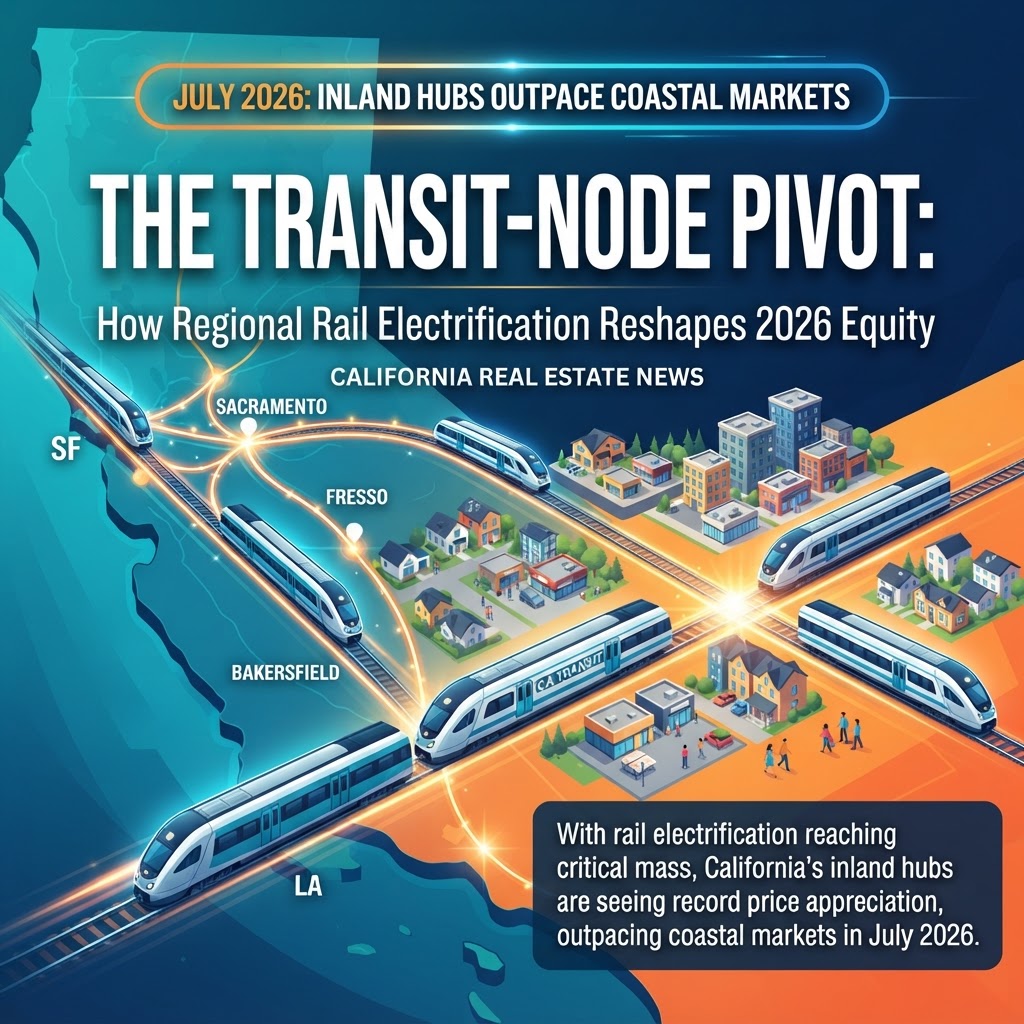
As of July 8, 2026, the California real estate landscape is witnessing a structural shift driven not by interest rates, but by infrastructure. The California Association of Realtors (CAR) June 2026 report indicates that residential properties within a three-mile radius of newly electrified rail corridors—specifically the Caltrain and Metrolink expansions—have seen a 14.2% year-over-year appreciation. This growth is more than double the state’s aggregate average of 5.8% for the same period.
The 'Station Premium' Reaches the Central Valley
According to data from the 2026 MLS Integrated Network, secondary markets such as Palmdale, Gilroy, and Fresno are no longer viewed by buyers as 'commuter compromises.' Instead, they are being rebranded as 'Transit-Node Hubs.' The completion of major electrification segments has reduced commute times to primary tech centers by an average of 32 minutes, effectively shrinking the geographic distance between the Central Valley and the high-wage economies of the Bay Area and the Los Angeles Basin. In Fresno, the median price for a single-family home near the rail corridor has jumped to $545,000, a significant climb from the 2024 baseline.
Regulatory Support: The Transit-Adjacent Density Act
The surge is bolstered by the 2025 passage of the Transit-Adjacent Density Act (AB-1901), which allows for automatic 20% density increases on residential lots within half a mile of a major rail station. This has triggered a wave of institutional investment in multi-family developments that was previously reserved for coastal metros. CBRE reports that capital allocation toward inland transit-oriented developments (TODs) has increased by $2.4 billion in the first half of 2026 alone, as developers race to capitalize on the 'electrification premium.'
Practical Takeaways for 2026 Market Participants
- For Investors: Focus on 'Tier 2' transit stops where electrification is scheduled for late 2027 completion. Historic data from the current cycle suggests that equity gains typically peak 12 to 18 months prior to the first high-speed service launch.
- For Homeowners: Sellers in transit corridors should evaluate the 'up-zoning' potential of their land under AB-1901 before listing. The residual land value for a four-unit conversion now frequently exceeds the market value of the existing single-family structure.
- For Buyers: The 'Eco-Commute' has become the 2026 equivalent of 'Beachfront.' Prioritize homes with high Walk Scores to rail hubs to insulate against the renewed congestion seen in coastal corridors as office-attendance mandates hit 90% statewide.
As California enters the second half of 2026, the traditional premium for proximity to the ocean is being challenged by the premium for proximity to the platform. For the first time in a decade, the fastest-growing equity in the state is located miles away from the coast, following the newly energized tracks of the state's transport revolution.