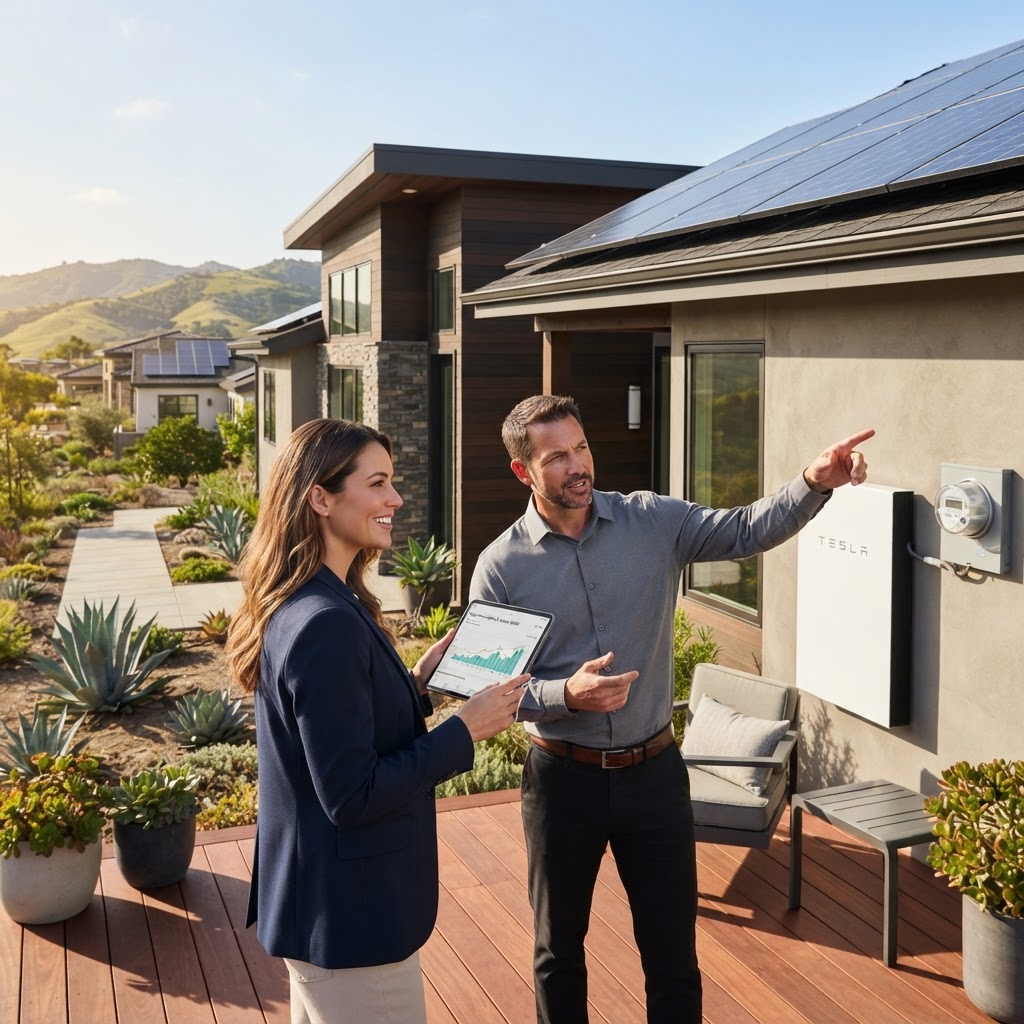
The New Metric of California Affordability: Kilowatt-Hour Cost
As of July 2026, the California real estate market has reached a critical inflection point where monthly utility obligations are rivaling property tax assessments in the buyer's total debt-to-income (DTI) equation. With investor-owned utilities like PG&E and SCE implementing double-digit rate increases over the past 24 months, the 'Utility Hedge' has become a primary driver of home valuation. For the modern California buyer, energy independence is no longer a green luxury—it is a financial necessity.
The NEM 3.0 Legacy and Appraisal Realities
Data from the California Association of Realtors (CAR) indicates that homes equipped with battery storage systems (BESS) are currently commanding a 4.2% premium over comparable non-storage homes. This shift is a direct result of the Net Billing Tariff (NEM 3.0) legacy. Buyers must distinguish between properties grandfathered into NEM 2.0 (high-value export credits) and newer installations. A NEM 2.0 system can save a homeowner an average of $2,500 more per year than a NEM 3.0 system without storage, adding significant 'hidden' value to older solar-equipped listings.
The Rise of Virtual Power Plants (VPPs)
A 2026 buyer must look beyond simple panels. Smart buyers are targeting homes integrated into Virtual Power Plants. According to the California Public Utilities Commission (CPUC), residential battery owners participating in grid-service programs can now earn between $500 and $1,200 annually in performance payments. When evaluating a property, verify if the existing energy system is compatible with VPP aggregators. This transforms the home from a passive shelter into a revenue-generating asset, effectively offsetting a portion of the mortgage interest.
Energy Resilience: A Practical Checklist
When touring California properties in 2026, your due diligence must include an 'Energy Resilience Audit.' Do not rely solely on the standard disclosure packet. Practical steps include:
- Check the Panel: Ensure the home has at least a 200-amp main service panel. Retrofitting a 100-amp panel to support EVs and heat pumps can cost between $4,000 and $7,000 in the current market.
- Verify Solar Ownership: A 2025 Lawrence Berkeley National Laboratory study found that homes with owned solar sell faster and for more than those with leased systems. Always request the original solar contract to verify the remaining warranty and UCC-1 filing status.
- Inverter Health: Ask for the monitoring app data. If the system is over 10 years old, the string inverter may be nearing its end-of-life, representing a $2,000–$3,500 upcoming capital expenditure.
Market Context: The Thermal Shell Premium
In California's Central Valley and Inland Empire, where summer temperatures regularly exceed 100 degrees, the 'Thermal Shell' of a home is now a top-tier appraisal factor. Search for listings that feature R-60 attic insulation and high-performance windows (U-factor below 0.30). MLS data shows that homes with high energy-efficiency ratings (HERS) spend 12% fewer days on market in high-heat corridors compared to un-upgraded stock.
Practical Takeaways for 2026 Buyers
1. Prioritize Energy Over Finishes: It is easier to replace a carpet than to retrofit a home for total energy independence. Prioritize the 'guts' of the home in your offer strategy.
2. Analyze the Utility History: Request 12 months of utility bills. If the seller has solar but the bills remain high, it indicates an undersized system or poor insulation.
3. Leverage Energy Credits in Negotiations: If a home lacks battery storage under NEM 3.0, use the projected utility costs as a lever to negotiate a credit for a post-closing battery installation.