Navigating the $950,000 Median: The New Math of 2026
As of June 30, 2026, the California real estate landscape remains a study in contradictions. While inventory has increased by 12% year-over-year according to the California Association of Realtors (CAR), the median price for a single-family home has climbed to approximately $948,500. For most buyers, the primary barrier is no longer just the interest rate, which has stabilized around 6.2%, but the initial entry capital. This guide focuses on the 'Financial Stack,' the most critical tool for the 2026 California home buyer.
The Power of Program Stacking
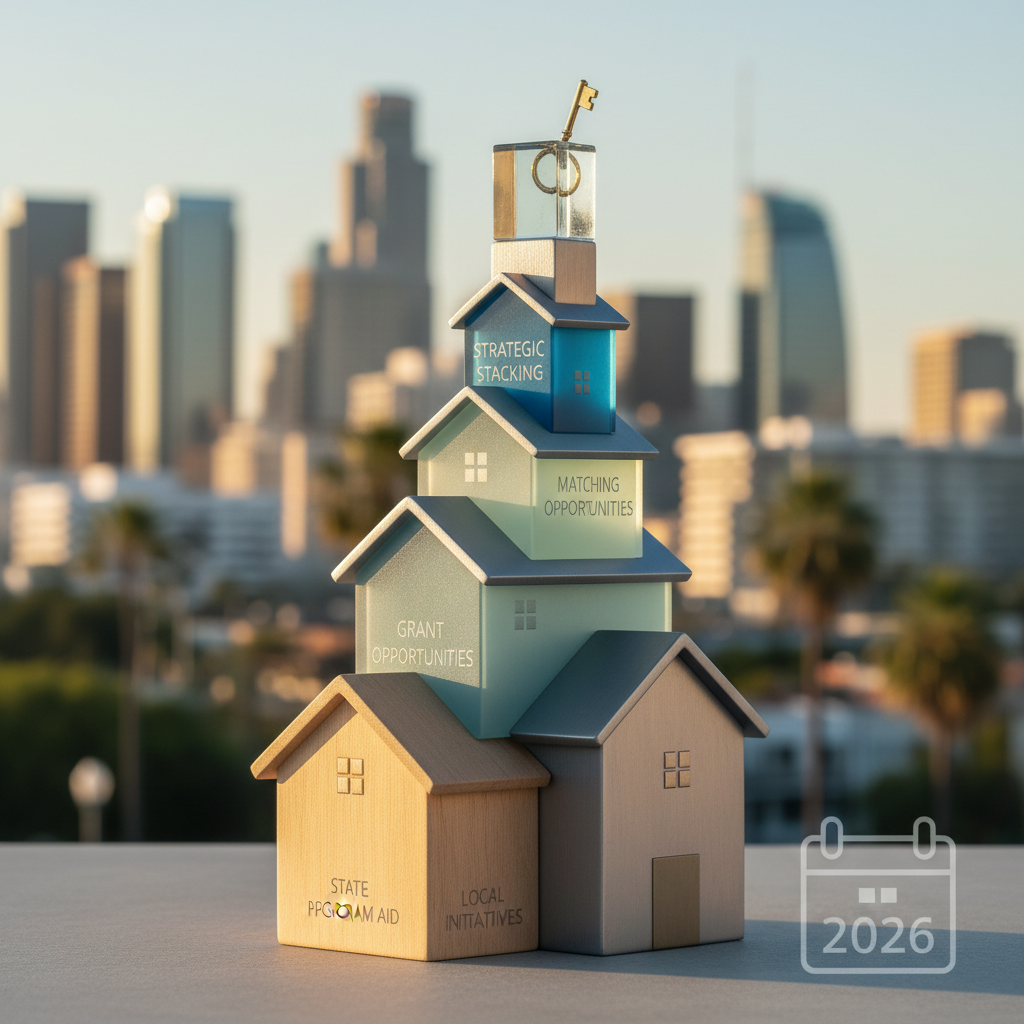
In 2026, the 'Dream for All' successor programs have matured into a sustainable shared-equity model. Data from CalHFA indicates that over 40% of first-time buyers in the current quarter are utilizing at least two distinct forms of down payment assistance (DPA). 'Stacking' involves layering a state-level grant with municipal 'silent second' mortgages and local workforce housing credits. This strategy allows buyers to enter the market with as little as 1% to 3% of their own capital while maintaining a manageable loan-to-value ratio.
Tiered Eligibility: The 2026 Breakdown
Success in the current market requires a granular understanding of the new tiered eligibility requirements introduced in the 2025-2026 budget cycle:
- First-Generation Credits: Buyers whose parents have not owned a home in the U.S. within the last three years qualify for an additional 5% equity share in state-backed programs, often covering the entire down payment.
- Area Median Income (AMI) Expansion: To combat middle-class flight, 2026 programs have expanded eligibility to 150% of the AMI in high-cost coastal counties like San Diego, Santa Clara, and Orange.
- Municipal 'Top-Off' Grants: Cities such as Sacramento, Long Beach, and Fresno have launched local vouchers that can be added to CalHFA funds, specifically for buyers purchasing in 'Infill Opportunity Zones.'
Practical Takeaways for 2026 Buyers
- Audit Your 'First-Gen' Status Early: Before seeking a pre-approval, document your family's 10-year housing history. In 2026, this documentation is as vital as your credit score for unlocking high-tier assistance.
- Map the Overlay Zones: Use updated GIS mapping tools to identify properties that fall within both state DPA zones and local municipal assistance districts. Finding these 'double-dip' zones can save a buyer upwards of $75,000 in upfront costs.
- Model the Equity Share: Most 2026 DPA is not a 'gift' but a shared equity loan. Work with a specialized lender to calculate the 'buy-back' cost at the 5-year and 10-year marks to ensure you have an exit strategy for the state's equity portion.
- Prioritize the 'Lender-Handoff': Not all lenders are certified to handle 'Stacked' files. Ensure your loan officer has a 2026 CalHFA Preferred Lender designation to avoid delays in the 21-day escrow periods now standard in the RPA.
By shifting focus from 'saving for twenty percent' to 'navigating the assistance ecosystem,' California buyers can bypass the affordability trap. In a market where the median price nears a million dollars, the strategic application of subsidized capital is the only viable path for the modern middle-class homeowner.