The End of the Litigation Lock: California’s New Density Reality
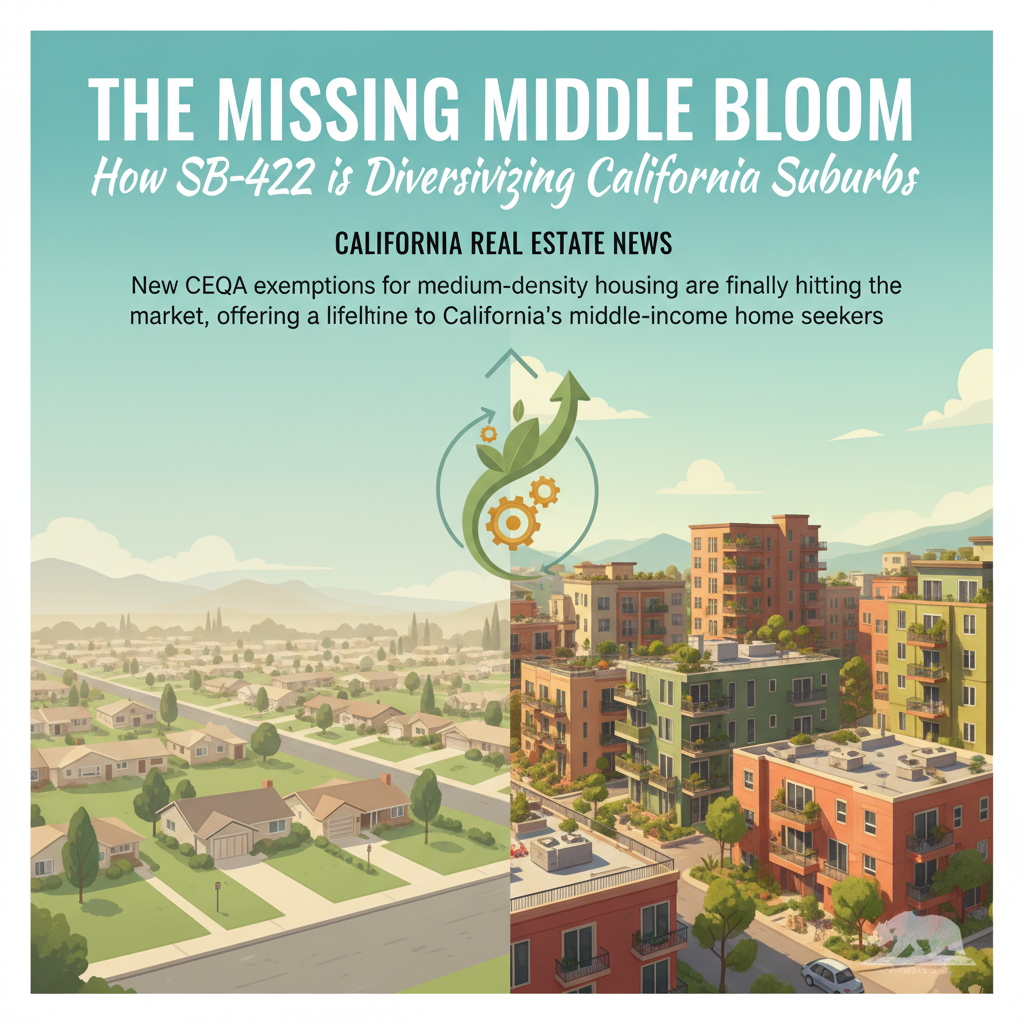
For decades, the California Environmental Quality Act (CEQA) was frequently utilized by local opposition groups to stall or kill multi-unit housing projects. However, as of June 30, 2026, the landscape has shifted. The implementation of Senate Bill 422 (SB-422), which took full effect last year, has created a 'fast-track' for 'Missing Middle' housing—projects consisting of 4 to 12 units—effectively exempting them from the lengthy environmental review processes that once added years to construction timelines.
Data Points: A Surge in Medium-Density Permits
According to recent data from the California Department of Housing and Community Development (HCD), permit applications for townhomes and small-scale apartment clusters have surged by 34% year-over-year. In traditionally restrictive markets like Orange County and Contra Costa County, the impact is even more pronounced. The California Association of Realtors (CAR) reports that for the first time in a decade, the 'missing middle' segment accounts for nearly 18% of new construction starts, up from just 6% in 2023.
This shift is stabilizing median home prices in the $750,000 to $950,000 range—a segment that previously saw the highest rates of bidding wars. By introducing 'attainable luxury' density, developers are finding they can maintain healthy margins while meeting the desperate demand from the state's professional class.
The 'Shotclock' Mandate in Action
A critical component of the 2026 market is the 'Shotclock' mandate included in the recent reforms. Local municipalities now have a maximum of 90 days to approve or deny a project that meets objective zoning standards. If a city fails to act, the project is deemed approved. This regulatory pressure has forced cities like Palo Alto and Santa Barbara to modernize their planning departments, reducing the 'regulatory tax' that developers typically passed on to buyers.
Practical Takeaways for Market Participants
- For Buyers: Look to 'Tier 2' suburbs where SB-422 projects are breaking ground. These 4-to-12 unit developments often offer modern amenities at a 15-20% discount compared to detached single-family homes in the same ZIP code.
- For Investors: Small-scale multi-family units are the new 'safe haven.' With the CEQA litigation risk significantly lowered, the time-to-market for these assets has dropped from 36 months to roughly 14 months, significantly improving Internal Rate of Return (IRR).
- For Sellers: If you own an oversized suburban lot with aging improvements, your land value may have appreciated based on its 'highest and best use' as a potential 6-unit townhome site rather than a single-family renovation.
Looking Ahead: A More Resilient Inventory
As we move into the second half of 2026, the diversification of California’s housing stock is no longer a policy goal—it is a market reality. While the 'Missing Middle' won't solve the inventory crisis overnight, the removal of the CEQA roadblock provides a sustainable pipeline for the very buyers California was most at risk of losing: the middle-class workforce.