The 3% Legacy: Unlocking the Golden Handcuffs
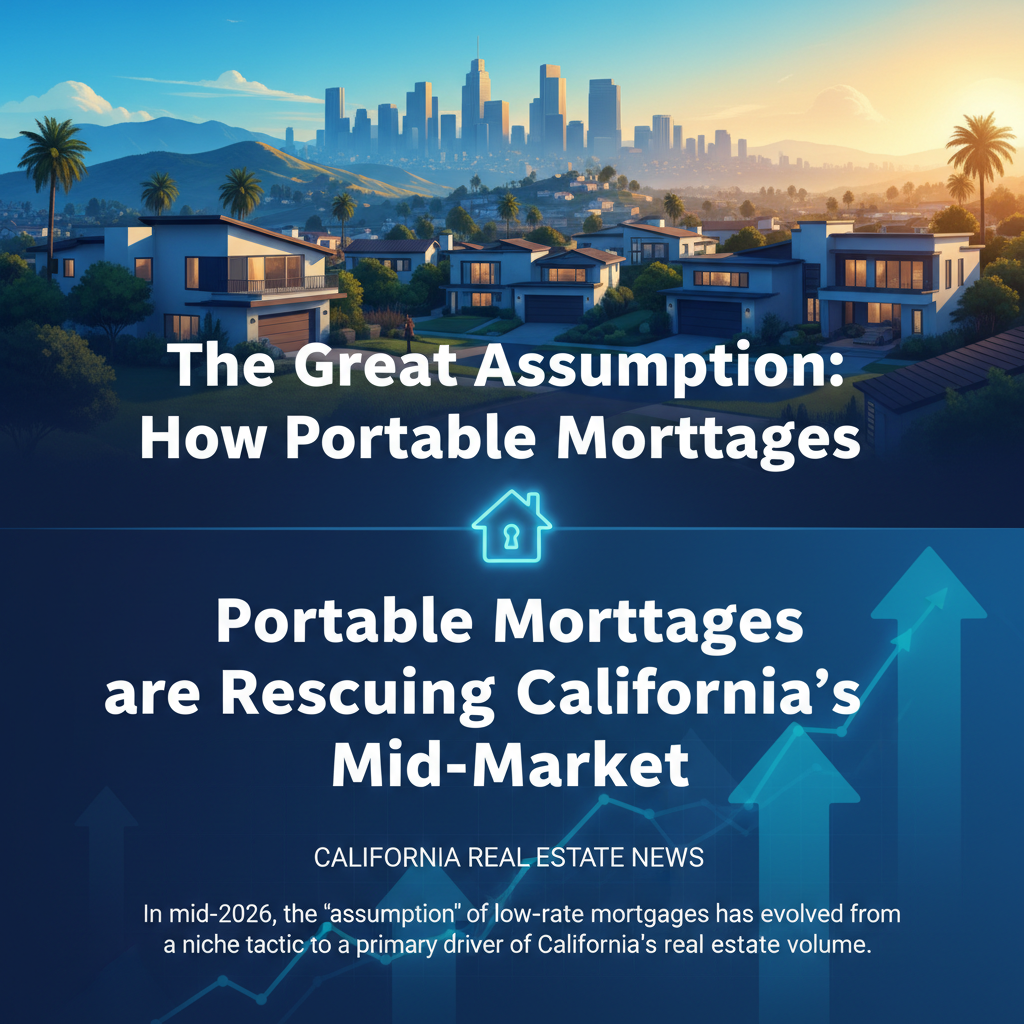
For nearly three years, the California real estate market was defined by the 'lock-in effect'—a stalemate where homeowners refused to sell and abandon their 2021-era mortgage rates. However, as of June 2026, the narrative has shifted. Data from the California Association of Realtors (C.A.R.) indicates a 22% year-over-year surge in transactions featuring assumable mortgages, particularly in mid-tier markets like the Inland Empire and the Central Valley.
Unlike the stagnation of 2024, the current market is being fueled by buyers who are no longer just looking at the listing price, but at the 'rate attachment.' With the average 30-year fixed rate currently hovering at 5.85%, the ability to take over a seller’s 3.2% FHA or VA loan represents a monthly savings of nearly $1,800 on a median-priced California home.
The Equity Gap Challenge
While the benefits are clear, the 'Great Assumption' wave faces a significant hurdle: the equity gap. Because home values in California have continued their modest climb, the difference between the remaining loan balance and the sales price is often substantial. In San Diego County, for instance, the average gap for an assumable loan sits at approximately $340,000.
To bridge this, a new ecosystem of 'Assumption-Second' liens has emerged. According to recent data from the Department of Financial Protection and Innovation (DFPI), California-based credit unions have seen a 40% increase in second-mortgage originations specifically designed to complement assumed first trust deeds. This financial stack allows buyers to leverage the 3% rate on the bulk of the debt while financing the remainder at current market rates, resulting in a blended rate that still significantly undercuts the national average.
Streamlined Processing: A Regulatory Win
The 2026 surge is not accidental. Following the 'Mortgage Transparency Act of 2025,' federal and state regulators forced servicers to reduce assumption processing times from six months to a mandatory 45-day window. This regulatory shift has removed the primary deterrent for sellers who previously feared their deals would languish in bureaucratic limbo.
Listing agents are now pivoting their strategies. In the Greater Los Angeles area, 'Assumable Rate' is frequently featured more prominently than square footage in MLS descriptions. 'We are seeing a bifurcated market,' says a lead analyst at a major California brokerage. 'Homes with assumable low-interest debt are selling in under 15 days, while those requiring new 6% financing are sitting for 45 to 60 days.'
Practical Takeaways for the 2026 Market
- For Buyers: Focus your search on FHA and VA-backed listings. Use specialized 2026 search filters that identify 'Assumption Eligible' properties to find significant monthly savings that aren't reflected in the sticker price.
- For Sellers: If you have an FHA or VA loan from 2020-2022, your mortgage is your most valuable asset. Marketing the 'monthly payment savings' rather than just the home's features can command a 5-8% price premium in the current environment.
- For Investors: Look for 'equity-thin' assumptions where the seller's gap is smaller. These are often found in areas with slower appreciation since 2022, providing a lower barrier to entry for cash-on-cash returns.
As we move into the second half of 2026, the ability to 'port' or 'assume' the low-interest environment of the past has become the essential lubricant for a market that many feared would remain frozen for a decade. In California, the mortgage—not just the land—is now the commodity.