Navigating the 2026 California Real Estate Landscape
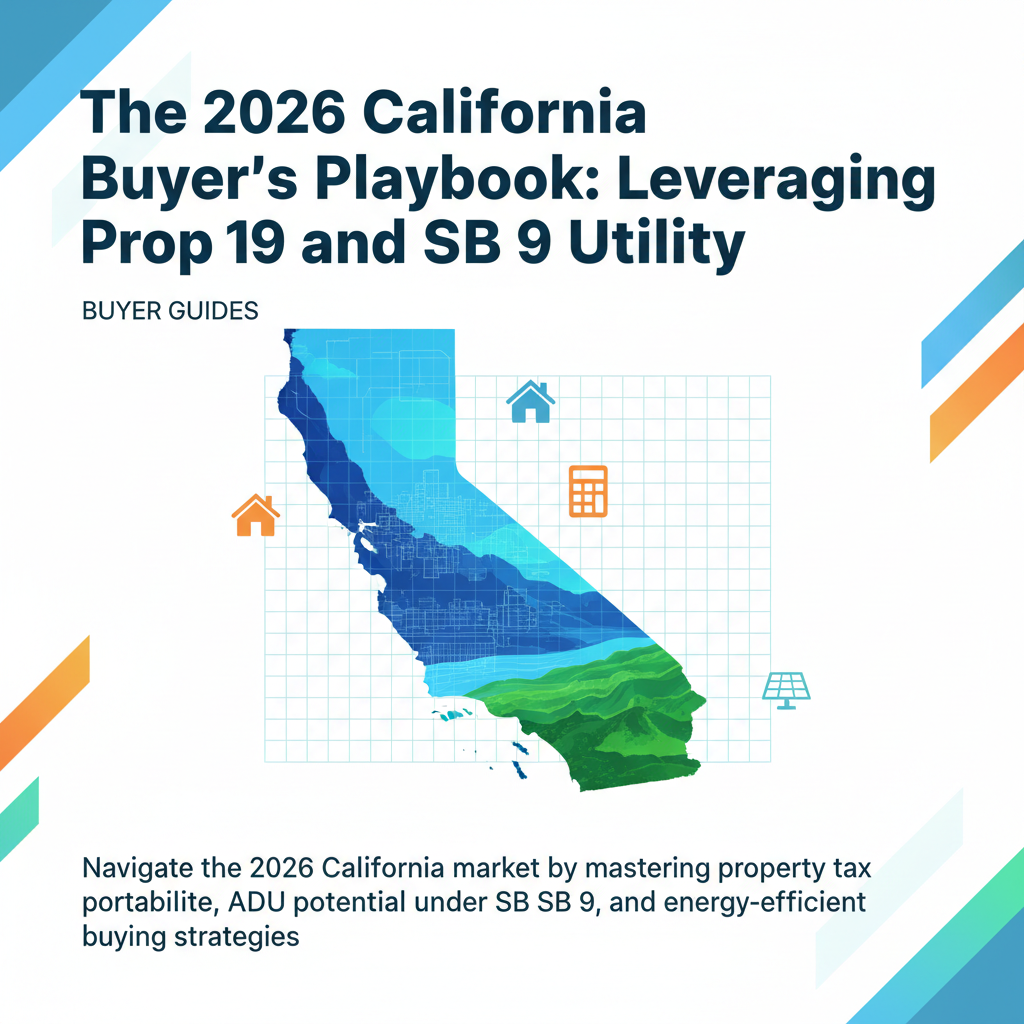
As of June 2026, the California housing market remains a complex environment defined by persistent inventory constraints and a stabilizing yet elevated interest rate environment. According to the California Association of Realtors (C.A.R.), the median home price has seen a 4.2% year-over-year increase, driven largely by a lack of new supply in coastal urban centers. For the modern buyer, success requires looking beyond the list price and evaluating the long-term fiscal utility of a property, specifically through the lens of Proposition 19 and Senate Bill 9 (SB 9).
The Prop 19 Advantage: Tax Base Portability
One of the most critical factors for 2026 buyers—particularly those moving from an existing California residence—is the strategic use of Proposition 19. This law allows homeowners who are over 55, severely disabled, or victims of wildfires/natural disasters to transfer their primary residence's property tax base to a replacement home anywhere in California.
Data from the State Board of Equalization suggests that for a buyer moving from a property held for 15+ years into a higher-priced home in a metropolitan hub like San Diego or San Jose, Prop 19 can result in annual property tax savings exceeding $8,000. When searching for a home, buyers must work with their lenders to calculate the 'blended' tax rate if the replacement home is of greater value, as this significantly impacts the debt-to-income (DTI) ratio during the qualification phase.
Maximizing Square Footage: The SB 9 and SB 10 Utility
With the California Department of Housing and Community Development (HCD) pushing for increased density, 2026 buyers should prioritize properties with 'SB 9 potential.' Senate Bill 9 allows for the ministerial approval of up to two residential units on a single-family lot and, in some cases, an urban lot split.
When evaluating listings, look for the following 'utility' indicators:
- Lot Configuration: Wide side-yards or alley access are goldmines for Accessory Dwelling Unit (ADU) construction or SB 9 lot splits.
- Zoning Overlays: Check if the property falls within a transit-rich area under SB 10, which may allow for even higher density (up to 10 units) if the local municipality has opted in.
- Utility Capacity: Older homes may require electrical panel upgrades to support additional units; 2026 estimates suggest these upgrades average between $4,500 and $7,000.
Energy Compliance and Title 24 Requirements
Sustainability is no longer optional in California. The 2026 update to Title 24 Energy Standards requires that any significant renovation or new construction meet stringent carbon-reduction goals. Buyers should look for homes that already feature 'future-proof' upgrades, such as heat pump water heaters and induction cooktops. Properties with existing, owned solar arrays (rather than leased) are currently commanding a 3% to 5% premium in the 2026 market, as they mitigate the rising costs of utility rates from providers like PG&E and SCE.
Practical Takeaways for 2026 Buyers
- Verify the Tax Base: If you are eligible for Prop 19, ensure your agent includes a tax base transfer contingency or provides a clear timeline for the application post-close.
- Conduct a 'Density Audit': Before making an offer on a single-family home, consult a land-use specialist to determine if the lot qualifies for an SB 9 split, which can provide a significant exit strategy or rental income.
- Assess Electric Readiness: With California’s push toward electrification, check the home’s amperage. A 200-amp service is now the standard for homes supporting EVs and electric HVAC systems.
- Identify 'Soft' Inventory: Focus on homes that have been on the market for 21+ days. In the current 2026 climate, these sellers are often more amenable to 'buy-down' credits, which can reduce your effective mortgage rate by 1% to 2% for the first few years.