The 50-Year Horizon: A New Era of Transparency
As of June 2026, the California real estate market is grappling with the full implementation of the Coastal Resilience Disclosure Act (SB 1104). The law, which reached full enforcement this spring, requires sellers of residential property within the ‘High-Risk Erosion Zone’ to provide buyers with a standardized 50-year sea-level rise projection and a detailed history of shoreline armoring at the property site. This regulatory shift is doing what decades of climate warnings could not: decoupling beachfront valuations from the broader coastal market.
The Emerging Price Rift
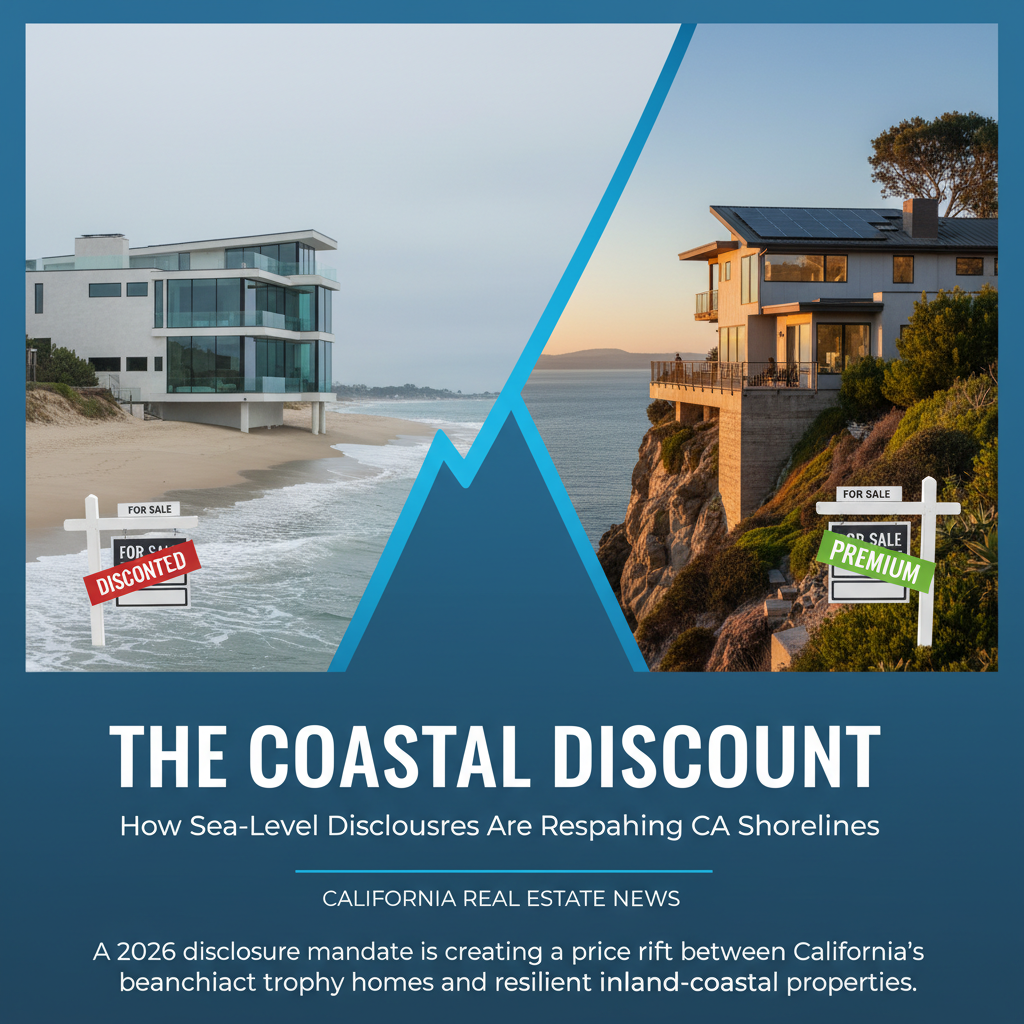
Data from the California Association of Realtors (CAR) and the California Coastal Commission indicates a growing divergence in price appreciation. While properties located 500 yards inland in markets like Santa Monica and Del Mar have seen a 4.2% year-over-year price increase, direct-oceanfront parcels in the same zip codes have stagnated or seen price reductions of up to 12% since January. This ‘coastal discount’ reflects a new reality where lenders and insurers are scrutinizing the long-term viability of shoreline assets.
According to recent MLS data, the average ‘Days on Market’ for cliffside properties in Malibu and Encinitas has surged to 85 days, compared to a coastal average of 22 days. Buyers are no longer just looking at the sunset; they are looking at the bluff stability reports. The National Association of Realtors (NAR) reports that 68% of luxury buyers in California now cite 'geological resilience' as a top-three priority, a metric that barely registered in 2020 surveys.
The End of the Seawall Era
The market movement is also driven by the Coastal Commission’s 2026 policy tightening regarding 'hard armoring.' New permits for seawalls are now almost impossible to obtain for residential structures, with the state favoring 'managed retreat' or 'soft-living shorelines.' This has created a secondary market for homes built on elevated pilings or those situated behind natural dune protections, which are fetching premiums of 15-20% over traditional slab-on-grade beachfront builds.
Practical Takeaways for Coastal Stakeholders
- For Buyers: Prioritize 'Elevation over Proximity.' Properties situated at least 30 feet above the current mean high-tide line are showing significantly better appraisal stability and lower insurance premiums.
- For Sellers: Invest in a private geological survey before listing. Providing a proactive bluff stability report can mitigate the sticker shock of the state-mandated disclosures and keep negotiations focused on the home's value rather than its risk.
- For Investors: Look to 'Second-Tier' coastal neighborhoods. Properties located just outside the 50-year inundation zone offer the lifestyle benefits of the coast without the looming capital depreciation associated with mandatory managed retreat policies.
Looking Ahead
As the June 2026 data settles, it is clear that California’s coastline is no longer a monolithic asset class. The transparency provided by SB 1104 is forcing a rationalization of risk that, while painful for current oceanfront owners, is creating a more stable and informed market for the next generation of California residents.