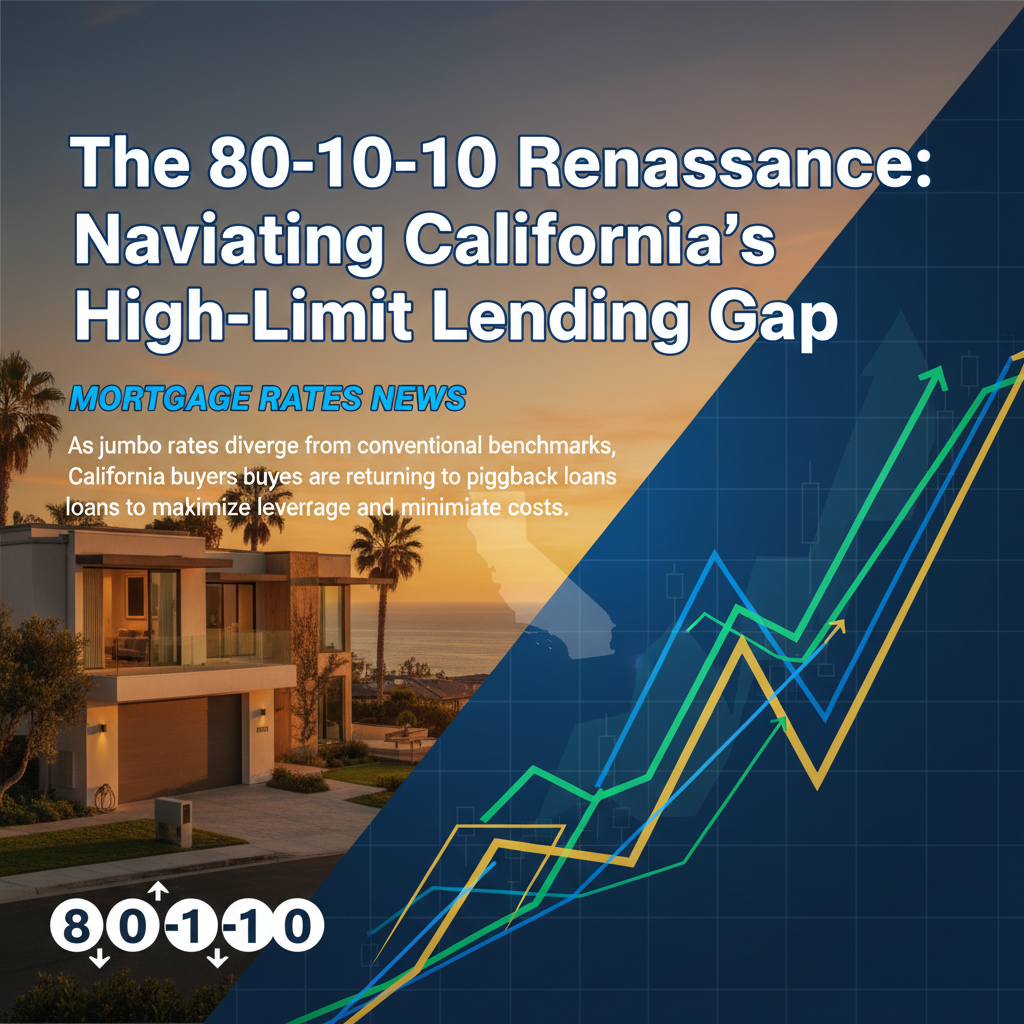
The 2026 Divergence: Why Conforming Limits Matter Again
As of June 4, 2026, the California housing market faces a unique structural challenge. While national mortgage rates have plateaued near 6.4%, a widening spread has emerged between 'conforming' loans—those backed by Fannie Mae and Freddie Mac—and 'jumbo' loans held on bank balance sheets. According to data from the Mortgage Bankers Association (MBA), jumbo rates are currently averaging 45 to 60 basis points higher than their conforming counterparts. In high-cost California corridors like the Bay Area, Orange County, and San Diego, where the median home price often exceeds the 2026 high-cost conforming limit of approximately $1,200,000, this 'jumbo premium' is forcing a tactical shift in financing.
The Mechanics of the Modern Piggyback
To bypass the higher costs of jumbo financing, savvy California borrowers are reviving the '80-10-10' strategy, also known as a piggyback loan. This structure involves a first mortgage at 80% of the home’s value, a second mortgage (often a Home Equity Line of Credit or HELOC) at 10%, and a 10% cash down payment. By keeping the first mortgage at or below the FHFA high-cost limit, buyers access the more aggressive pricing of the secondary market while avoiding the stringent reserve requirements and higher rates associated with jumbo products.
Why California is the Epicenter
The resurgence of this strategy is uniquely Californian. Data from the California Association of Realtors (CAR) shows that nearly 35% of transactions in the state’s coastal markets now sit in the 'gray zone'—prices that are too high for standard conforming loans but where buyers want to avoid the 20-25% down payment often required for the best jumbo terms. The 80-10-10 allows these buyers to maintain liquidity, a crucial advantage in a market where homeowners are increasingly using cash reserves for post-purchase renovations or ADU construction.
Practical Takeaways for Summer 2026 Buyers
- Audit the Spread: Before committing to a jumbo loan, ask your lender for a side-by-side comparison of a single jumbo mortgage versus a 'blended' 80-10-10 rate. The savings often exceed $400 per month on a $1.5 million purchase.
- Monitor HELOC Terms: Unlike the fixed-rate first mortgage, the 10% 'piggyback' portion is often a variable rate. Ensure your strategy includes a plan to pay down the second lien aggressively or a provision to convert it to a fixed rate if the Fed signals further hikes.
- Appraisal Accuracy: Piggyback loans require 'double' approval—one from the primary lender and one from the second lien holder. Ensure your appraisal is robust, as secondary lenders in 2026 are increasingly conservative with valuations in inland California markets.
As the summer inventory squeeze continues, the 80-10-10 provides a path to competitive financing that doesn't require the massive capital outlays of the previous decade. For the California buyer, it is no longer just about the rate, but about the structure that keeps that rate attainable.