The Pendulum Swings: Corporate Mandates Meet Real Estate Reality
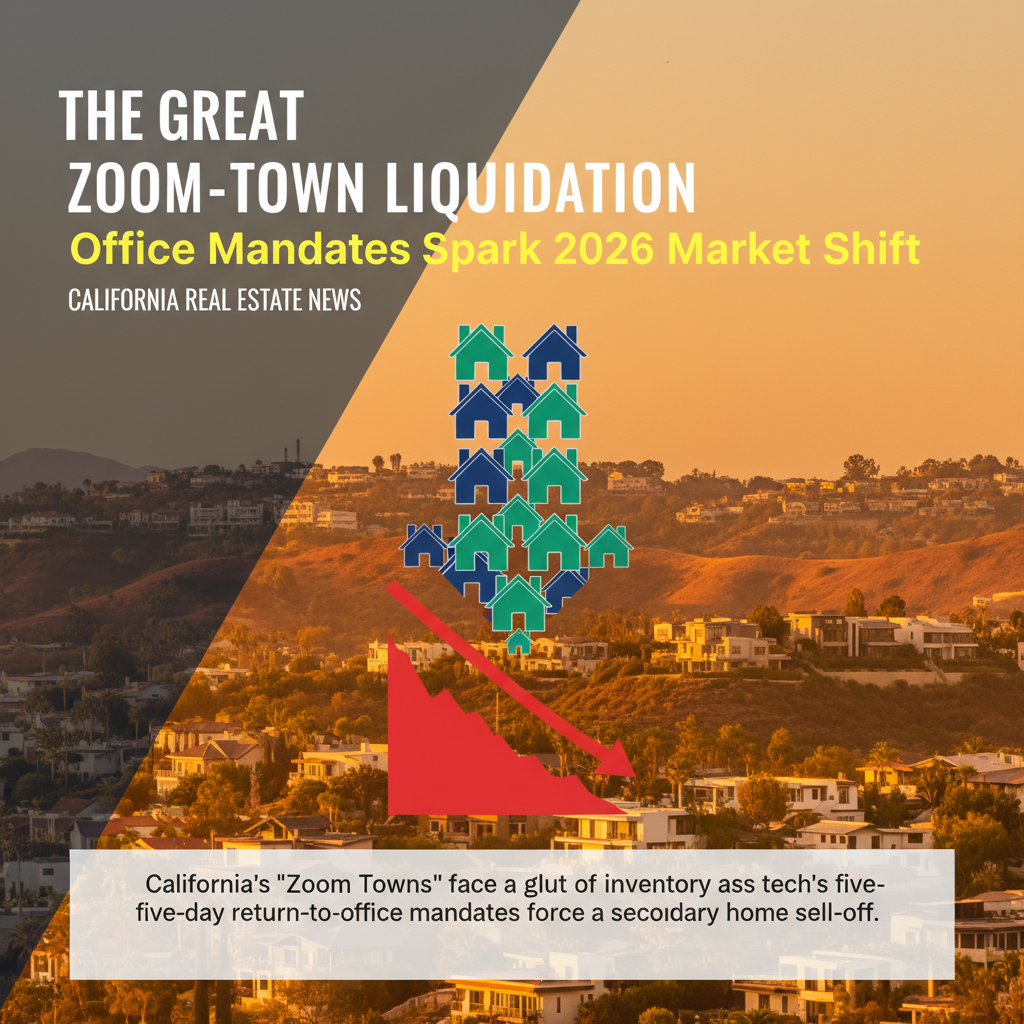
For the past five years, the California real estate market has been defined by the flight to 'lifestyle' geographies. However, as of May 2026, a significant correction is underway. Following the 'Final Five' mandates—a series of strict five-day-a-week return-to-office (RTO) policies enacted by the state’s largest tech and financial employers in Q1—the secondary home markets that boomed during the early 2020s are experiencing a massive inventory influx.
Data from the Front Lines: The Secondary Market Glut
According to the California Association of Realtors (CAR) May 2026 report, active listings in regions such as Truckee, Joshua Tree, and Ojai have surged by 42% year-over-year. This represents the highest inventory level in these leisure-centric corridors since 2014. Meanwhile, the median days on market (DOM) in these areas has stretched to 58 days, a sharp contrast to the 12-day 'flash sales' seen during the height of the remote-work era.
Data from the Bay Area Council Economic Institute suggests that the 'Hybrid Era' has effectively ended for 70% of the Bay Area’s workforce. "We are seeing a coordinated liquidation phase," says a lead analyst at CBRE. "Owners who banked on a permanent 2-day commute are finding that a 5-day commitment makes a home in the Santa Cruz Mountains or the high desert untenable as a primary or even a viable secondary residence."
The Urban Core Counter-Weight
While the 'Zoom Towns' soften, the primary urban cores are seeing a 'compressed demand' effect. In San Mateo, Santa Clara, and Irvine, inventory remains at historic lows—roughly 1.8 months of supply. This scarcity is being exacerbated by the very people selling their lifestyle properties; they are now competing for a limited pool of turn-key townhomes and condos within a 20-minute radius of corporate campuses.
Price action reflects this divide. While luxury cabin prices in the Sierras have retraced 8% since January, the median price for a single-family home in the 'Silicon Core' has ticked up 3.4%, fueled by a surge in all-cash offers from high-income professionals needing to secure housing before the fall school semester.
Strategic Takeaways for 2026 Stakeholders
- For Buyers in Leisure Markets: The 'fear of missing out' has been replaced by an 'opportunity of oversupply.' Buyers looking for long-term vacation homes now have significant leverage. Negotiate on contingencies and look for 'stale' listings that have crossed the 60-day threshold.
- For Urban Sellers: If your property is within striking distance of a major tech hub or financial district, you are in the strongest selling position of the decade. Highlight 'commute-friendliness' and proximity to transit as primary marketing pillars.
- For Investors: The yield on short-term rentals in former Zoom Towns is compressing due to supply. Pivot toward high-density workforce housing in urban transit corridors where the 5-day office week is driving rental demand back to pre-pandemic peaks.
As the 'great decentralization' of the early 2020s reverses, the 2026 market is proving that in California, proximity to the economic engine remains the ultimate arbiter of value.