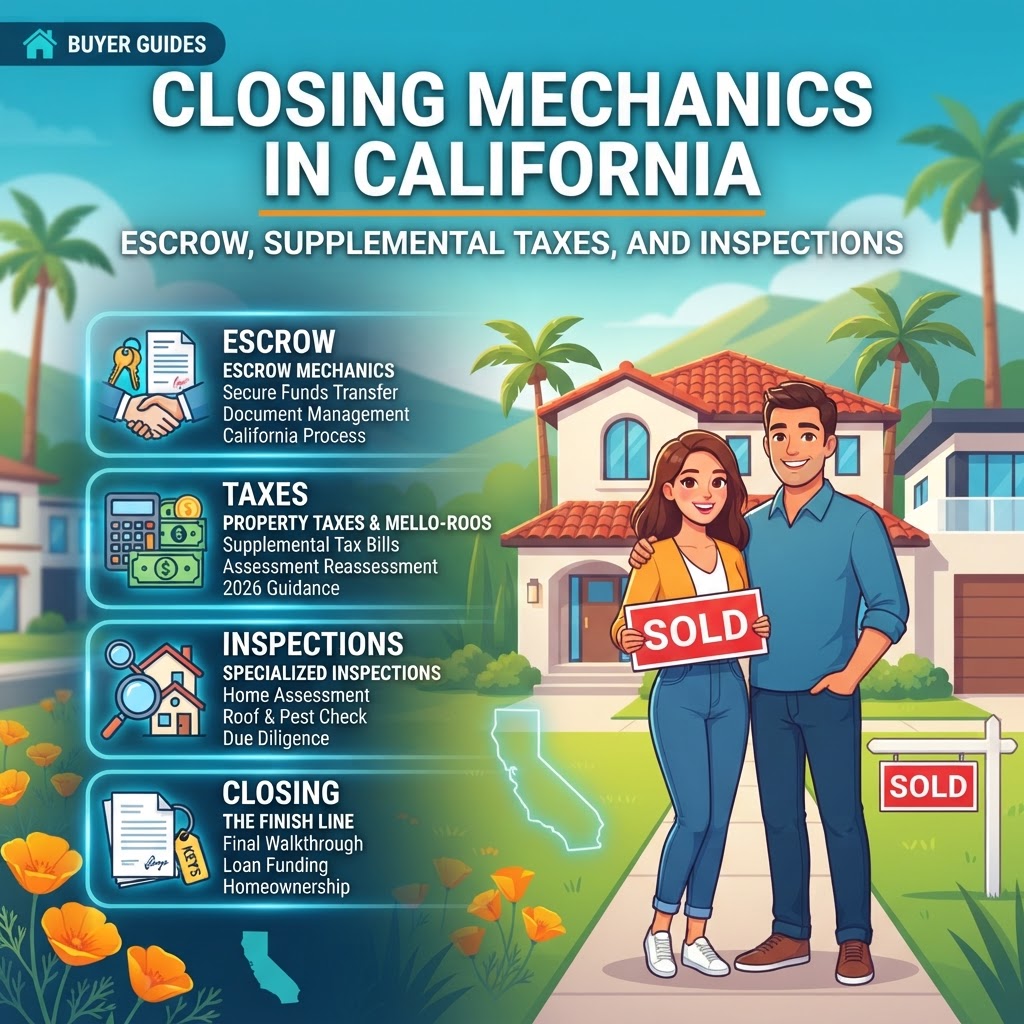
In the California real estate market of 2026, the purchase price is only one variable in a complex financial equation. Unlike many states with uniform closing procedures, California operates under a patchwork of regional customs that dictate who pays for what. For a buyer, understanding whether you are in a ‘Northern’ or ‘Southern’ custom county can result in a swing of thousands of dollars in out-of-pocket expenses.
The Great Regional Divide: Who Pays for Title and Escrow?
California is broadly divided by regional traditions regarding closing costs. While everything in a real estate contract is technically negotiable, deviating from local custom can weaken an offer in a competitive environment.
- Southern California Custom (Los Angeles, Orange, San Diego, Riverside): Traditionally, the seller pays for the owner’s title insurance policy and the documentary transfer tax, while the escrow fee is split 50/50 between buyer and seller.
- Northern California Custom (San Francisco, Alameda, Contra Costa): In many Bay Area counties, the buyer traditionally pays for both the title insurance and the escrow fees. However, in Santa Clara and San Mateo, the custom often flips back to the seller paying.
According to data from the California Association of Realtors (C.A.R.), closing costs for buyers typically range from 2% to 5% of the purchase price. In a market where the median home price in April 2026 hovers around $840,000, failing to account for these regional variances can lead to a $15,000 shortfall at the closing table.
The Transfer Tax Trap: County vs. City
Every property transfer in California triggers a County Documentary Transfer Tax, standard at $1.10 per $1,000 of the sale price. However, buyers must be vigilant regarding City Transfer Taxes, which are prevalent in charter cities. For example:
- Los Angeles: Beyond standard taxes, Measure ULA (the ‘mansion tax’) applies to high-value transfers, though its thresholds are adjusted annually for inflation.
- Berkeley and Oakland: These cities have some of the highest municipal transfer taxes in the state, often exceeding $15 per $1,000, frequently split between buyer and seller.
- San Francisco: Employs a tiered transfer tax rate that increases significantly as the property value climbs, a critical factor for luxury buyers.
The Supplemental Tax Bill: The Post-Closing Surprise
Perhaps the most misunderstood aspect of buying in California is the Supplemental Property Tax Bill. Under Proposition 13, properties are taxed based on their 1975 value plus an annual inflation factor of no more than 2%. When a home is sold, it is reassessed at the new purchase price.
Lenders typically calculate impound accounts based on the seller’s old, lower tax rate. Months after closing, the County Assessor will send a supplemental bill representing the difference between the old tax rate and the new one, prorated for the remainder of the fiscal year. Buyers should use the 1.25% rule of thumb (1% base plus local assessments) of the purchase price to budget for this inevitable bill, separate from their monthly mortgage payment.
Practical Takeaways for the 2026 Buyer
- Audit the Preliminary Title Report: Look for specific city liens or unique assessments (like Mello-Roos) that are common in newer master-planned communities in the Inland Empire and Central Valley.
- Verify Local Customs Early: Before submitting an offer, have your agent confirm the ‘standard’ fee splits for that specific county to ensure your net sheet is accurate.
- Budget for the ‘Second Bill’: Set aside a reserve fund specifically for the supplemental tax bill, which usually arrives 4 to 9 months after deed recordation.
- Negotiate Credits, Not Just Price: In the current 2026 climate, asking a seller to cover recurring closing costs can be more beneficial for a buyer’s immediate cash flow than a minor reduction in the sale price.