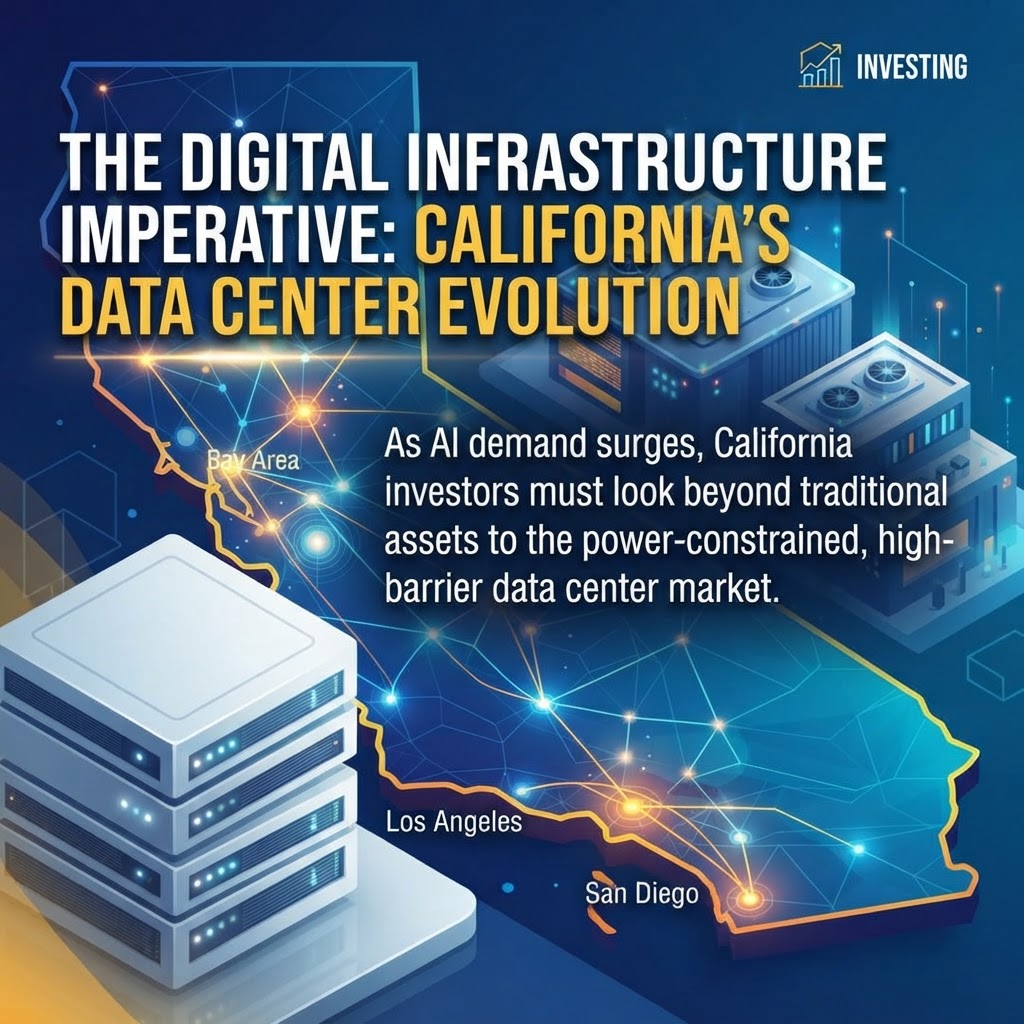
The Digital Infrastructure Imperative: California’s Data Center Evolution
As of November 2026, the commercial real estate landscape is undergoing a fundamental shift driven by the rapid integration of artificial intelligence into the global economy. While traditional sectors like office and retail navigate structural headwinds, the data center asset class has emerged as the primary beneficiary of the AI-driven infrastructure boom (BlackRock, 2026).
The AI-Driven Demand Surge
The data center sector is currently distinguishing itself as one of the fastest-growing areas of CRE, fueled by hyperscale demand and the massive computational requirements of modern AI models (Capright, 2026). Unlike traditional CRE, where value is often tied to location and foot traffic, data center valuation is increasingly tied to power availability, water access, and fiber connectivity (DCD, 2026).
California’s Unique Constraints and Opportunities
For California investors, the data center market presents a paradox. While the state is a global hub for AI development, it faces significant regulatory and infrastructure hurdles, particularly regarding power grid capacity. Recent activity, such as the listing of data center-ready sites near Sacramento, highlights the premium placed on land that already possesses the necessary utility entitlements (DCD, 2026).
Key Considerations for Investors:
- Power as the New Location: In the past, CRE was about 'location, location, location.' Today, for data centers, it is 'power, power, power.' Investors must prioritize sites with proximity to substations and renewable energy sources.
- Regulatory Hurdles: California’s stringent environmental and zoning regulations create high barriers to entry. This scarcity of supply acts as a protective moat for existing facilities, potentially driving long-term rent growth.
- The Infrastructure Pivot: Investors should evaluate whether their existing industrial holdings have the potential for conversion or if they are situated in 'power-rich' zones that could support future digital infrastructure development.
Strategic Takeaways
The shift toward digital infrastructure does not mean abandoning traditional CRE, but rather re-evaluating portfolios through the lens of technological utility. Investors should focus on:
- Due Diligence on Utility Capacity: Before acquiring industrial or land assets, conduct rigorous engineering studies on local grid capacity.
- Monitoring Hyperscale Leasing: Keep a close watch on leasing dynamics between hyperscalers and enterprise users, as these long-term, credit-backed leases provide the stability that many other CRE sectors currently lack (DCD, 2026).
- Diversification: While data centers offer high growth, they are capital-intensive. A balanced approach involves pairing these high-growth assets with stable, income-producing properties in resilient sectors like infill retail, which has shown recent strength in Southern California (CRE Daily, 2026).
By aligning with the infrastructure requirements of the AI era, California investors can position themselves to capture value in a market that is increasingly defined by digital necessity rather than traditional occupancy metrics.