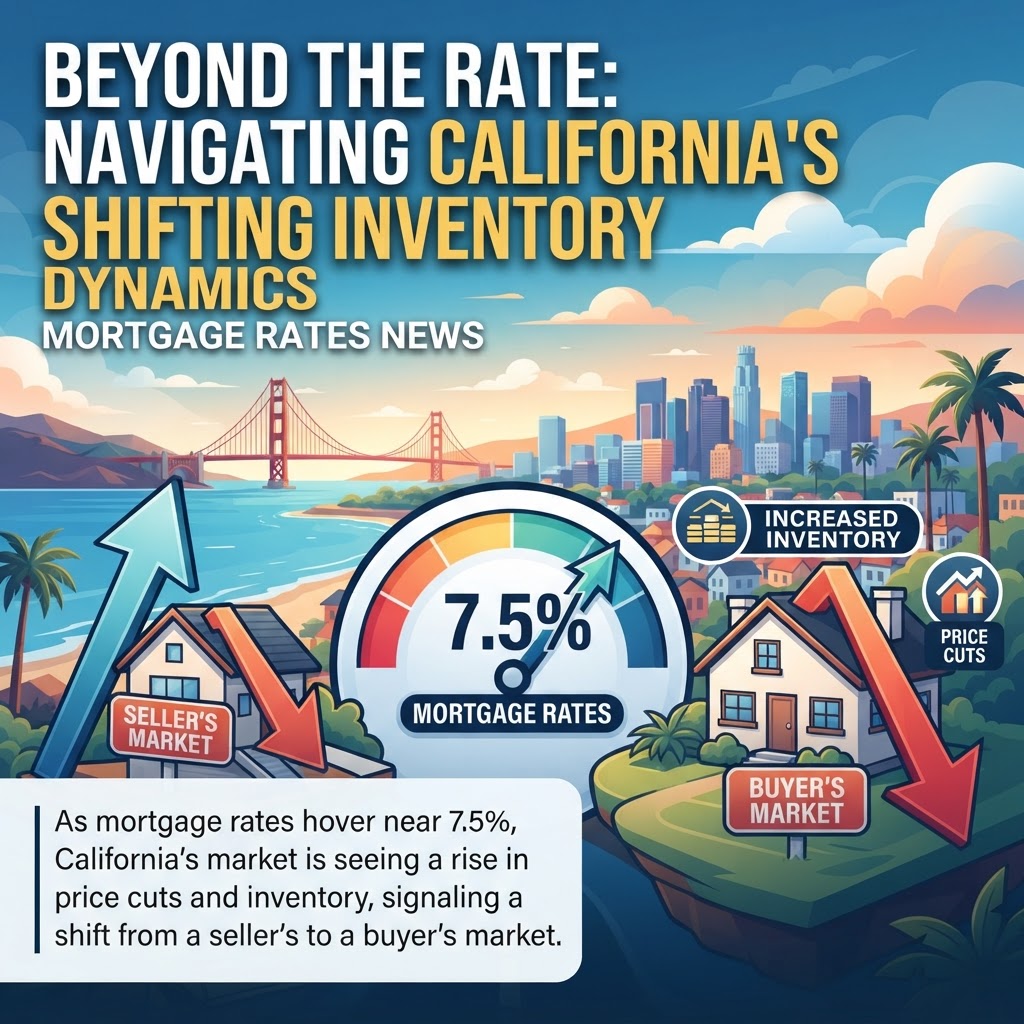
Beyond the Rate: Navigating California's Shifting Inventory Dynamics
For California home buyers, the headline figure of 7.5% mortgage rates has become a familiar, if unwelcome, constant. While much of the discourse focuses on the cost of borrowing, a more nuanced shift is occurring beneath the surface of the Golden State’s real estate market: a fundamental change in inventory and pricing power.
The Inventory Pivot
Recent data indicates that the high-rate environment is finally beginning to break the gridlock that defined the last two years. With national data showing 62.6% more sellers than buyers, California is seeing the effects of this supply-demand imbalance firsthand. According to recent market reports, price cuts are becoming increasingly common, with declines observed in 20 of California’s 53 counties as of mid-October 2026.
Why Price Cuts Are Replacing Rate Sensitivity
The 'locked-in' effect—where homeowners with sub-4% rates refused to sell—is being challenged by the reality of a cooling market. Sellers who must move are finding that they can no longer rely on the aggressive bidding wars of the past. Instead, they are forced to adjust their expectations to meet the purchasing power of buyers constrained by 7.5% financing. This transition is creating a rare window of opportunity for buyers who have remained on the sidelines.
Practical Takeaways for Market Participants
- For Buyers: Focus on 'days on market' rather than just the list price. Properties that have sat for more than 30 days are prime candidates for negotiation. With price cuts becoming more frequent, your leverage is higher than it has been in years.
- For Sellers: Pricing strategy is paramount. In a market where buyers are sensitive to monthly payments, overpricing a home often leads to stagnation. Consult with local agents to identify the 'clearing price' in your specific neighborhood rather than relying on peak-market comps from 2025.
- For Investors: The shift toward a buyer's market in specific counties suggests that cash-flow potential is improving as price corrections outpace the rise in interest costs. Focus on regions where inventory is accumulating, as these areas may offer the best entry points for long-term holds.
While the 7.5% baseline remains a significant hurdle, the California market is moving toward a more balanced state. By shifting focus from the macro-level interest rate environment to micro-level inventory trends, buyers and sellers can better navigate this new, more rational landscape.


