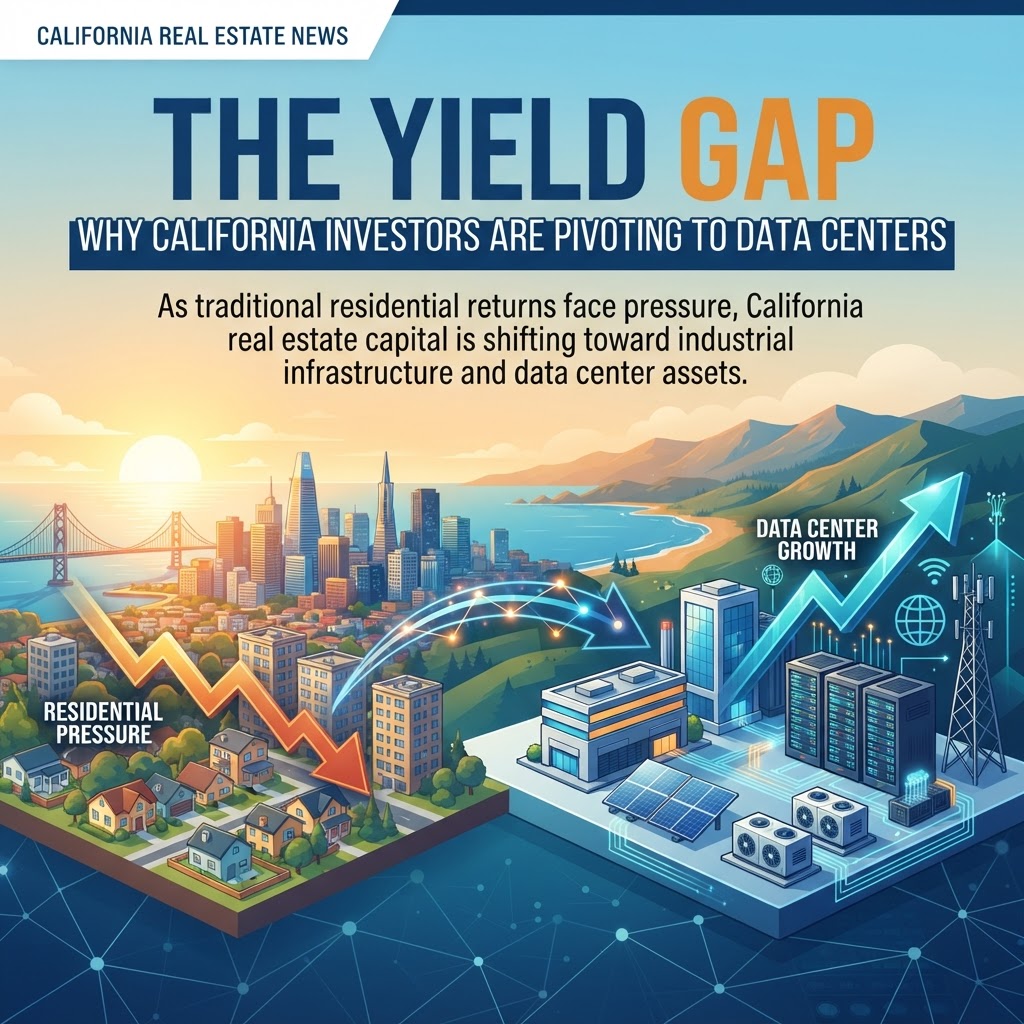
The Yield Gap: Why California Investors Are Pivoting to Data Centers
As of October 2026, the California real estate landscape is undergoing a structural shift. While residential markets grapple with a 18% affordability rate and a median home price hovering near $900,000, institutional and private capital is increasingly bypassing traditional multifamily assets in favor of high-demand industrial infrastructure, specifically data centers.
The Residential Performance Plateau
The residential sector, once the bedrock of California investment, is currently defined by a 'stability trap.' With statewide home price appreciation slowing to an average annual rate of 1.9%—a significant cooling from the 9.5% pace seen during the 2018-2022 period—investors are finding it difficult to justify the entry costs against current mortgage rates, which have recently flirted with the 7% threshold. According to recent market analysis, apartment investments have underperformed relative to other niches over the past year, leading to a re-evaluation of portfolio allocations.
The Rise of Industrial Infrastructure
In contrast to the cooling residential sector, data centers have emerged as a top-performing asset class. Driven by the relentless demand for digital infrastructure, these properties are seeing valuation growth that significantly outpaces traditional housing. While mall values have seen a 12% increase in the past year, data centers are capturing the attention of investors looking for long-term, stable yields that are less sensitive to the immediate volatility of the residential mortgage market.
Strategic Takeaways for Market Participants
- For Residential Investors: The current market is no longer about rapid appreciation. Focus on cash-flow stability and long-term hold strategies, as the era of double-digit annual gains has effectively ended.
- For Portfolio Diversification: Investors should monitor the 'yield gap' between residential and industrial assets. As residential margins compress—falling to 44.1% in early 2026—the risk-adjusted returns of industrial infrastructure, such as data centers, are becoming increasingly attractive.
- For Buyers: With affordability remaining the primary constraint, the market is favoring those who can navigate the 'payment math' rather than those betting on a price collapse. Entry-level and mid-priced homes remain the most active segments, suggesting that demand is driven by necessity rather than speculative fervor.
As California moves into the final quarter of 2026, the divergence between residential housing and specialized industrial real estate is likely to widen. Investors who prioritize infrastructure over traditional residential plays may find themselves better positioned to weather the ongoing policy uncertainty and interest rate fluctuations currently defining the state's economic climate.


